
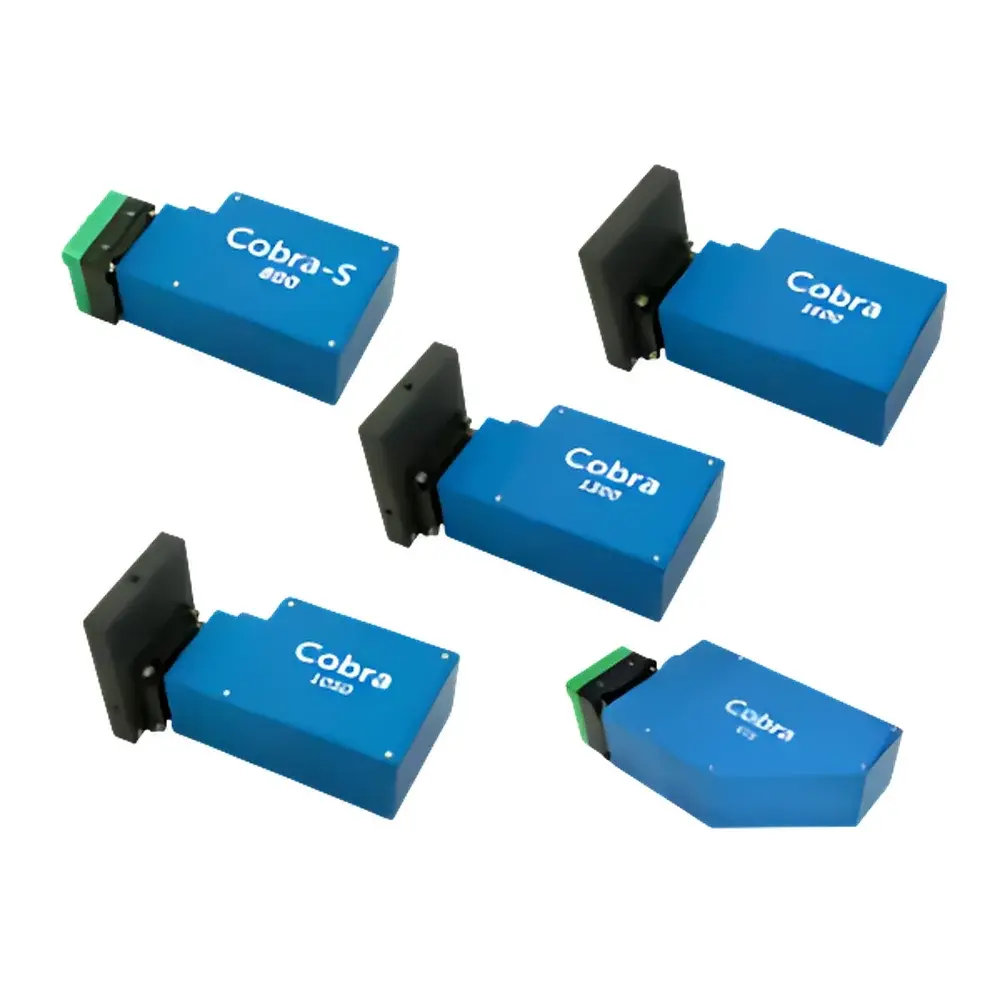
Wasatch Photonics Cobra-S 800 Spectral Domain Optical Coherence Tomography (SD-OCT) Spectrometer
| Brand | Wasatch Photonics |
|---|---|
| Model | Cobra-S 800 |
| Core Technology | High-Throughput Volume Phase Holographic (VPH) Grating-Based SD-OCT Spectrometer |
| Wavelength Range | 650–950 nm (configurable variants: 28–300 nm bandwidth) |
| Imaging Depth (in air) | 1.1–12.9 mm |
| Spectral Resolution | 0.015–0.15 nm |
| Line Scan Rate | Up to 250 kHz |
| Pixel Count | 2048 |
| Interface | USB 3.0 (≤130 kHz) or Camera Link (≤250 kHz) |
| Optical Design | Athermalized, Diffraction-Limited, Low-Crosstalk Imaging Optics |
| Key Camera Options | e2v Octoplus, Teledyne DALSA Piranha, Sensors Unlimited InGaAs |
Overview
The Wasatch Photonics Cobra-S 800 is a high-performance, volume phase holographic (VPH) grating-based spectral domain optical coherence tomography (SD-OCT) spectrometer engineered for demanding biomedical and industrial imaging applications. Unlike conventional diffraction-grating spectrometers, the Cobra-S 800 leverages proprietary VPH transmission gratings that deliver superior optical throughput, minimal polarization dependence, and exceptional thermal stability—enabling robust, long-term operation without active thermal compensation. Its optical architecture is optimized for Fourier-domain OCT signal acquisition, where high spectral fidelity, low stray light, and sub-pixel wavelength calibration accuracy directly determine axial resolution (typically <2 µm in tissue) and system sensitivity roll-off. Designed for integration into commercial and research-grade OCT platforms—including ophthalmic, dermatological, endoscopic, and materials inspection systems—the Cobra-S 800 operates across a broad 650–950 nm spectral window, with configurable bandwidths (28–300 nm) and corresponding trade-offs between imaging depth (1.1–12.9 mm in air), axial resolution, and sensitivity. The spectrometer’s athermal mechanical design ensures stable alignment under ambient temperature fluctuations common in laboratory and clinical environments.
Key Features
- Proprietary high-efficiency VPH transmission grating with >85% peak diffraction efficiency and negligible zero-order leakage
- Athermalized optical bench with kinematic mounts and low-expansion materials, eliminating focus drift over ±5 °C ambient variation
- Diffraction-limited imaging optics paired with low-crosstalk, back-illuminated CMOS line-scan sensors (e.g., e2v Octoplus, DALSA Piranha)
- Sub-pixel spectral calibration capability via on-board reference source or external wavelength standard, supporting ISO/IEC 17025 traceable validation
- Dual interface options: USB 3.0 (up to 130 kHz line rate, ideal for portable or laptop-integrated systems) and Camera Link (up to 250 kHz, suitable for high-speed volumetric acquisition)
- Modular housing with standardized optical input (FC/APC or SMA905) and electrical I/O (trigger in/out, sync signals) compliant with SEMI E19 and PICMG guidelines
Sample Compatibility & Compliance
The Cobra-S 800 supports a wide range of sample types—from transparent ocular tissues and polymer films to scattering biological specimens and layered composite materials—by virtue of its tunable spectral bandwidth and high dynamic range (>70 dB). Its optical path is compatible with standard OCT interferometer configurations (Michelson or Mach-Zehnder), and the input NA is optimized for single-mode fiber coupling (SMF-28 or similar). From a regulatory perspective, the spectrometer’s firmware and data acquisition protocols support audit-trail-enabled operation per FDA 21 CFR Part 11 when integrated with validated host software. It meets electromagnetic compatibility requirements per EN 61326-1:2013 and safety standards per IEC 61010-1:2010. While not a medical device itself, the Cobra-S 800 is routinely deployed in Class IIa/IIb OCT systems certified to ISO 13485 and compliant with EU MDR Annex II technical documentation requirements.
Software & Data Management
Wasatch Photonics provides the open-source WasatchPython SDK—a cross-platform Python library with full API access to spectrometer configuration, real-time data streaming, hardware triggering, and on-the-fly spectral calibration. Binary drivers are also available for LabVIEW, MATLAB, C/C++, and .NET environments. All firmware includes non-volatile memory for storing user-defined calibration coefficients, enabling reproducible measurements across instruments and labs. Raw spectral data is output as 16-bit integer arrays (2048 × N), time-stamped with microsecond precision and synchronized to external TTL triggers. For GLP/GMP workflows, optional logging modules generate HDF5-formatted datasets with embedded metadata (wavelength vector, exposure time, gain setting, temperature readback), satisfying FAIR data principles and facilitating downstream analysis in OCT reconstruction pipelines (e.g., GPU-accelerated FFT, dispersion compensation, complex conjugate suppression).
Applications
- Ophthalmic imaging: High-speed, high-resolution retinal layer segmentation and anterior chamber biometry at 250 kHz line rates
- Vascular angiography: Motion-corrected Doppler OCT and OCT angiography (OCTA) with <10 µm capillary-level contrast
- Industrial metrology: Non-contact thickness measurement of multi-layer polymer coatings and semiconductor thin films
- Preclinical research: Real-time 3D imaging of zebrafish embryogenesis and murine tumor microvasculature
- Materials science: Defect detection in carbon-fiber composites and delamination mapping in adhesive bonds
- Endoscopic OCT: Miniaturized probe integration for intravascular and gastrointestinal imaging using OEM-configured compact variants
FAQ
What is the maximum achievable axial resolution with the Cobra-S 800?
Axial resolution depends on the configured spectral bandwidth and sample group velocity dispersion; typical values range from 2.1 µm (in air, CS800-841/28) to 9.5 µm (CS800-800/300), calculated as λ₀²/(2·Δλ), where Δλ is the FWHM bandwidth.
Can the Cobra-S 800 be calibrated traceably to NIST standards?
Yes—via external wavelength references (e.g., hollow-cathode lamps or stabilized laser comb sources), and Wasatch provides calibration reports aligned with ISO/IEC 17025-accredited laboratories upon request.
Is Camera Link interface mandatory for 250 kHz operation?
Yes—USB 3.0 bandwidth limits sustained frame rates to ≤130 kHz; Camera Link Base or Medium profile is required for full 250 kHz line-scan performance.
Does the spectrometer support real-time dispersion compensation?
No—dispersion correction is performed in post-processing or by the host system’s FPGA/GPU; however, the spectrometer’s high SNR (>65 dB) and sub-pixel repeatability minimize residual phase errors.
Are custom optical inputs or fiber pigtails available?
Yes—OEM customers may specify FC/APC, SMA905, or free-space collimated input, along with polarization-maintaining or multimode fiber options, subject to minimum order quantities.
Related Products





