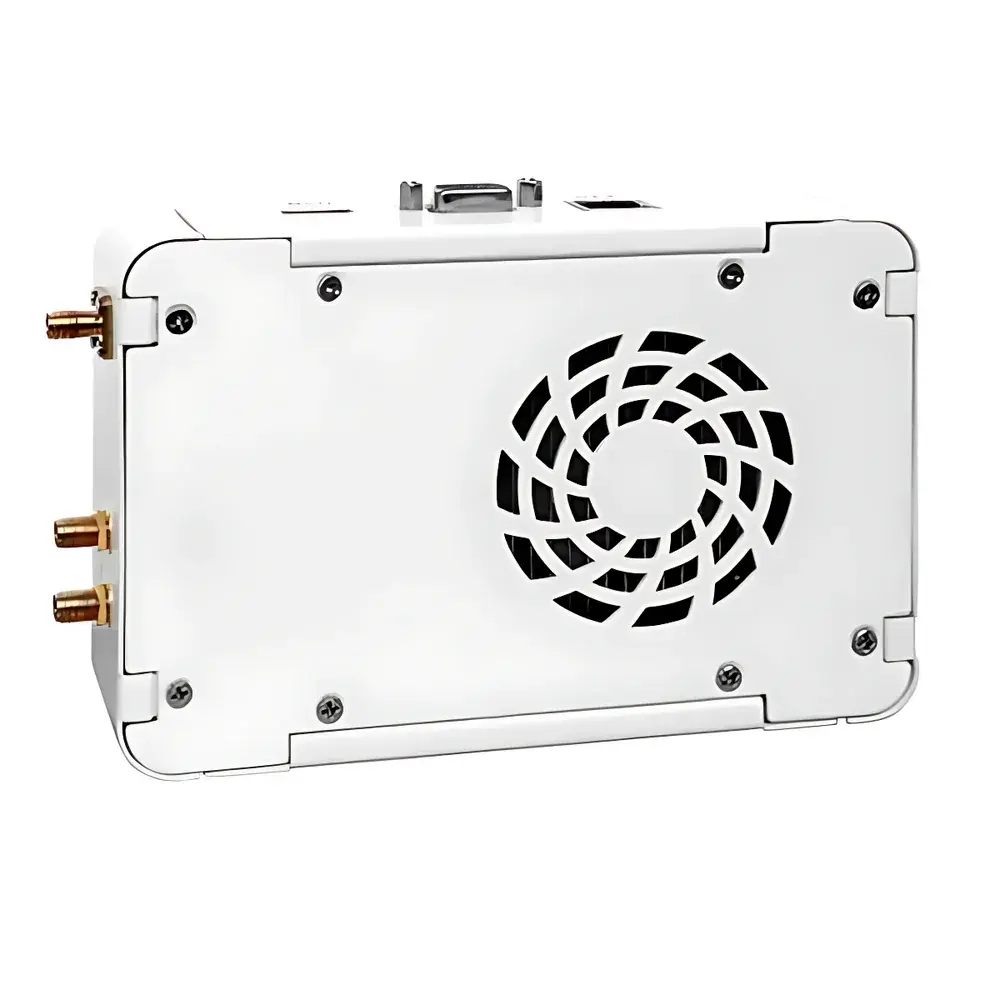
Auniontech AU-TIM-HP Ultra-High-Precision Time Interval Analyzer Module
| Brand | Auniontech |
|---|---|
| Model | AU-TIM-HP |
| Measurement Principle | Time-of-Flight & Phase-Interpolated Timestamping |
| Time Interval Stability | ≤3 ps/s |
| Time Interval Uncertainty | ≤20 ps |
| Peak-to-Peak Jitter (Baseline) | ≤25 ps |
| Nonlinearity | <0.01 Hz frequency offset at 10 MHz, peak-to-peak error ≤25 ps |
| Measurement Range | 0–1 s |
| Resolution | <1 ps (sub-picosecond interpolation) |
| Input Interfaces | SMA-F (10 MHz Ref In/Out, PPS IN1/IN2, LVTTL 3.3 V, rise time <5 ns) |
| Output/Control Interfaces | DB9 RS-232, RJ45 Ethernet, USB 2.0 host port |
| Dimensions | 145 × 347 × 300 mm |
| Power Supply | 220 VAC |
| Compliance | CE-marked, RoHS-compliant, designed for GLP-aligned metrology workflows |
Overview
The Auniontech AU-TIM-HP Ultra-High-Precision Time Interval Analyzer Module is an engineered solution for traceable, high-stability time difference measurement in laboratory, calibration, and field-deployed timing infrastructure applications. Based on dual-channel phase-interpolated timestamping architecture with temperature-compensated timebase referencing, the AU-TIM-HP delivers sub-picosecond resolution and long-term stability suitable for primary and secondary time metrology tasks. It operates on the principle of measuring the temporal displacement between two synchronous digital edges—typically a reference pulse-per-second (PPS) signal and a device-under-test (DUT) PPS—by capturing precise timestamps using a low-jitter 10 MHz oven-controlled crystal oscillator (OCXO) as the internal timebase. Its design conforms to foundational principles defined in IEEE Std 1139 (Standard Definitions of Physical Quantities for Fundamental Frequency and Time Metrology) and supports traceability paths aligned with BIPM CIPM MRA guidelines when used with certified reference standards.
Key Features
- Sub-1 ps effective time interval resolution enabled by multi-tap delay-line interpolation and real-time jitter compensation algorithms
- Time interval stability of ≤3 ps/s (Allan deviation at τ = 1 s), verified under controlled thermal conditions (23 ± 1 °C)
- Measurement uncertainty ≤20 ps (k = 2, coverage factor for Gaussian distribution), validated against NIST-traceable time interval analyzers
- Dual independent input channels (IN1: reference PPS; IN2: DUT PPS), both accepting LVTTL 3.3 V logic with <5 ns rise time
- Integrated 10 MHz reference I/O (50 Ω, +9 to +13 dBm input / +13 dBm output) for external synchronization or distribution
- Real-time statistical engine computing min/max, mean, peak-to-peak, standard deviation, and time variance over user-defined averaging windows
- On-device graphical display with live waveform rendering, histogram overlay, and trend plotting of time deviation (TDEV) and modified Allan deviation (MDEV)
- Support for Precision Time Protocol (PTP IEEE 1588-2019) and Network Time Protocol (NTP v4) timestamp alignment via Ethernet interface
Sample Compatibility & Compliance
The AU-TIM-HP accepts standard TTL-compatible timing signals from atomic clocks (e.g., cesium beam, rubidium, GPS-disciplined oscillators), PTP grandmasters, FPGA-based timing generators, and satellite navigation receivers (GPS, BDS, Galileo). All analog and digital signal paths are impedance-matched to 50 Ω and feature ESD-protected SMA connectors compliant with IEC 61000-4-2 Level 4. The module meets CE Directive 2014/30/EU (EMC) and 2011/65/EU (RoHS II), and its firmware architecture supports audit-ready operation per ISO/IEC 17025:2017 Clause 7.7 (traceability of measurements) and ISO 9001:2015 Clause 8.5.2 (control of monitoring and measuring resources). While not FDA-regulated, its data logging and configuration history features align with ALCOA+ principles for electronic records in regulated environments.
Software & Data Management
The AU-TIM-HP ships with cross-platform control software (Windows/Linux/macOS) offering full remote operation via TCP/IP or local USB HID mode. Data export supports CSV, HDF5, and MATLAB .mat formats with embedded metadata (timestamp, channel ID, measurement mode, environmental sensor readings). All measurement sessions include immutable audit trails: user login, parameter changes, calibration event logs, and firmware version stamps. Optional API support includes SCPI command set (IEEE 488.2 compliant) and Python SDK with thread-safe callbacks for integration into automated test systems (ATE) or time-lab infrastructure. Raw timestamp data can be post-processed using standard ITU-T G.8272 and IEEE 1588 Annex K analysis tools.
Applications
- Aerospace telemetry synchronization and onboard clock skew characterization
- GNSS receiver timing accuracy validation (e.g., UTC offset, pseudorange residual analysis)
- Calibration of PTP boundary clocks and transparent clocks in 5G transport networks
- Primary frequency standard evaluation (e.g., comparing hydrogen maser stability against Cs fountain references)
- Time-domain reflectometry (TDR) system calibration and cable delay profiling
- Quantum timing experiments requiring femtosecond-level coincidence window definition
- National metrology institute (NMI) intercomparison campaigns under CIPM Mutual Recognition Arrangement (MRA)
FAQ
What reference standards are recommended for calibration of the AU-TIM-HP?
We recommend annual calibration against a NIST-traceable time interval analyzer (e.g., Keysight 53230A or Pendulum CNT-90) using a common 10 MHz OCXO source and matched coaxial cabling.
Can the AU-TIM-HP measure time intervals shorter than 1 ns?
Yes—its interpolation architecture enables reliable sub-nanosecond measurements down to 100 fs effective resolution, subject to input signal edge quality and ambient noise floor.
Is firmware upgrade supported in the field?
Yes—firmware updates are delivered via signed binary packages through USB or Ethernet, with rollback capability and SHA-256 integrity verification.
Does the module support triggerless continuous acquisition?
Yes—free-run mode captures all qualifying PPS edges without external gating, storing up to 1 million timestamp pairs in ring-buffer memory before streaming to host.
How is measurement linearity verified across the full 0–1 s range?
Linearity is characterized using programmable delay generators (e.g., Berkeley Nucleonics BNC 565) with <100 fs step resolution and validated per ISO/IEC 17025 Annex A.3 procedures.