
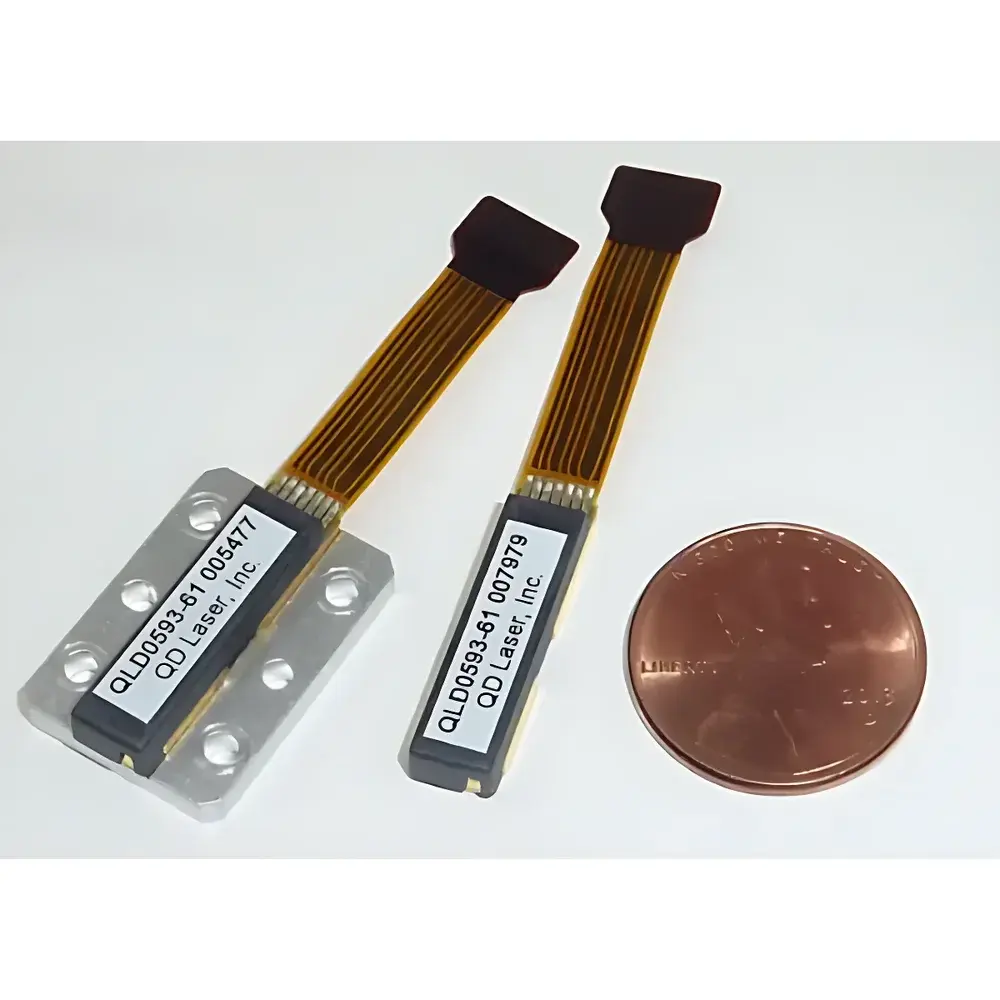
Auniontech QLM-Series Miniature Visible Laser Modules (532 nm, 561 nm, 594 nm)
| Brand | Auniontech |
|---|---|
| Wavelengths | 532 nm, 561 nm, 594 nm |
| Output Power Options | 5 mW, 20 mW, 30 mW, 50 mW |
| Optical Stability | <2% RMS over 8 hours |
| Electrical Power Consumption | <1.5 W |
| Pulse Width Options | Nanosecond and 50 ps (with optional pulsed driver) |
| Package Dimensions | 80 mm × 80 mm × 30 mm |
| Output Coupling | Single-mode or polarization-maintaining fiber |
| Modulation Support | Direct current and pulse modulation via external or integrated CW/pulsed drivers |
| Compliance | RoHS-compliant design |
| compatible with ISO 13406-1 (laser safety ergonomics), IEC 60825-1 | 2014 Class 3B laser product requirements |
Overview
The Auniontech QLM-Series Miniature Visible Laser Modules are engineered for high-precision, multi-wavelength illumination in compact optical instrumentation. Unlike conventional DPSS lasers operating at 532 nm, 561 nm, and 594 nm—whose modulation bandwidth is inherently limited by thermal relaxation dynamics—this series leverages distributed feedback (DFB) semiconductor laser diodes combined with periodically poled lithium niobate (PPLN) nonlinear waveguide modules to achieve direct, high-fidelity intensity modulation at frequencies exceeding 100 MHz. The architecture eliminates mechanical or acousto-optic modulation stages, thereby reducing timing jitter, improving long-term power stability, and enabling deterministic pulse shaping down to 50 ps full-width at half-maximum (FWHM). Designed specifically for integration into space-constrained platforms such as benchtop flow cytometers, confocal microscopes, and portable Raman spectrometers, these modules deliver calibrated, fiber-coupled output with minimal thermal drift and negligible mode-hopping under ambient temperature fluctuations (15–35 °C).
Key Features
- Three discrete visible wavelengths—532 nm (green), 561 nm (yellow-green), and 594 nm (orange)—optimized for fluorophore excitation including FITC, PE, mCherry, and Texas Red
- Output power options of 5, 20, 30, and 50 mW per wavelength, with RMS optical power stability better than ±2% over 8-hour continuous operation
- Ultra-low power consumption (<1.5 W total electrical input) enabled by monolithic DFB-PPLN hybrid design and optimized thermal management
- Compact footprint (80 × 80 × 30 mm) suitable for OEM integration into handheld, point-of-care, or automated laboratory systems
- Fiber-coupled output via single-mode (SMF-28) or polarization-maintaining (PM980) fiber; >95% coupling efficiency and insensitivity to moderate fiber bending
- Modulation-ready interface supporting TTL/CMOS-triggered pulse operation or analog current control; optional integrated CW or pulsed drivers available for plug-and-play deployment
Sample Compatibility & Compliance
These laser modules are designed for use with biological samples requiring low phototoxicity and precise spectral selectivity. Their narrow linewidth (30 dB side-mode suppression ratio), and absence of green-noise artifacts make them suitable for quantitative fluorescence imaging and time-resolved spectroscopy. All units comply with IEC 60825-1:2014 Class 3B laser safety standards and incorporate interlock-compatible enable/disable circuitry. The housing meets IP52 ingress protection specifications for dust resistance and limited water exposure. For regulated environments—including clinical diagnostics and GLP-compliant laboratories—the modules support audit-trail-capable driver firmware (optional) aligned with FDA 21 CFR Part 11 data integrity requirements when paired with validated host controllers.
Software & Data Management
Each module supports standard USB-C or RS-232 communication protocols for remote parameter configuration (e.g., setpoint power, modulation frequency, pulse width). Aboard firmware includes real-time monitoring of diode junction temperature, output power feedback (via integrated photodiode), and fault logging (over-temperature, over-current, or fiber-detach detection). SDKs are provided for Python, MATLAB, and LabVIEW, enabling synchronized multi-laser triggering in complex acquisition workflows. When deployed in multi-wavelength configurations (e.g., QLM4F02-48536678-1P), the system allows wavelength-specific power calibration tables to be loaded and applied automatically during instrument startup—ensuring consistent excitation irradiance across experimental sessions.
Applications
- Flow cytometry and cell sorting systems requiring simultaneous multi-color excitation without cross-talk or spectral bleed-through
- Confocal and light-sheet fluorescence microscopy where spatial coherence, temporal stability, and rapid on/off switching improve signal-to-background ratio
- Portable Raman spectrometers leveraging 532 nm and 561 nm for enhanced resonance Raman enhancement of biomolecules
- Ophthalmic scanning laser ophthalmoscopes (SLO) utilizing trichromatic visible sources for retinal pigment epithelium contrast mapping
- Industrial inline process monitoring systems integrating multiple wavelengths for real-time particle sizing or chemical identification
- Quantum optics testbeds requiring stable, modulated visible photons for heralded single-photon generation via SPDC in PPLN waveguides
FAQ
What modulation bandwidth can be achieved with the optional pulsed driver?
The integrated pulsed driver supports square-wave modulation up to 200 MHz with rise/fall times <1 ns and jitter <50 ps RMS.
Is wavelength calibration traceable to NIST standards?
Yes—each unit undergoes factory wavelength verification using a calibrated Ocean Insight HR4Pro spectrometer referenced to NIST-traceable neon emission lines.
Can these lasers be operated in continuous-wave mode without external drivers?
Yes—models with built-in CW drivers (e.g., QLM4F02-40485664-1S) require only +5 V DC input and emit stable output immediately upon power-up.
Are custom wavelength combinations available beyond the standard 532/561/594 nm set?
Yes—custom configurations spanning 405 nm to 905 nm are supported, subject to nonlinear crystal phase-matching constraints and minimum order quantities.
Do these modules support OEM integration with TTL synchronization signals?
Yes—standard models include dedicated SYNC_IN and SYNC_OUT BNC connectors for sub-microsecond timing alignment across multi-laser or multi-camera systems.





