
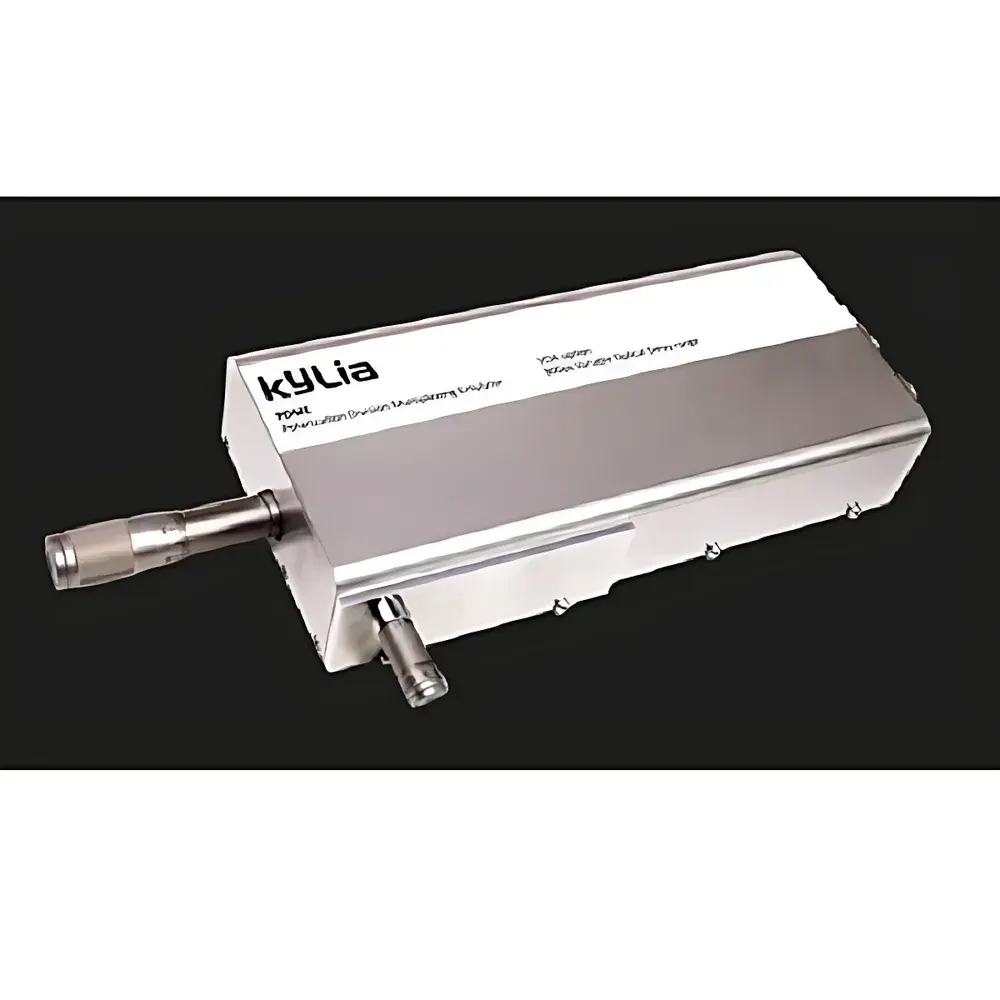
Ixblue VODL Series Variable Optical Delay Line
| Brand | Ixblue / Ixblue Photonics |
|---|---|
| Origin | France |
| Model | VODL Series |
| Delay Range | 100 ps – 12 ns |
| Resolution (Motorized) | down to 3 fs |
| Insertion Loss | ≤2 dB (max) |
| Polarization Extinction Ratio | ≥20 dB (SM), ≥15 dB (PM) |
| Wavelength Range | 1520–1625 nm (customizable: 800 nm, 1064 nm, 1300 nm) |
| Return Loss | >35 dB |
| Reference Insertion Loss | ≤0.5 dB |
| Reference Position Accuracy | ≤1 ps |
| VOA Option | >60 dB attenuation, sensitivity ≤0.1 dB |
| ORP Option | available |
| Fiber Type | SMF-28 or PM fiber (customizable) |
Overview
The Ixblue VODL Series Variable Optical Delay Line is a precision optomechanical instrument engineered for high-fidelity temporal control of optical pulses in ultrafast photonics, interferometry, and coherent optical systems. Based on a robust free-space or fiber-coupled retroreflector translation architecture, the VODL implements path-length modulation via precise linear displacement of a mirror stage—enabling deterministic, repeatable adjustment of optical group delay without spectral distortion. Its core functionality relies on the fundamental relation Δτ = 2ΔL/c, where delay time τ is linearly proportional to mechanical displacement ΔL. Designed for demanding applications such as optical coherence tomography (OCT), quantum optics experiments, laser pulse shaping, and fiber-optic sensor calibration, the VODL delivers nanosecond-scale delay tuning with femtosecond-level resolution and sub-picosecond positional repeatability. The device operates within the C- and L-bands (1520–1625 nm) as standard, with factory-calibrated options available for 800 nm (Ti:sapphire systems), 1064 nm (Nd:YAG/Yb-fiber platforms), and 1300 nm (OCT broadband sources). All units are assembled and tested in Ixblue’s ISO 9001-certified facility in France, ensuring traceable metrology and long-term thermal-mechanical stability.
Key Features
- Adjustable optical delay range from 100 ps up to 12 ns (equivalent to 30 mm to 1.8 m optical path difference)
- Motorized version achieves <3 fs incremental resolution and ≤1 ps reference position accuracy
- Manual and motorized variants both maintain insertion loss ≤2 dB across full delay range (SM fiber), with polarization-maintaining (PM) configurations supporting PER ≥15 dB
- Integrated optical reference path (ORP) option enables real-time delay monitoring and active stabilization against thermal drift
- Optional integrated variable optical attenuator (VOA) provides >60 dB dynamic range with ≤0.1 dB step resolution
- Low polarization-dependent loss (35 dB) ensure minimal signal degradation in sensitive interferometric setups
- Modular design supports OEM integration—including custom flange interfaces, vacuum-compatible variants, and multi-channel parallel delay banks
Sample Compatibility & Compliance
The VODL Series is compatible with standard single-mode (SMF-28, HI1060) and polarization-maintaining (PANDA, Bow-tie) fibers. All fiber pigtails are fusion-spliced with industry-standard FC/APC or FC/PC connectors and qualified per Telcordia GR-326-CORE. Units comply with CE marking requirements for electromagnetic compatibility (EMC Directive 2014/30/EU) and low-voltage safety (LVD Directive 2014/35/EU). Motorized models meet RoHS 2011/65/EU material restrictions. For regulated environments—including clinical OCT instrumentation or aerospace-grade test benches—the VODL supports documentation packages aligned with ISO 13485 and AS9100 quality management frameworks. Traceable calibration certificates (NIST-traceable interferometric verification) are available upon request.
Software & Data Management
Motorized VODL units integrate seamlessly with Ixblue’s open-architecture control suite, accessible via USB 2.0 or RS-232 interfaces. Drivers are provided for Windows (x64), Linux (kernel 4.x+), and MATLAB® R2020a+. The API supports SCPI command syntax and includes native Python bindings for automated script-based sequencing. All position commands include built-in hysteresis compensation and bidirectional backlash correction. Audit trails record timestamped delay settings, motor current, temperature readings (via onboard thermistor), and error flags—fully compliant with FDA 21 CFR Part 11 when deployed with validated electronic lab notebook (ELN) systems. Firmware updates are delivered through signed binary packages verified via SHA-256 checksums.
Applications
- Time-domain optical coherence tomography (TD-OCT) reference arm scanning
- Ultrafast pump-probe spectroscopy requiring sub-10 fs timing jitter
- Quantum interference experiments (e.g., Hong–Ou–Mandel visibility optimization)
- Fiber Bragg grating (FBG) and distributed acoustic sensing (DAS) system calibration
- Coherent optical time-domain reflectometry (C-OTDR) resolution enhancement
- Laser cavity dispersion compensation and mode-locking diagnostics
- Photonic integrated circuit (PIC) testing with programmable delay matching
FAQ
What is the maximum achievable delay stability over 24 hours?
Under constant ambient temperature (±0.5 °C), motorized VODL units demonstrate ≤±2 ps peak-to-peak drift over 24 h, attributable primarily to piezoelectric creep in the actuator—not mechanical relaxation.
Can the VODL be used in vacuum environments?
Yes—vacuum-rated versions (10⁻⁶ mbar) are available with stainless-steel housing, ceramic bearings, and dry-lubricated leadscrews; contact engineering support for outgassing certification data.
Is firmware upgrade capability supported in-field?
Yes—firmware updates retain all user calibration coefficients and require no hardware revalidation; update process takes <90 s and preserves EEPROM-stored position maps.
Does the ORP option provide absolute or relative delay measurement?
The optical reference path delivers absolute delay readout traceable to HeNe laser interferometry, with uncertainty <±0.3 ps (k=2) at 1550 nm.
Are there limitations on input power handling?
Standard models support continuous-wave (CW) powers up to +23 dBm (200 mW); high-power variants (up to +33 dBm) are available with fused silica collimators and AR-coated optics.





