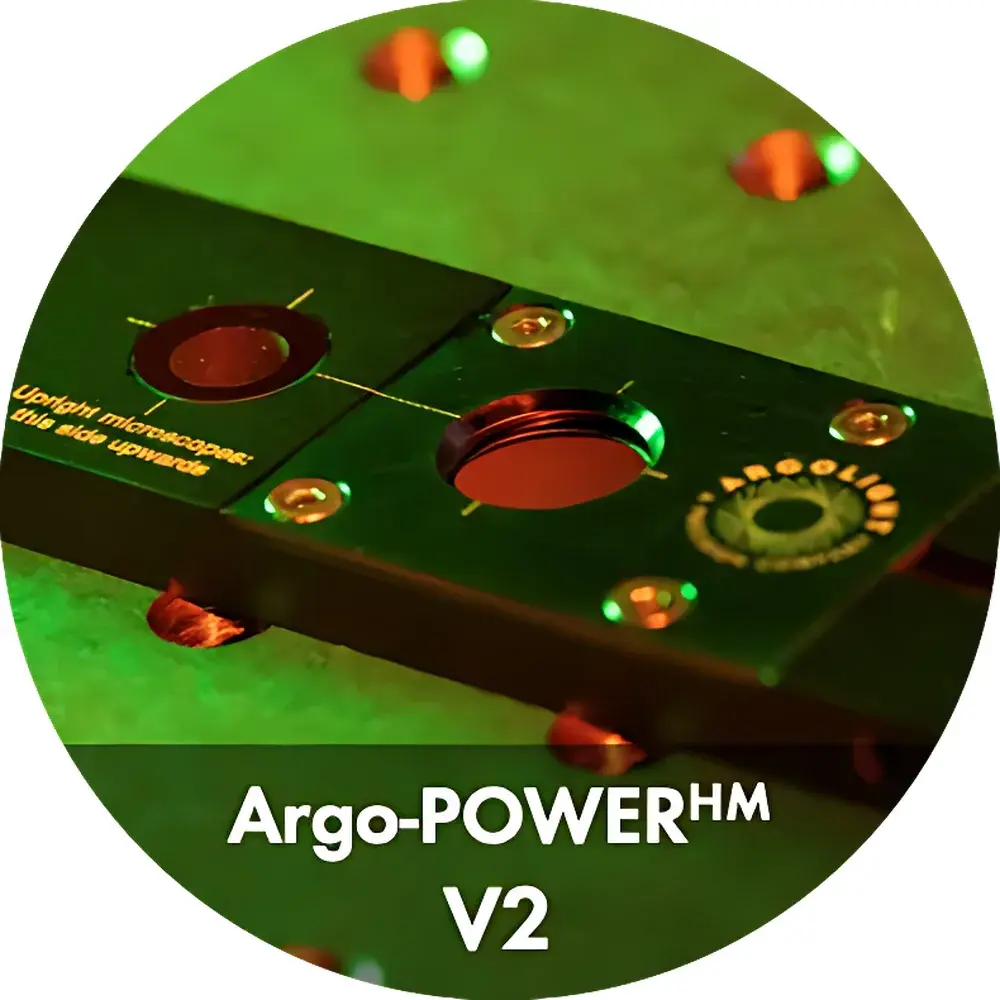
ARGOLIGHT Argo-POWER-HM Confocal Fluorescence Microscope Calibration Slide with Integrated Optical Power Meter
| Brand | ARGOLIGHT (distributed by Auniontech) |
|---|---|
| Origin | Shanghai, China |
| Product Type | Fluorescence Microscope Calibration Slide & Integrated Power Sensor |
| Dimensions | 75 × 25 × 6 mm |
| Excitation Wavelength Range | 250–650 nm (CW) |
| Emission Wavelength Range | λₑₓ + 15 nm to 800 nm (broadband) |
| Power Measurement Range | 10 µW – 100 mW |
| Measurable Wavelength Range | 350–1100 nm |
| Immersion Compatibility | Dry, oil, and water immersion objectives |
| Recommended Imaging Duration per Session | < 20 min |
| Storage Conditions | 10–40 °C, 20–70 % RH |
| Damage Threshold | 50 GW/cm² (peak or average irradiance) |
| Pattern Stability | Photostable, non-bleaching embedded 2D/3D fluorescent nanostructures |
Overview
The ARGOLIGHT Argo-POWER-HM is a metrologically traceable calibration reference slide engineered specifically for quantitative performance verification of confocal fluorescence microscopes. Unlike conventional fluorescent standards relying on organic dyes, it integrates photostable, sub-nanometer-precision fluorescent patterns directly embedded in the glass substrate via proprietary ion-beam lithography. This eliminates photobleaching, enabling indefinite reuse without signal degradation—critical for longitudinal instrument qualification and inter-laboratory comparability. The device simultaneously functions as both a spatial resolution standard (lateral and axial) and an integrated optical power meter, delivering real-time, wavelength-corrected irradiance measurements across 350–1100 nm. Its design conforms to the foundational principles of fluorescence microscopy metrology: deterministic pattern geometry, spectrally defined emission profiles, and calibrated radiometric response—making it suitable for ISO/IEC 17025-accredited calibration workflows and GLP-compliant imaging validation.
Key Features
- Embedded photostable fluorescent nanostructures with sub-50 nm lateral feature fidelity and <100 nm axial step resolution, enabling precise PSF characterization and Z-stack alignment verification.
- Integrated thermopile-based optical power sensor with NIST-traceable calibration, supporting real-time irradiance monitoring during acquisition—essential for quantitative intensity normalization and phototoxicity assessment.
- Broad spectral compatibility: excitable from deep UV (250 nm) through visible to near-IR (650 nm), with broadband emission spanning λₑₓ + 15 nm to 800 nm—validating multi-channel alignment and spectral crosstalk.
- Universal immersion compatibility: validated for dry, oil-immersion (n = 1.518), and water-immersion (n = 1.33) objectives without refractive index mismatch artifacts.
- No consumables or reagents required; lifetime warranty against intrinsic fluorescence decay or structural degradation under specified operating conditions.
Sample Compatibility & Compliance
The Argo-POWER-HM is compatible with all commercial confocal laser scanning microscopes (CLSM), spinning-disk systems, and widefield fluorescence platforms utilizing single-photon excitation. It is explicitly incompatible with stimulated emission depletion (STED), structured illumination microscopy (SIM), and multiphoton (e.g., two-photon) modalities due to nonlinear excitation requirements. The slide meets ASTM E2848-22 (Standard Practice for Characterizing Resolution of Fluorescence Microscopes) and supports compliance with ISO 10993-5 (biocompatibility testing instrumentation validation) and USP (fluorescence assay system suitability). Its radiometric calibration is traceable to PTB (Physikalisch-Technische Bundesanstalt) reference detectors, satisfying audit requirements for FDA 21 CFR Part 11–compliant data integrity in regulated environments.
Software & Data Management
The calibration slide operates independently of proprietary software but generates quantifiable outputs compatible with common image analysis platforms including ImageJ/Fiji (with Metrology Toolbox), MATLAB (Image Processing Toolbox), and Python (scikit-image, OpenCV). Power meter readings are delivered via USB-C interface with ASCII-formatted serial output (baud rate 115200), enabling direct integration into LabVIEW, Python scripts, or custom QC dashboards. All measurement logs—including timestamped irradiance values, wavelength settings, and exposure duration—are exportable as CSV files with embedded metadata for full audit trail generation, meeting ALCOA+ (Attributable, Legible, Contemporaneous, Original, Accurate, Complete, Consistent, Enduring, Available) data governance criteria.
Applications
- Periodic verification of lateral (XY) and axial (Z) resolution according to Rayleigh and Abbe criteria.
- Quantitative assessment of illumination uniformity (flat-field correction validation) and point-spread function (PSF) symmetry.
- Calibration of detector gain, dynamic range, and linearity across multiple gain settings and exposure times.
- Validation of spectral unmixing algorithms using precisely defined excitation/emission overlap profiles.
- Long-term stability monitoring for microscope qualification in GMP manufacturing environments (e.g., cell therapy QC, viral vector titering).
- Training and certification of microscopy core facility staff on standardized performance evaluation protocols.
FAQ
Can the Argo-POWER-HM be used for multiphoton microscopy calibration?
No. Its embedded fluorophores operate exclusively under single-photon excitation; nonlinear absorption mechanisms in multiphoton systems prevent reliable signal generation.
Is the power sensor calibrated per wavelength or broadband?
It provides wavelength-specific responsivity correction factors (supplied in calibration certificate) for accurate irradiance calculation at any setting between 350–1100 nm.
How often should the slide be recalibrated?
No user recalibration is required. The embedded patterns are intrinsically stable; only the power sensor requires biennial traceable recalibration by an accredited metrology lab.
Does the slide require special mounting or orientation?
It adheres to ANSI standard microscope slide dimensions (75 × 25 × 1 mm base thickness) and mounts identically to conventional specimens—no adapter or alignment jig needed.
Can it be cleaned and reused after exposure to biological samples?
Yes. Standard ethanol/isopropanol wipe cleaning is sufficient; the fluorescent structures are subsurface-embedded and unaffected by solvents or mild detergents.