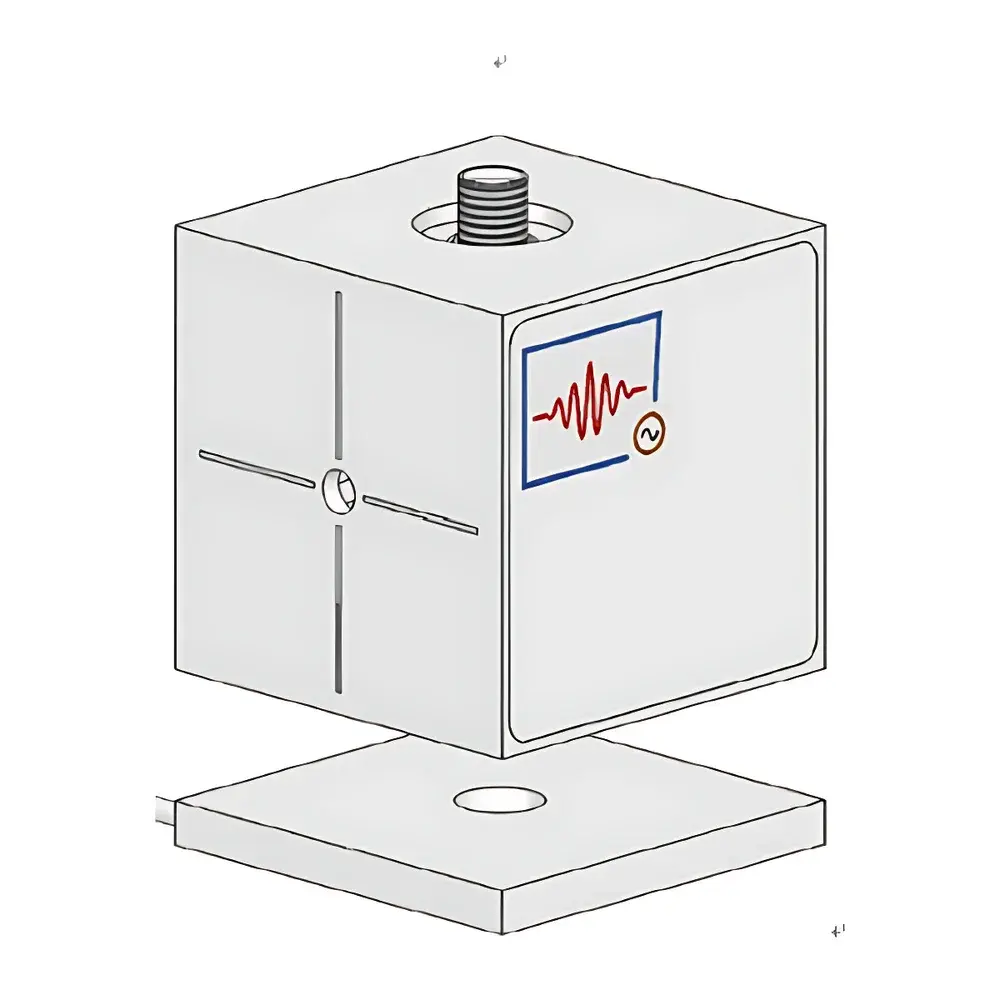
QUBIG Resonant Electro-Optic Phase Modulator
| Brand | Auniontech (HaoLiang) |
|---|---|
| Origin | Shanghai, China |
| Manufacturer Type | Authorized Distributor |
| Product Category | Domestic |
| Model | Resonant EOM |
| Price | Upon Request |
Overview
The QUBIG Resonant Electro-Optic Phase Modulator (R-EOM) is a high-stability, low-residual-amplitude-modulation (RAM) optical phase modulator engineered for precision quantum optics and ultra-stable laser systems. Based on resonant enhancement of the electro-optic effect in lithium niobate (LiNbO₃), this device operates by coupling radio-frequency (RF) drive signals at mechanically and electrically tuned resonance frequencies—typically between 0.1 MHz and 100 MHz—to significantly reduce half-wave voltage (Vπ) while maintaining linear phase response. Unlike broadband non-resonant modulators, the R-EOM achieves enhanced modulation efficiency through impedance-matched cavity resonance, enabling sub-volt-level drive requirements for 1 rad phase shift (e.g., 2.15 Vp at 5 MHz with 852 nm light). Its design suppresses parasitic amplitude modulation to < 0.1%—a critical specification for Pound–Drever–Hall (PDH) locking, atomic interferometry, optical clock stabilization, and quantum state manipulation where phase fidelity directly determines system coherence time and signal-to-noise ratio.
Key Features
- Resonant operation with tunable fundamental frequency (f₀ = 0.1–100 MHz), typical bandwidth Δν ≈ 0.014 × f₀, and quality factor Q ≈ 70
- Low residual amplitude modulation (RAM), optimized via crystal orientation, electrode geometry, and RF matching network design
- Lithium niobate (LiNbO₃) electro-optic crystal with Ø3 mm clear aperture and AR-coating options for 360 nm–2 µm wavelength range
- High optical damage threshold: ≥2 W/mm² (CW), surface quality ≤20–10 scratch-dig, wavefront distortion ≤λ/6 @ 633 nm
- Thermally stable mechanical housing compatible with optional temperature-controlled mounting kits (sold separately)
- Customizable mechanical interface: threaded mounting holes, flange geometry, and connector orientation per OEM integration requirements
Sample Compatibility & Compliance
The R-EOM supports linearly polarized input beams aligned to either P- or S-polarization depending on crystal configuration (single-wedge vs. parallel-plate). For single-wedge variants, incident polarization must be horizontal (P) when SMA connector faces upward and logo is front-facing; vertical (S) polarization is required when logo faces upward and output beam deflects vertically. The device complies with standard cleanroom-compatible handling protocols and meets RoHS Directive 2011/65/EU for hazardous substance restrictions. While not certified to IEC 61000-4 EMC standards out-of-box, its RF-shielded enclosure and 50 Ω matched input facilitate integration into ISO/IEC 17025-accredited metrology labs and quantum infrastructure meeting NIST SP 800-53 physical security controls.
Software & Data Management
The R-EOM functions as a hardware component within larger experimental control architectures and does not include embedded firmware or user-facing software. Integration is performed via standard RF signal generators (e.g., Keysight 33600A series) and network analyzers (e.g., Keysight FieldFox or Rhode & Schwarz ZNB) for resonance characterization. Users typically log reflection coefficient (S₁₁) sweeps and modulation depth data using LabVIEW, Python (with PyVISA), or MATLAB-based acquisition frameworks. All calibration datasets—including Vπ(f), RAM(f), and cavity transmission sideband ratios—are traceable to NIST-traceable power meters and wavemeters. Audit trails for RF drive settings, environmental temperature logs, and optical alignment records are maintained in accordance with GLP-compliant laboratory documentation practices.
Applications
- Ultra-stable laser frequency stabilization via PDH or FM spectroscopy techniques
- Atomic fountain clocks and optical lattice clocks requiring sub-mrad phase noise floor
- Quantum memory interfaces and photonic qubit manipulation in trapped-ion and neutral-atom platforms
- Coherent optical time-transfer over fiber networks (e.g., UTC dissemination with <100 fs timing jitter)
- High-sensitivity interferometric sensing (gravimetry, inertial navigation, vacuum metrology)
- Mode-locked laser cavity dispersion compensation and active cavity length control
FAQ
What is the typical RF drive impedance requirement?
The R-EOM is designed for 50 Ω source impedance and includes integrated impedance-matching circuitry optimized for resonance at specified f₀.
Can the device operate outside its nominal resonance frequency?
Yes, but modulation efficiency drops sharply beyond ±Δν/2; off-resonance operation yields >10× higher Vπ and increased RAM.
Is temperature stabilization necessary for long-term phase stability?
For applications demanding <1 mrad/h phase drift, optional thermoelectric coolers (TECs) and PID controllers are recommended—especially above 40 °C ambient.
How is resonance frequency calibrated during installation?
Via vector network analyzer (VNA) S₁₁ measurement; minimum reflection point defines f₀, with fine-tuning possible using adjustable capacitive trimmers in select models.
Does the modulator support pulsed laser operation?
Yes, provided peak power remains below damage threshold and pulse repetition rate avoids mechanical resonance excitation (verified via impulse response testing).