
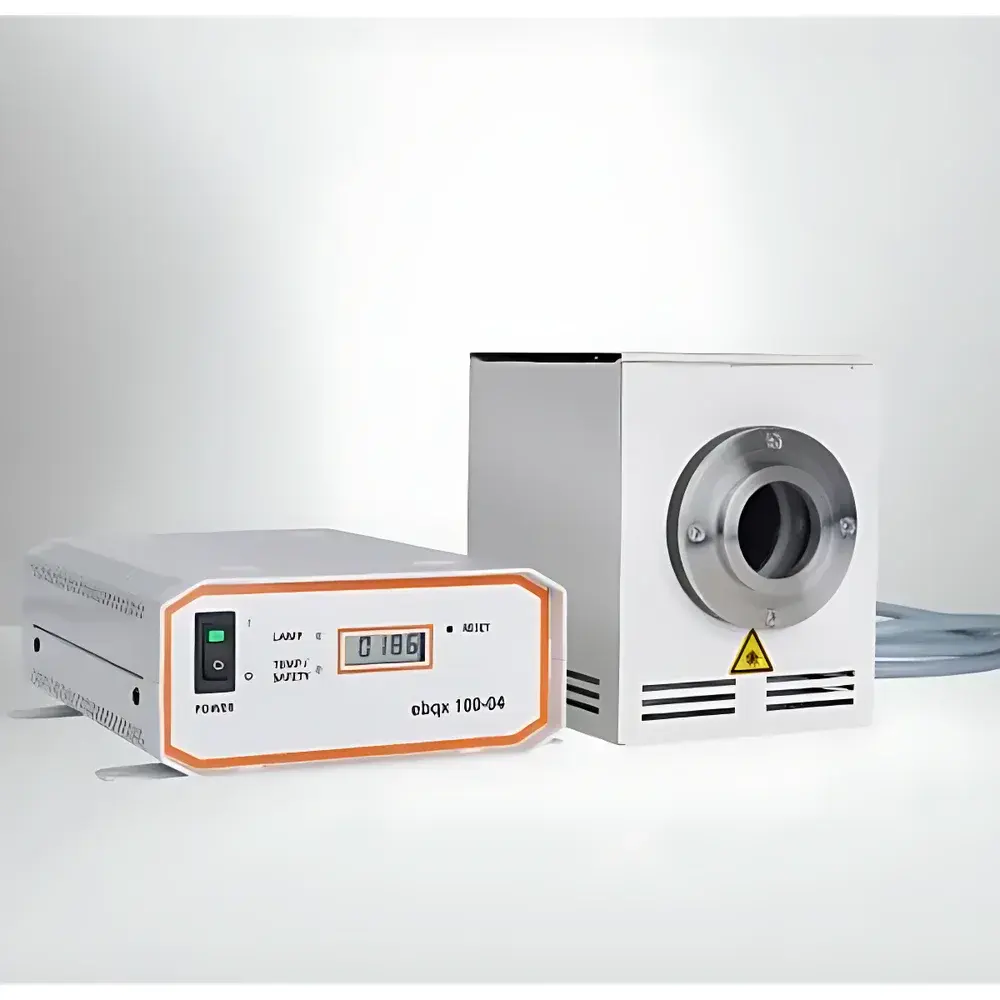
DUV Mercury-Xenon Arc Lamp Illumination Source – Auniontech LH-QX-100.60
| Key | Brand: Auniontech |
|---|---|
| Origin | Shanghai, China |
| Model | LH-QX-100.60 |
| Lamp Type | DC-driven Hg–Xe short-arc lamp |
| Power Rating | 100 W |
| Lamp Compatibility | Hamamatsu L8029-01 / L2422-01 |
| Electrical Interface | M16+PE socket (Schaltbau) |
| Safety Compliance | EN 61010-1, IP20 (EN 60529), Class I Protection |
| Ignition System | Integrated high-voltage igniter |
| Reflector Adjustment | X/Y/Z manual fine alignment |
| Collector Adjustment | Z-axis adjustable |
| Mounting | Flange or dovetail interface + lamp-head adapter for X/Y positioning |
| Spectral Range | Deep UV (DUV), dominant emission lines at 185 nm, 254 nm, 365 nm, 405 nm, 436 nm |
Overview
The Auniontech LH-QX-100.60 is a precision-engineered deep ultraviolet (DUV) illumination source based on a stabilized mercury–xenon (Hg–Xe) short-arc discharge lamp. Designed for high-fidelity optical metrology in semiconductor fabrication and photomask inspection, this system delivers stable, spectrally rich DUV output without thermal drift—enabled by a regulated DC power supply and thermally isolated mechanical architecture. Unlike AC-driven alternatives, the DC excitation eliminates intensity modulation and arc wander, ensuring consistent irradiance over time and across repeated measurements. The lamp’s spectral profile features strong emission lines at 185 nm (vacuum UV, requires purged path), 254 nm (germicidal UVC), 365 nm (i-line), 405 nm (h-line), and 436 nm (g-line), making it suitable for both broadband and quasi-monochromatic applications in lithography process control, defect review, and critical dimension (CD) verification.
Key Features
- DC-powered Hg–Xe arc lamp (100 W) with <0.5% RMS intensity stability over 8 hours—engineered to suppress thermal drift and arc instability
- Integrated high-voltage igniter housed within the lamp housing—eliminates external spark cables and reduces EMI risk
- Three-axis (X/Y/Z) manually adjustable ellipsoidal reflector for precise collimation and beam centering
- Z-axis adjustable quartz collector lens optimized for DUV transmission (185–400 nm), with AR coating for >92% throughput at 254 nm and 365 nm
- Modular mechanical design: lamp head mounts via custom adapter for sub-10 µm X/Y repeatability; housing attaches via ISO-KF flange or precision dovetail rail
- Comprehensive safety architecture including overtemperature cutoff, open-circuit detection, interlock-ready circuitry, and Class I electrical protection per EN 61010-1
- IP20-rated enclosure (EN 60529) with ventilated heat-sink design—compatible with cleanroom environments when operated in recirculating cooling mode
Sample Compatibility & Compliance
The LH-QX-100.60 is compatible with standard photomask substrates (quartz, low-thermal-expansion glass), silicon wafers (bare and patterned), and EUV multilayer test coupons. Its DUV spectral output supports ISO 13655:2017 (graphic technology — spectral measurement and colorimetric computation) and ASTM F2633-22 (standard guide for optical inspection of photomasks). For regulated environments—including ISO Class 5 cleanrooms and GMP-aligned wafer fabs—the system meets electromagnetic compatibility requirements per EN 61326-1 and incorporates hardware-enforced safety interlocks compliant with SEMI S2-0215. While not intrinsically vacuum-compatible, optional N₂ purge ports enable operation down to 185 nm in inert-atmosphere configurations.
Software & Data Management
This is a standalone illumination module requiring no proprietary software stack. Intensity monitoring is performed via optional calibrated photodiode sensors (e.g., Thorlabs PM100D + S120VC UV-enhanced head) connected to third-party DAQ systems. All mechanical adjustments are manually indexed and documented using engraved scale rings and reference marks—supporting GLP-compliant setup traceability. For integration into automated inspection platforms (e.g., KLA eDR7280, Applied Materials UVision), digital I/O signals (TTL-compatible enable/interlock lines) and analog 0–10 V intensity control input are available via rear-panel DB9 connector. Audit trails for lamp runtime and thermal events are stored locally in nonvolatile memory and accessible via RS-232 serial interface.
Applications
- Photomask inspection and metrology: high-contrast imaging of sub-100 nm line/space patterns using 254 nm or 365 nm illumination
- Wafer-level defect detection: identification of particles, scratches, and resist residues on front-side and back-side surfaces
- UV curing validation: spatial uniformity mapping of DUV irradiance across exposure fields
- Optical component characterization: transmittance/reflectance testing of DUV-grade fused silica, CaF₂, and MgF₂ optics
- Surface contamination analysis: fluorescence excitation of organic residues under 254 nm illumination
- Research in photochemistry and surface science requiring stable, line-specific UV excitation sources
FAQ
Is the LH-QX-100.60 compatible with vacuum or nitrogen-purged optical paths?
Yes—optional N₂ purge fittings are available; for operation below 190 nm (e.g., 185 nm line), continuous purge with dry nitrogen (<1 ppm H₂O, <1 ppm O₂) is required.
What lamp replacements are supported, and what is typical lifetime?
Hamamatsu L8029-01 (100 W, 2,000 h rated life) and L2422-01 (100 W, 1,500 h) are certified replacements; actual lifetime depends on thermal management and ignition cycle count.
Can the system be integrated into an automated inspection platform?
Yes—via TTL interlock inputs, analog intensity control, and RS-232 for runtime logging; full integration documentation and pinout schematics are provided upon request.
Does the unit include radiometric calibration data?
No—calibration is performed externally using NIST-traceable UV radiometers; however, mounting kinematics and beam geometry are documented to ±25 µm positional accuracy.
Is service support available outside mainland China?
Yes—Auniontech maintains authorized technical partners in Germany, Singapore, and the United States for field service, lamp replacement, and optical realignment support.




