
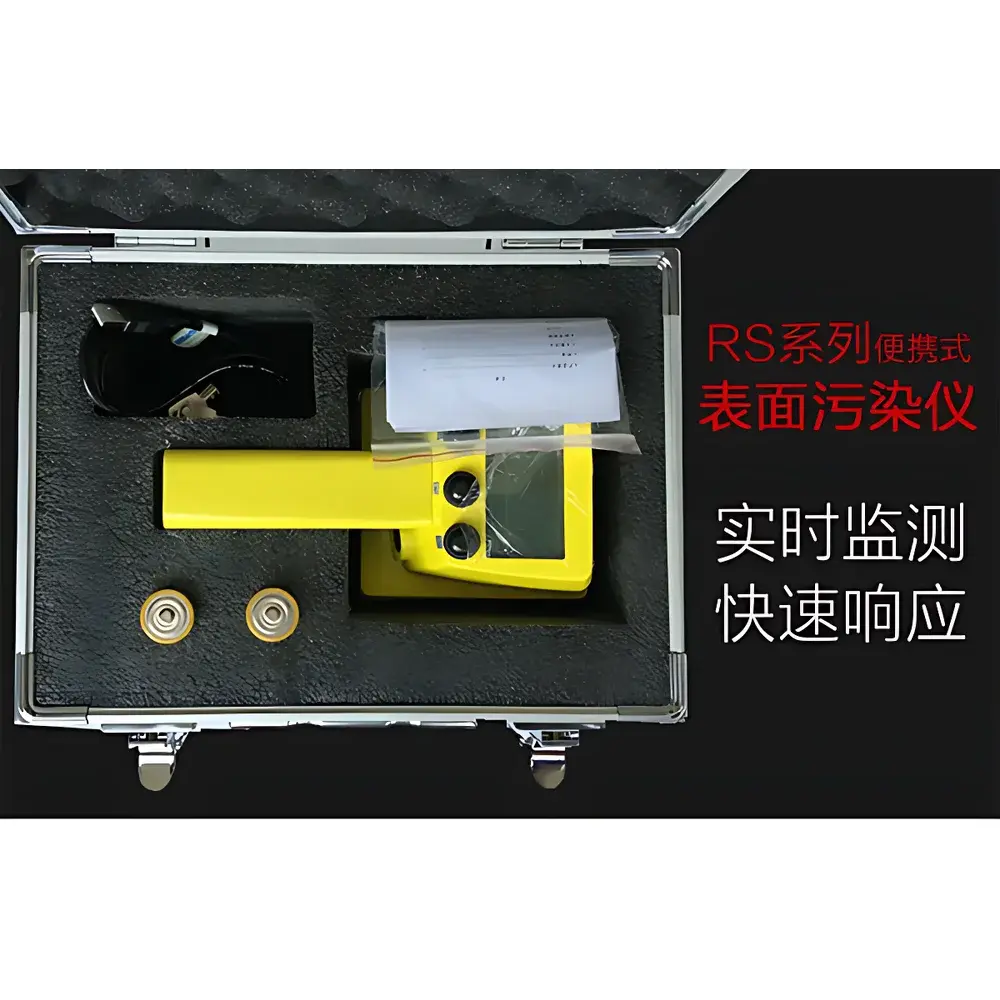
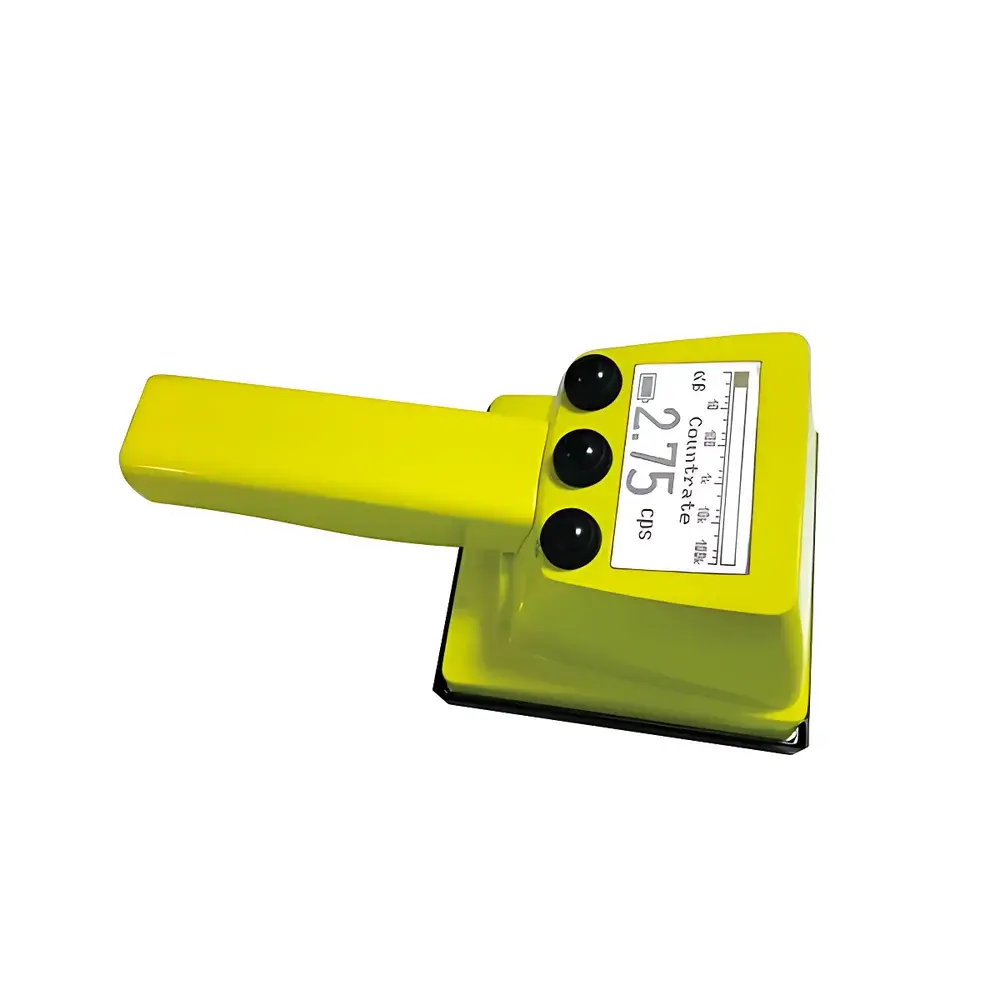
SMACH RS2100 Portable Alpha/Beta Surface Contamination Monitor
| Brand | SMACH |
|---|---|
| Origin | Fujian, China |
| Model | RS2100 |
| Instrument Type | Portable |
| Detector Type | Plastic Scintillator + ZnS(Ag) |
| Radiation Types | Alpha and Beta |
| Count Rate Range | 0–1×10⁵ cps |
| Sensitivity | 233 cps/(Bq·cm⁻²) (for ²⁴¹Am) |
| Detection Efficiency | ≥52% (²⁴¹Am), ≥17% (¹⁴C), ≥48% (²⁰⁴Tl), ≥50% (⁹⁰Sr/⁹⁰Y), ≥45% (¹³⁷Cs) |
| Effective Detection Area | 100 cm² (10×10 cm) |
| Window Material | Aluminized Polyester Foil |
| Beta Energy Range | 150 keV – 2.5 MeV |
| Display | 128×64 Dot-Matrix LCD |
| Power Supply | Standard C-Cell Alkaline or Rechargeable Batteries |
| Battery Life | ~150 h (backlight off) |
| Weight | ~1.0 kg |
| Units | cps, cps/cm², Bq, Bq/cm² |
| Alarm | Dual Adjustable Thresholds |
| Interface | USB Serial Communication |
| Housing | Impact-Resistant Enclosure |
| Detector Assembly | Vacuum-Sealed with Quick-Replace Aluminum Foil Window |
Overview
The SMACH RS2100 Portable Alpha/Beta Surface Contamination Monitor is a field-deployable radiation survey instrument engineered for quantitative measurement of alpha and beta-emitting radionuclides on surfaces. It operates on the principle of dual-layer scintillation detection: incident alpha particles interact primarily with the thin ZnS(Ag) layer, while beta particles deposit energy in the underlying plastic scintillator—both generating prompt photons detected by a photomultiplier tube (PMT). Pulse shape discrimination and window-based pulse-height analysis enable real-time separation and independent quantification of alpha and beta events. Designed to meet operational requirements in regulated environments, the RS2100 supports routine contamination screening, decommissioning surveys, and emergency response protocols where rapid, reliable surface activity assessment is critical.
Key Features
- Dual-mode detection: simultaneous, selective, or exclusive alpha/beta counting via hardware-level pulse discrimination
- Optimized detector geometry with high-reflectivity internal surfaces ensures uniform detection efficiency across the full 100 cm² active area
- Vacuum-sealed scintillation assembly with quick-swap aluminized polyester entrance window—minimizes downtime during foil replacement
- Two independently configurable alarm thresholds (alpha-only, beta-only, or combined), with audible and visual alert indicators
- Backlit monochrome LCD (128×64 pixels) with auto-dimming function; intuitive single-button backlight control
- Ruggedized housing rated for field use: shock-absorbing design, IP54-rated ingress protection against dust and splashing water
- USB serial interface compliant with standard RS-232 emulation for direct connection to Windows/Linux PCs without proprietary drivers
- Low-power architecture supporting up to 150 hours of continuous operation on six C-cell alkaline batteries (backlight disabled)
- Calibration traceable to national standards; factory-certified efficiency values provided per ISO 7503-1 for common reference nuclides
Sample Compatibility & Compliance
The RS2100 is validated for direct contact or proximity-based scanning of non-porous and semi-porous surfaces—including stainless steel, concrete, vinyl flooring, gloves, lab coats, and footwear—without requiring sample preparation. Its 150 keV–2.5 MeV beta response range covers major occupational isotopes (e.g., ⁹⁰Sr/⁹⁰Y, ¹⁴C, ³⁶Cl), while the ZnS(Ag) layer delivers robust sensitivity to low-energy alpha emitters (e.g., ²⁴¹Am, ²³⁹Pu, ²¹⁰Po). The instrument complies with IEC 60846-2:2014 for portable contamination monitors and supports documentation required under ISO/IEC 17025-accredited laboratory quality systems. Data output formats are compatible with nuclear facility radiological protection programs aligned with IAEA Safety Standards Series No. RS-G-1.7 and US NRC Regulatory Guide 4.15.
Software & Data Management
Raw count data, time-stamped measurements, and user-defined location tags are exportable via USB as CSV or ASCII text files. No proprietary software is required; exported datasets integrate natively with industry-standard tools including Microsoft Excel, MATLAB, and LIMS platforms. Audit-trail functionality records operator ID, calibration date, alarm activation events, and battery status—supporting GLP-compliant recordkeeping. Firmware updates are performed via drag-and-drop file transfer using standard USB mass-storage mode. All configuration parameters—including unit selection (cps, Bq/cm²), background subtraction mode, and alarm setpoints—are stored in non-volatile memory with write-protection options.
Applications
- Routine contamination monitoring in nuclear power plant auxiliary buildings, spent fuel handling areas, and radioactive waste packaging zones
- Decommissioning verification at legacy research reactors and uranium processing facilities per IAEA WS-G-2.5 guidelines
- Personnel exit screening in radio-pharmaceutical production suites and diagnostic nuclear medicine departments
- Environmental surveillance at licensed disposal sites and remediated brownfield locations
- Emergency response triage following transportation incidents involving sealed or unsealed sources
- QA/QC verification of decontamination efficacy following chemical or mechanical cleaning procedures
FAQ
What is the minimum detectable activity (MDA) for ²⁴¹Am on a 100 cm² surface?
The MDA is approximately 0.37 Bq/cm² (10 dpm/100 cm²) at 95% confidence level for a 10-second count, assuming typical background (0.2 cps) and 52% detection efficiency.
Can the RS2100 be used for swipe (smear) assay analysis?
Yes—the instrument supports fixed-area counting of filter papers or wipes placed directly over the detector window; efficiency corrections for geometry and self-absorption must be applied per ISO 7503-2.
Is firmware upgrade capability available in the field?
Yes—firmware updates are delivered as signed binary files and installed via USB without external programming hardware.
Does the device support dose rate estimation?
No—the RS2100 is a contamination monitor only; it does not provide ambient dose equivalent (H*(10)) or air kerma rate readings.
How is energy compensation achieved for varying beta spectra?
The detector’s intrinsic response is characterized per nuclide using certified reference sources; no real-time spectral correction is applied—users select appropriate efficiency factors from the included calibration certificate.
Related Products







