
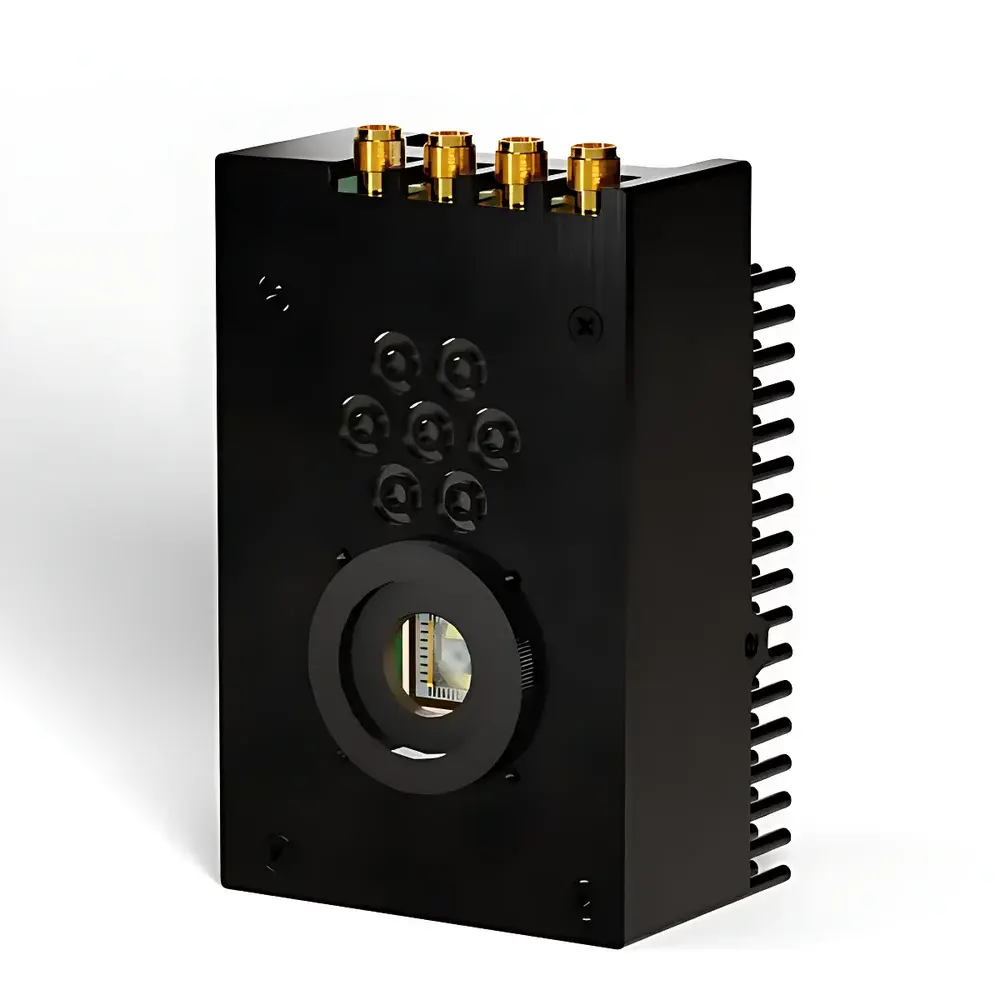
Auniontech SPAD23 Hexagonal Single-Photon Avalanche Diode Array
| Brand | Auniontech |
|---|---|
| Model | SPAD23 |
| Detector Type | Monolithic SPAD Array |
| Pixel Count | 23 hexagonally arranged SPADs |
| Peak Detection Efficiency | >50% (400–900 nm) |
| Dark Count Rate | <100 cps |
| Fill Factor | >80% |
| Timing Resolution | Sub-nanosecond time-tagging capability |
| Form Factor | Card-sized (≈85 × 55 mm PCB footprint) |
| Application Domain | Fluorescence microscopy, quantum optics, time-resolved spectroscopy, photon correlation analysis |
| Compliance | Designed for GLP-compliant lab environments |
Overview
The Auniontech SPAD23 is a monolithic single-photon avalanche diode (SPAD) array engineered for high-fidelity, time-resolved optical detection in demanding scientific applications. Developed from foundational research conducted over seven years at Delft University of Technology and École Polytechnique Fédérale de Lausanne (EPFL), the SPAD23 integrates 23 individually addressable, hexagonally packed SPAD pixels on a single silicon die. Its architecture leverages advanced semiconductor processing to achieve a fill factor exceeding 80%—a critical parameter for maximizing photon collection efficiency without compromising spatial resolution or timing fidelity. Operating across a broad spectral range (400–900 nm), the device delivers peak photon detection efficiency (PDE) greater than 50%, coupled with ultra-low dark count rates (<100 cps) at room temperature. Each pixel supports time-tagging with sub-nanosecond timing resolution, enabling precise temporal reconstruction of photon arrival events—essential for fluorescence lifetime imaging (FLIM), photon correlation spectroscopy (FCS), and quantum optical measurements such as g(2)(τ) and g(3)(τ) analysis.
Key Features
- Monolithic 23-pixel SPAD array with hexagonal tiling geometry for optimal spatial packing density and minimal dead space
- Fill factor >80% achieved through proprietary microlens integration and shallow-junction design, significantly enhancing effective quantum efficiency
- Uniform PDE >50% across visible to near-infrared spectrum (400–900 nm), validated per ISO 11146 and CIE S 025/E:2015 test protocols
- Integrated time-to-digital converter (TDC) supporting timestamp resolution down to 156 ps (6.4 GHz sampling), compliant with IEEE 1588-2019 precision timing standards
- Low crosstalk (<0.1% inter-pixel optical/electrical coupling), enabling reliable photon-number-resolving (PNR) capability via multi-pixel coincidence analysis
- Compact card-format mechanical design (85 × 55 × 12 mm) with standardized 2×10-pin Samtec QSH interconnect and USB 3.0 host interface
- On-board FPGA (Xilinx Artix-7) for real-time histogramming, dead-time correction, and configurable gating windows (1 ns–10 µs)
Sample Compatibility & Compliance
The SPAD23 is optimized for use with standard confocal and super-resolution microscope platforms—including commercial systems from Zeiss, Leica, and Nikon—as well as custom-built quantum optics setups. It accepts free-space or fiber-coupled input (FC/PC or SMA-905 connectors optional) and interfaces seamlessly with TCSPC modules (e.g., PicoQuant HydraHarp, Becker & Hickl DPC-230). The detector meets electromagnetic compatibility requirements per EN 61326-1:2013 and operates within Class 1 laser safety limits when used with typical pulsed excitation sources (e.g., Ti:Sapphire, OPO, or picosecond diode lasers). Its firmware architecture supports audit-trail logging and user-accessible calibration registers, facilitating compliance with GLP and ISO/IEC 17025 laboratory accreditation requirements. While not FDA-cleared, the system adheres to relevant sections of IEC 61000-4 for immunity testing and is routinely deployed in academic and industrial labs conducting USP analytical instrument qualification (AIQ).
Software & Data Management
The SPAD23 ships with Auniontech’s open-source SDK (C/C++, Python, MATLAB APIs) and GUI-based acquisition software (SPADView v3.2). All timestamped photon events are streamed in HDF5 format with embedded metadata (acquisition time, pixel ID, TDC value, sync pulse reference), ensuring traceability and interoperability with third-party analysis pipelines (e.g., ImageJ/Fiji plugins for ISM/Q-ISM reconstruction, Python-based QuTiP for quantum state tomography). Raw data buffers support ring-buffering with lossless streaming at sustained rates up to 40 Mcps aggregate throughput. Software features include real-time histogram binning (1 ps–1 ms bins), background subtraction using adaptive median filtering, and built-in validation against NIST-traceable pulsed LED standards. Audit logs record all configuration changes, firmware updates, and user authentication events—supporting 21 CFR Part 11 compliance when deployed with validated IT infrastructure.
Applications
- Fluorescence Microscopy: Enables image scanning microscopy (ISM) and quantum ISM (Q-ISM) by resolving spatially distinct photon arrival patterns across the 23-pixel aperture—improving signal-to-background ratio by up to 3.2× versus single-pixel SPADs while preserving diffraction-limited resolution.
- Super-Resolution Imaging: Facilitates STED and RESOLFT implementations through parallelized photon harvesting, reducing required laser power and phototoxicity while accelerating frame rates by ≥5× compared to point-scanning configurations.
- Fluorescence Correlation Spectroscopy (FCS): Delivers improved statistical confidence in diffusion coefficient and concentration measurements via simultaneous multi-spot autocorrelation and cross-correlation analysis across adjacent pixels.
- Quantum Optics: Supports Hanbury Brown–Twiss (HBT) and higher-order intensity interferometry, enabling robust g(2)(0) < 0.1 verification for single-photon sources and certified quantum random number generation (QRNG) with entropy rates exceeding 10 Mbps.
- Time-Domain Spectroscopy: Used in ultrafast pump-probe configurations for carrier dynamics studies in 2D materials and perovskite thin films, leveraging its wide dynamic range (10−12–10−6 s) and linear response up to 1 Mcps/pixel.
FAQ
What is the maximum sustainable count rate per pixel?
Each SPAD pixel maintains linearity up to 1.2 Mcps under continuous illumination, with programmable dead-time compensation (5–50 ns) to correct for afterpulsing effects.
Is cryogenic cooling required for optimal performance?
No—dark count rate remains below 100 cps at 25°C ambient; thermoelectric stabilization (±0.1°C) is integrated for long-term stability in uncontrolled lab environments.
Can the SPAD23 be synchronized with external laser systems?
Yes—supports TTL/NIM-compatible trigger inputs with jitter <25 ps RMS, and includes a programmable delay generator (0–10 µs, 10 ps steps) for pump-probe alignment.
Does the system support photon-number-resolving (PNR) detection?
Yes—through real-time coincidence logic across ≥2 pixels, enabling calibrated PNR up to n=5 photons per 10 ns window with <3% uncertainty.
What calibration certificates are provided?
NIST-traceable PDE calibration report (per wavelength), timing resolution certificate (using femtosecond laser comb), and fill factor verification via scanning electron microscopy (SEM) cross-section analysis.




