
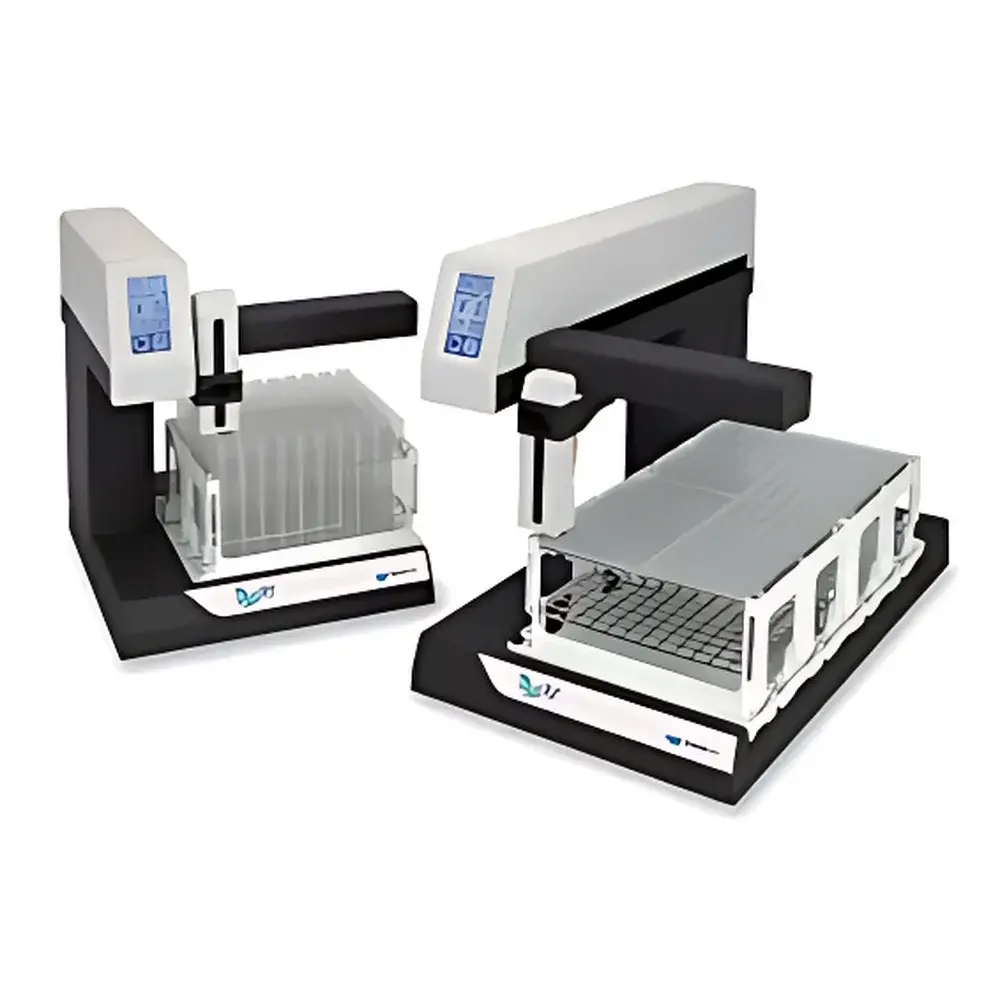
CoMetro R1/R2 Fraction Collector
| Brand | CoMetro |
|---|---|
| Model | R1/R2 Fraction Collector |
| Type | Mixed-Mode Fraction Collector |
| Collection Modes | Drop-count, Time-based, Volume-based, Peak-triggered |
| Max Flow Rate | 100 mL/min |
| Dimensions (R1) | 31 × 33 × 35.5 cm |
| Dimensions (R2) | 31 × 53 × 38 cm |
| Weight (R1, w/o rack) | 7.7 kg |
| Weight (R2, w/o rack) | 10.6 kg |
| Power Supply | 115 VAC or 230 VAC, 50/60 Hz |
| Tube Capacity Options | Up to 144 × 12–13 mm tubes, 100 × 16 mm tubes, 72 × 18 mm tubes, 36 × 25 mm tubes, 60 × 1.5 mL microcentrifuge tubes, 36 × 50 mL centrifuge tubes, or 96-well microplates |
| Safety Features | Leak-proof valve design, electrical insulation protection |
| Mounting | Optional instrument stand for space-efficient integration |
Overview
The CoMetro R1/R2 Fraction Collector is an engineered solution for precise, programmable fractionation in preparative liquid chromatography (prep-LC), flash chromatography, and gravity-fed column chromatography workflows. Designed around a dual-mode actuation architecture—supporting both sequential (left-to-right) and serpentine collection patterns—the system ensures high positional accuracy and minimal dead volume during fraction transfer. Its core operation relies on a pneumatically assisted, low-backpressure switching valve with chemically inert fluidic pathways (PEEK and PTFE wetted materials), enabling compatibility with organic solvents, aqueous buffers, and mildly aggressive reagents. The collector integrates seamlessly into open-loop or closed-loop chromatographic systems via TTL, analog, or RS-232 trigger inputs, allowing synchronization with UV/Vis, conductivity, or mass spectrometric detectors. Unlike basic timed collectors, the R1/R2 supports real-time peak-based triggering using external analog voltage signals (0–10 V), permitting dynamic fraction gating aligned with elution profiles—a critical requirement for isolating narrow peaks in complex natural product or peptide separations.
Key Features
- Dual collection logic: Configurable left-to-right or serpentine tube indexing for optimal spatial utilization and reduced carryover between fractions.
- Multi-parameter triggering: Independent selection of drop-count, elapsed time, volumetric threshold, or detector signal peak detection—each with user-defined thresholds and hysteresis settings.
- Modular tube rack system: Interchangeable racks support standardized labware including 12–13 mm test tubes (144-position), 16 mm tubes (100-position), 18 mm tubes (72-position), 25 mm tubes (36-position), 1.5 mL microcentrifuge tubes (60-position), 50 mL centrifuge tubes (36-position), and 96-well microplates.
- Low-noise, maintenance-free actuation: Brushless stepper motor drive with optical position feedback ensures repeatable tube alignment (< ±0.2 mm positional tolerance) and silent operation (< 45 dB(A) at 1 m).
- Integrated safety architecture: IP22-rated enclosure with redundant leak-detection circuitry and reinforced insulation on all high-voltage control lines; conforms to IEC 61010-1 for laboratory electrical safety.
- Compact footprint and flexible mounting: R1 unit occupies < 0.035 m²; R2 adds extended rack capacity without compromising benchtop accessibility. Optional vibration-damped instrument stand enables stable stacking with pumps or detectors.
Sample Compatibility & Compliance
The R1/R2 is validated for use with common chromatographic mobile phases including acetonitrile, methanol, isopropanol, THF, dichloromethane, and aqueous buffers (pH 2–12). All fluid-contact components meet USP Class VI biocompatibility requirements. The system supports GLP-compliant data integrity when paired with CoMetro’s optional audit-trail-enabled software (sold separately), which logs all method changes, collection events, operator IDs, and timestamped metadata in accordance with FDA 21 CFR Part 11 Annex 11 principles. It complies with ISO/IEC 17025:2017 clause 5.9.1 for equipment traceability and is CE-marked under the EU Machinery Directive 2006/42/EC and Low Voltage Directive 2014/35/EU.
Software & Data Management
The embedded controller stores up to 99 user-defined methods with full parameter recall—including trigger mode, delay offsets, tube dwell times, and post-collection valve purge cycles. Methods are transferred via USB 2.0 port (Type-A) or configured locally using the 3.5-inch resistive touchscreen interface with tactile feedback buttons. For networked environments, optional Ethernet module enables remote monitoring and method push via HTTP API (RESTful endpoints for GET/POST of status, configuration, and event logs). Raw collection logs export as CSV files with ISO 8601 timestamps, supporting direct import into LIMS platforms such as LabVantage or Thermo Fisher SampleManager. No proprietary drivers required—OS-agnostic operation across Windows, macOS, and Linux.
Applications
- Purification of synthetic intermediates in pharmaceutical process development, where fraction purity and recovery yield are governed by regulatory guidelines (ICH Q5, Q7).
- Isolation of bioactive compounds from plant extracts or fermentation broths using medium-pressure silica or reversed-phase columns.
- Automated collection of SEC fractions for protein aggregation analysis, minimizing manual handling-induced denaturation.
- Parallel purification of oligonucleotides or ADC linker-payload conjugates requiring strict solvent compatibility and low metal leaching.
- Method development support in academic core facilities, where rapid reconfiguration between analytical-scale scouting and preparative-scale isolation is routine.
FAQ
What types of chromatographic systems is the R1/R2 compatible with?
It interfaces with any LC or FPLC system providing TTL pulse, analog voltage (0–10 V), or RS-232 output for fraction triggering—including Agilent, Waters, Shimadzu, Bio-Rad, and ÄKTA platforms.
Can the R1/R2 perform peak-triggered collection without a dedicated data system?
Yes—its analog input accepts real-time detector signals directly; no external PC or acquisition software is required for basic peak gating.
Is tubing included for connection to the chromatography system?
Standard PEEK capillary tubing (1/16″ OD × 0.02″ ID, 1.5 m length) and compression fittings are supplied with each unit.
Does the system support gradient-aware fractionation?
While it does not interpret gradient programs autonomously, users can define time- or volume-based windows aligned with known gradient segments using stored methods.
How is calibration verified for drop-count mode?
Drop calibration is performed using the built-in meniscus detection algorithm during setup, referencing standard droplet volumes (e.g., 50 µL per drop at 1 mL/min flow rate) with optional gravimetric validation.
Related Products





