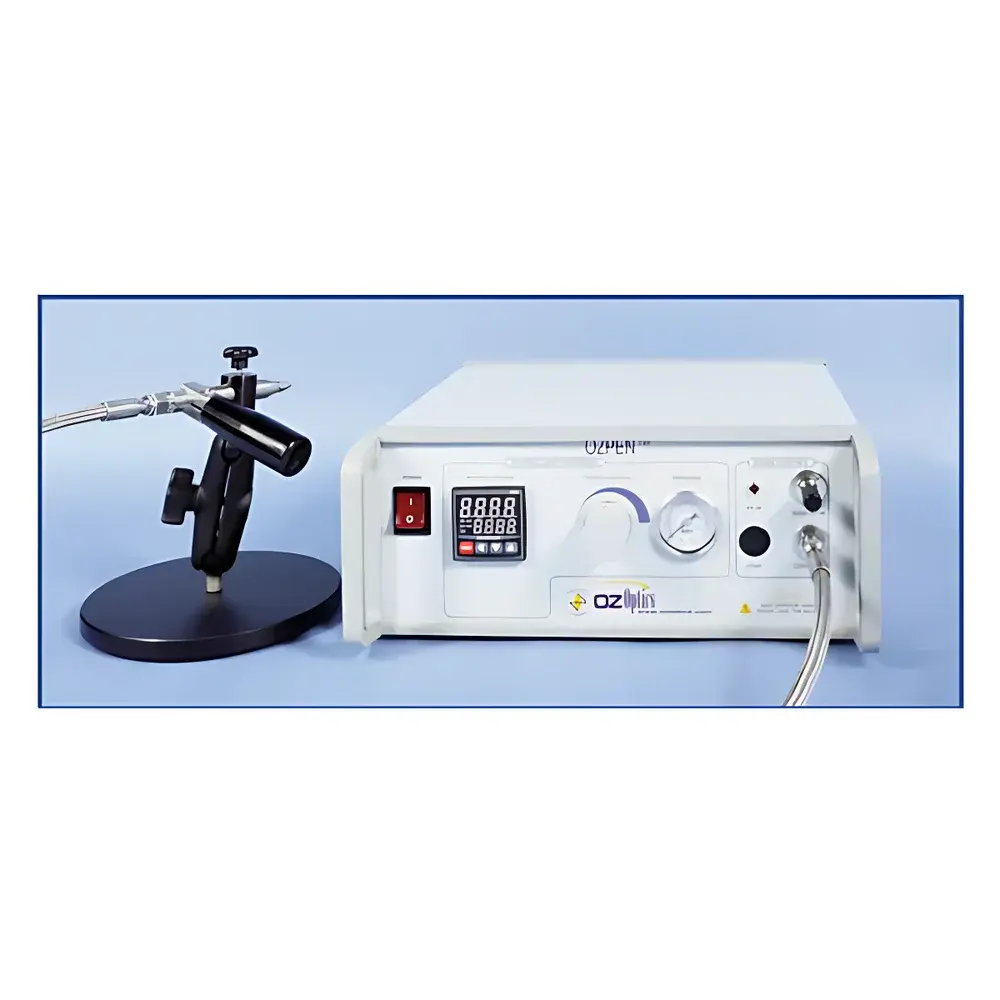
OZPEN CO2 Fiber Optic Cleaning System
| Brand | Auniontech |
|---|---|
| Origin | Shanghai, China |
| Manufacturer Type | Authorized Distributor |
| Country of Origin | China |
| Model | OZPEN CO2 Fiber Optic Cleaning System |
| Pricing | Upon Request |
Overview
The OZPEN CO2 Fiber Optic Cleaning System is a precision dry-cleaning instrument engineered for contamination control in critical optical and photonic manufacturing environments. It operates on the principle of cryogenic particle impact cleaning—utilizing solid carbon dioxide (CO₂) micro-snow particles accelerated in a supersonic gas stream to remove sub-100 nm particulates, organic films, fingerprints, polishing residues, and hygroscopic contaminants from delicate surfaces without mechanical contact or solvent residue. Unlike conventional wet wiping or compressed-air-only methods, the OZPEN system delivers controlled, localized cleaning via phase-transition dynamics: liquid CO₂ is metered through a thermally regulated nozzle, undergoing rapid expansion and solidification into micron-scale snow particles (typically 10–50 µm) at approximately −78 °C. The kinetic energy transfer from impacting snow particles dislodges surface-bound contaminants, while the expanding CO₂ vapor phase entrains and evacuates debris—leaving no secondary residue, moisture, or static charge. This process is intrinsically compatible with high-power optical interfaces, fiber end-faces, lens coatings, and hermetically sealed optoelectronic assemblies where solvent compatibility, thermal stability, and electrostatic safety are non-negotiable.
Key Features
- Precision coaxial pencil-style spray nozzle with 1-meter flexible hose and foot-switch activation for hands-free, ergonomic operation
- Independent adjustment of propellant pressure (0–125 psi), nozzle temperature, and CO₂ mass flow rate to optimize cleaning efficacy across diverse substrate geometries and contaminant types
- Integrated benchtop generator unit featuring power switch, dual-pressure gauges (for CDA/N₂ supply and CO₂ delivery), thermal controller, and calibrated flow regulator
- Pre-installed 20-gauge capillary for fine-particle generation; compatible with optional capillaries for varying snow density and velocity profiles
- Propellant-agnostic design supporting both clean dry air (CDA) and nitrogen as carrier gases—enabling operation in inert or Class 100 cleanroom environments
- No consumables beyond liquid CO₂; eliminates solvent waste, lint shedding, and operator exposure risks associated with IPA or acetone-based protocols
Sample Compatibility & Compliance
The OZPEN system is validated for use on silica-based optical fibers (SMF-28, PM fibers), FC/PC, LC, and MPO connectors, fused silica lenses, AR/HR-coated optics, MEMS mirrors, semiconductor wafers (Si, InP, GaAs), stainless steel housings, and medical-grade polymer substrates. Its dry, non-abrasive mechanism meets ISO 14644-1 Class 5 cleanroom requirements when operated with filtered CDA or N₂. While not certified to specific regulatory standards out-of-the-box, the system’s repeatable, traceable cleaning parameters support documentation under ISO 9001 quality management systems and can be integrated into GLP/GMP workflows requiring audit-ready process records (e.g., via optional analog/digital I/O for external data logging). It complies with OSHA PEL limits for CO₂ exposure when used in ventilated laboratories per ANSI Z9.5 guidelines.
Software & Data Management
The base OZPEN system operates without embedded firmware or proprietary software—ensuring deterministic, real-time manual control and eliminating cybersecurity vulnerabilities common in networked lab instruments. All operational parameters (propellant pressure, temperature setpoint, trigger duration) are manually adjustable and mechanically locked, enabling full procedural reproducibility. For integration into automated test benches or QC stations, analog 0–10 V inputs/outputs allow synchronization with PLCs or DAQ systems. Optional USB-to-serial adapters enable timestamped logging of pressure and temperature readings using third-party SCADA platforms compliant with FDA 21 CFR Part 11 (when paired with electronic signature-capable software and audit-trail configuration).
Applications
- Cleaning of high-power fiber-optic terminations prior to splicing, connectorization, or laser coupling to prevent thermal damage and mode distortion
- Pre-deposition cleaning of optical substrates in thin-film coating chambers (e.g., ion-assisted e-beam evaporation, sputtering)
- Removal of polishing slurry residues from interferometric cavity mirrors and etalon surfaces
- Decontamination of photodetector windows, OCT probe tips, and endoscopic imaging optics in regulated medical device manufacturing
- Surface preparation of photonic integrated circuits (PICs) and silicon photonics test chips before dicing or packaging
- Post-lithography residue removal from biochip sensor arrays and microfluidic channel inlets
FAQ
Is the OZPEN system compatible with ultra-low-particulate environments such as ISO Class 3 cleanrooms?
Yes—when supplied with ISO Class 2 or better CDA/N₂ and operated with appropriate exhaust filtration, it meets ISO 14644-1 Class 3 airborne particle limits during active spraying.
Can the system be used on plastic or polymer optical components without thermal cracking?
The localized, transient cooling effect (−78 °C at impact zone only) poses negligible risk to most engineering polymers (e.g., PMMA, PC, COC); thermal shock testing is recommended for specialty biopolymers.
What maintenance is required for long-term reliability?
Annual calibration of pressure transducers and thermal sensors is advised; nozzle capillaries should be inspected for clogging after every 200 hours of cumulative use.
Does the system generate electrostatic discharge (ESD)?
No—CO₂ gas is inherently conductive; the system includes grounding lugs and meets ANSI/ESD S20.20 requirements when properly earthed.
Is training or certification required to operate the OZPEN system?
Basic operation requires no formal certification; however, Auniontech provides application-specific SOP development and on-site validation support for regulated industries.