
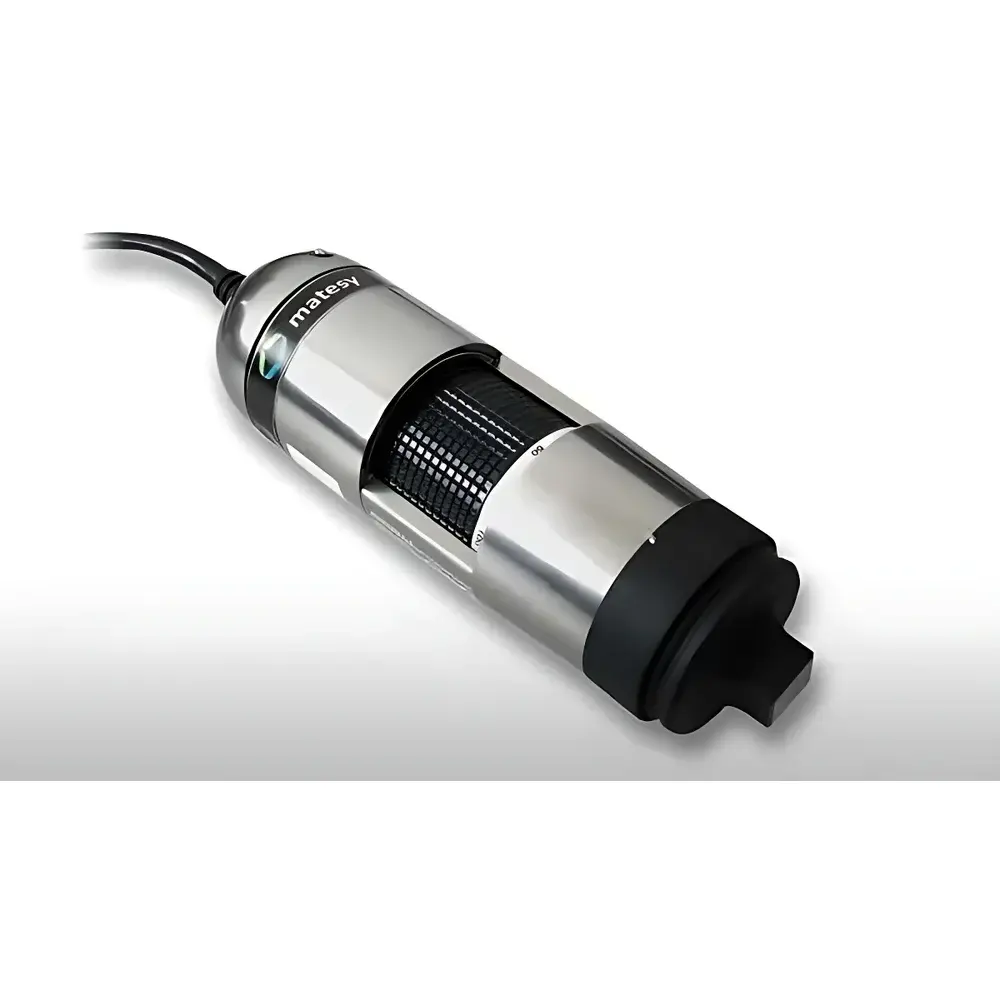
Auniontech Mageye Handheld Magnetic Field Camera
| Brand | Auniontech |
|---|---|
| Model | Mageye |
| Type | Handheld Magneto-Optic Field Imaging System |
| Measurement Principle | Faraday Effect-Based Pulsed Magnetic Field Visualization |
| Magnetic Field Range | 0.01–130 kA/m (0.1–1600 Oe) |
| Sensor Active Area | Up to 8 × 8 mm |
| Interface | USB 2.0 |
| Optical Resolution | Micrometer-Level (µm) |
| Power Supply | Bus-Powered via USB |
| Compliance | CE, RoHS |
| Application Domain | Non-Destructive Magnetic Inspection, GLP-Compatible Qualitative Field Mapping |
Overview
The Auniontech Mageye Handheld Magnetic Field Camera is a compact, USB-powered magneto-optic imaging system engineered for real-time, non-contact visualization and qualitative assessment of stray magnetic fields. Unlike conventional Hall-effect or fluxgate-based scanners, the Mageye leverages the Faraday effect in a thin-film magneto-optic sensor—where linearly polarized LED illumination passes through a bismuth-substituted rare-earth iron garnet (Bi:RIG) layer—and undergoes polarization rotation proportional to the local magnetic flux density component perpendicular to the optical path. This rotation is converted into intensity contrast by an analyser polarizer and captured by a high-resolution monochrome CMOS microscope camera. The result is a direct, spatially resolved grayscale image representing field polarity, gradient distribution, and domain structure at micrometer-scale resolution—without requiring external excitation, scanning mechanics, or cryogenic cooling. Designed for field-deployable operation, the Mageye delivers immediate visual feedback in industrial QA, forensic reconstruction, geological sample screening, and R&D environments where portability and rapid qualitative mapping outweigh quantitative traceability requirements.
Key Features
- True handheld form factor with integrated LED illumination, polarizer/analyzer optics, and magneto-optic sensor—all housed in a single ergonomic unit weighing under 350 g
- Micrometer-level spatial resolution enabled by optical magnification and sub-pixel interpolation algorithms, supporting visualization of domain walls in soft magnetic films and microstructure-related flux leakage
- Real-time USB 2.0 video streaming (up to 60 fps at 1280 × 1024) with onboard gamma correction and dynamic range optimization for low-contrast field gradients
- Field sensitivity range from 0.01 kA/m (0.1 Oe) to 130 kA/m (1600 Oe), covering applications from weak remanent fields in degaussed components to strong permanent magnet surfaces
- No external power supply required—fully bus-powered via standard USB 2.0 interface, ensuring compatibility with laptops, embedded PCs, and battery-powered workstations
- Factory-calibrated sensor response curve provided as lookup table (LUT) for semi-quantitative intensity-to-field conversion in post-processing
Sample Compatibility & Compliance
The Mageye accommodates flat or gently curved ferromagnetic, ferrimagnetic, and paramagnetic samples up to 15 mm in thickness, including laminated electrical steel, sintered NdFeB magnets, magnetic encoding strips, credit card magnetic stripes, and welded joints exhibiting residual stress-induced magnetism. It supports ambient temperature operation (10–40 °C) and relative humidity ≤80% non-condensing. While not certified for ISO/IEC 17025 accredited quantitative metrology, the system conforms to CE Directive 2014/30/EU (EMC) and 2011/65/EU (RoHS). Its qualitative imaging output is routinely employed in GLP-aligned internal quality audits for magnetic component verification, consistent with ASTM A932–22 (Standard Guide for Magnetic Particle Testing) and ISO 9934-3 (Non-destructive testing — Magnetic particle testing — Part 3: Equipment). For forensic serial number recovery, it complies with NIST SP 800-111 guidelines on non-invasive evidence preservation.
Software & Data Management
The Mageye ships with cross-platform acquisition software (Windows/macOS/Linux) supporting live preview, frame capture, time-lapse recording, and multi-frame averaging. Export formats include TIFF (16-bit), AVI, and CSV intensity matrices. Built-in annotation tools enable region-of-interest (ROI) marking, false-color LUT application, and comparative overlay of sequential scans. Audit trail functionality logs operator ID, timestamp, exposure settings, and sensor temperature—meeting baseline requirements for FDA 21 CFR Part 11-compliant environments when deployed with validated IT infrastructure. SDKs (C/C++, Python) are available for integration into custom inspection workflows, automated pass/fail decision engines, or laboratory information management systems (LIMS).
Applications
- Quality assurance of soft magnetic materials: detection of localized demagnetization, grain boundary anomalies, and coating defects in electrical steels and ferrite cores
- Forensic metallurgy: non-destructive restoration of obliterated serial numbers on firearms, vehicle chassis, and aerospace components via subsurface magnetic signature mapping
- Geological specimen analysis: identification of magnetic mineral phases (e.g., magnetite, pyrrhotite) and shock metamorphism features in meteorites and terrestrial rocks
- Security document verification: validation of magnetic ink character recognition (MICR) tracks and covert magnetic anti-counterfeiting patterns in banknotes and ID cards
- R&D of permanent magnets: rapid screening of pole alignment uniformity, edge demagnetization, and multi-pole encoder magnetization fidelity
- Weld integrity assessment: visualization of residual magnetic fields induced by welding-induced plastic deformation and phase transformation
FAQ
Is the Mageye suitable for quantitative magnetic field measurement?
No—it provides qualitative and semi-quantitative field mapping based on calibrated intensity response. For traceable field magnitude reporting, use a NIST-traceable Hall probe or fluxmeter.
Can the Mageye image through non-magnetic coatings?
Yes, provided the coating is optically transparent to visible light (e.g., lacquer, thin oxide layers, polymer films) and does not exceed ~50 µm thickness.
Does the system require magnetic shielding during operation?
Not typically—its differential sensing architecture rejects uniform background fields up to ±5 kA/m; however, strong AC interference (>50 Hz) may induce artifact patterns.
What is the maximum working distance between sensor and sample?
Optimal imaging occurs at 0–2 mm standoff; contact-mode operation is supported using the included precision spacer ring.
Is SDK support available for automated inspection line integration?
Yes—full API documentation, sample code, and driver packages for LabVIEW, MATLAB, and Python are provided under commercial license.



