
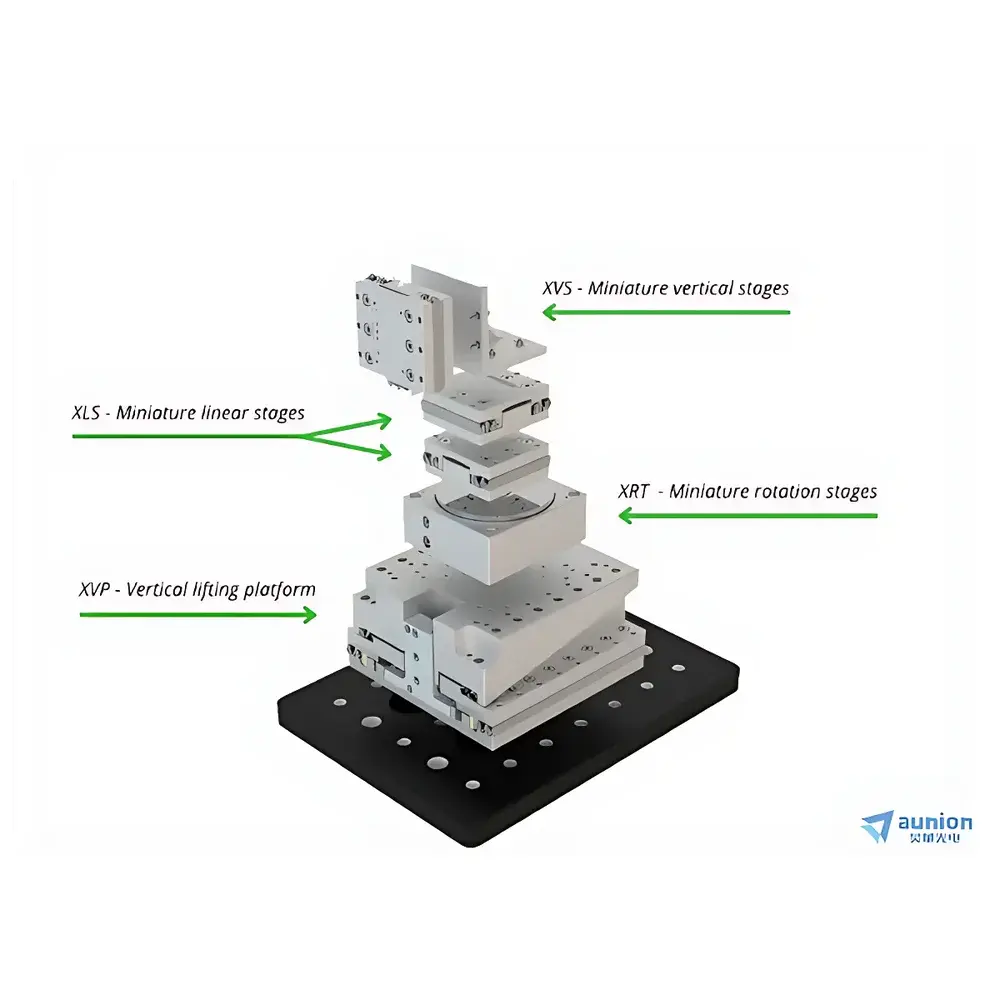
Xeryon Multi-Axis Piezo Nanopositioning Stage
| Brand | Auniontech (HaoLiang) |
|---|---|
| Origin | Belgium |
| Manufacturer Type | Authorized Distributor |
| Origin Category | Imported |
| Model | Xeryon Series Nanopositioning Stage |
| Price | Upon Request |
Overview
The Xeryon Multi-Axis Piezo Nanopositioning Stage is a high-precision motion platform engineered for sub-nanometer positioning stability and dynamic multi-degree-of-freedom control in demanding optical, metrological, and vacuum-integrated applications. Unlike traditional stepper or servo-driven stages, this system employs ultrasonic piezoelectric motor technology—based on the inertial friction drive principle—to achieve direct-drive actuation without gear trains or lead screws. This architecture eliminates backlash, hysteresis, and mechanical compliance, enabling true nanoscale resolution and repeatability under both open-loop and closed-loop operation. Designed for integration into advanced photonics workbenches, semiconductor alignment systems, and in-situ SEM/TEM sample manipulators, the stage supports configurable kinematic architectures including XY, XYZ, X-θ, XY-θ, and full 5-axis (XYZ + θx + θy) configurations. Its compact monolithic construction—each axis weighing under 40 g—ensures minimal thermal drift and high modal stiffness, critical for vibration-sensitive interferometric and scanning applications.
Key Features
- Sub-5 nm linear resolution and 3 µrad angular resolution—verified per ISO 230-2 Annex B under controlled environmental conditions
- High-speed motion: up to 1000 mm/s linear velocity and 720°/s rotational speed, with acceleration exceeding 5 g
- Extended lifetime rating: >1,000 km cumulative travel (linear axes) and >107 revolutions (rotary axes), validated via accelerated wear testing per IEC 60068-2-64
- Modular design supporting custom axis combinations (e.g., Z-θz for tip-tilt focusing, XYZ-θx-θy for adaptive optics beam steering)
- Integrated position feedback options: capacitive sensors (standard), strain-gauge-based encoders, or optical interferometric readouts (optional)
Sample Compatibility & Compliance
The Xeryon nanopositioning stage is compatible with standard optical breadboards (M6/M4 tapped holes), kinematic mounts (K-series), and vacuum feedthrough interfaces. Vacuum-compatible variants are certified for high vacuum (HV, ≤1×10⁻⁶ mbar) and ultra-high vacuum (UHV, ≤1×10⁻⁹ mbar) environments per ISO 10110-7 and ASTM E595 outgassing specifications. Available flange options include D-Sub 15-pin (conforming to MIL-DTL-24308), Fischer 12-pin (IP67-rated), and LEMO 12-pin (Type FGG.1B.304) vacuum feedthroughs. All UHV models undergo helium leak testing (≤1×10⁻¹⁰ mbar·L/s) and are assembled in Class 100 cleanrooms. The stage complies with CE marking requirements under the EU Machinery Directive 2006/42/EC and EMC Directive 2014/30/EU.
Software & Data Management
The stage is fully supported by the XD-C (single-axis) and XD-M (multi-axis) controller families, which provide real-time trajectory generation, S-curve motion profiling, and hardware-triggered synchronization (TTL/RS422). Native drivers are provided for Windows (x64, .NET 6.0+), LabVIEW 2020–2023 (64-bit), MATLAB R2021a–R2024a (via Instrument Control Toolbox), Python 3.8+ (PyPI package xeryon-sdk), and C++17 (header-only API). All SDKs include built-in support for audit trail logging, timestamped motion event capture, and export to HDF5 or CSV formats—enabling traceability in GLP/GMP-regulated environments. Controller firmware implements deterministic real-time scheduling (≤50 µs jitter) and supports FDA 21 CFR Part 11-compliant electronic signatures when deployed with validated IT infrastructure.
Applications
- Active alignment of photonic integrated circuits (PICs) and fiber arrays in telecom transceiver assembly
- Nanoscale sample navigation and focus correction in confocal, STED, and light-sheet microscopy
- In-situ mechanical testing inside SEM/FIB chambers using synchronized stage motion and image acquisition
- Beam pointing stabilization and wavefront correction in adaptive optics systems for astronomy and laser machining
- Precision wafer probing and mask alignment in semiconductor lithography R&D
- Atomic force microscopy (AFM) scanner calibration and reference stage validation
FAQ
What vacuum levels are supported, and what certifications apply?
HV and UHV variants are available; UHV models meet ISO 10110-7 cleanliness standards and are helium-leak tested to ≤1×10⁻¹⁰ mbar·L/s.
Is closed-loop operation mandatory for achieving 5 nm resolution?
Open-loop operation delivers ~10 nm step resolution; capacitive feedback is required for guaranteed 5 nm linearity and hysteresis compensation.
Can the stage be synchronized with external imaging systems?
Yes—hardware trigger I/O (TTL/RS422) enables sub-microsecond timing alignment with cameras, detectors, or laser pulse generators.
Which motion controllers are natively supported beyond XD-M?
Beckhoff TwinCAT 3, Omron NX/NJ-Series, Festo CPX-AP-A, ACS SPiiPlusEC, and Elmo Gold Line controllers are supported via EtherCAT or CANopen profiles.
What is the thermal drift performance over 8 hours at 23°C ambient?
Typical drift is <±15 nm (linear) and <±5 µrad (rotary) after thermal stabilization, measured per ISO 230-3 Annex C.





