
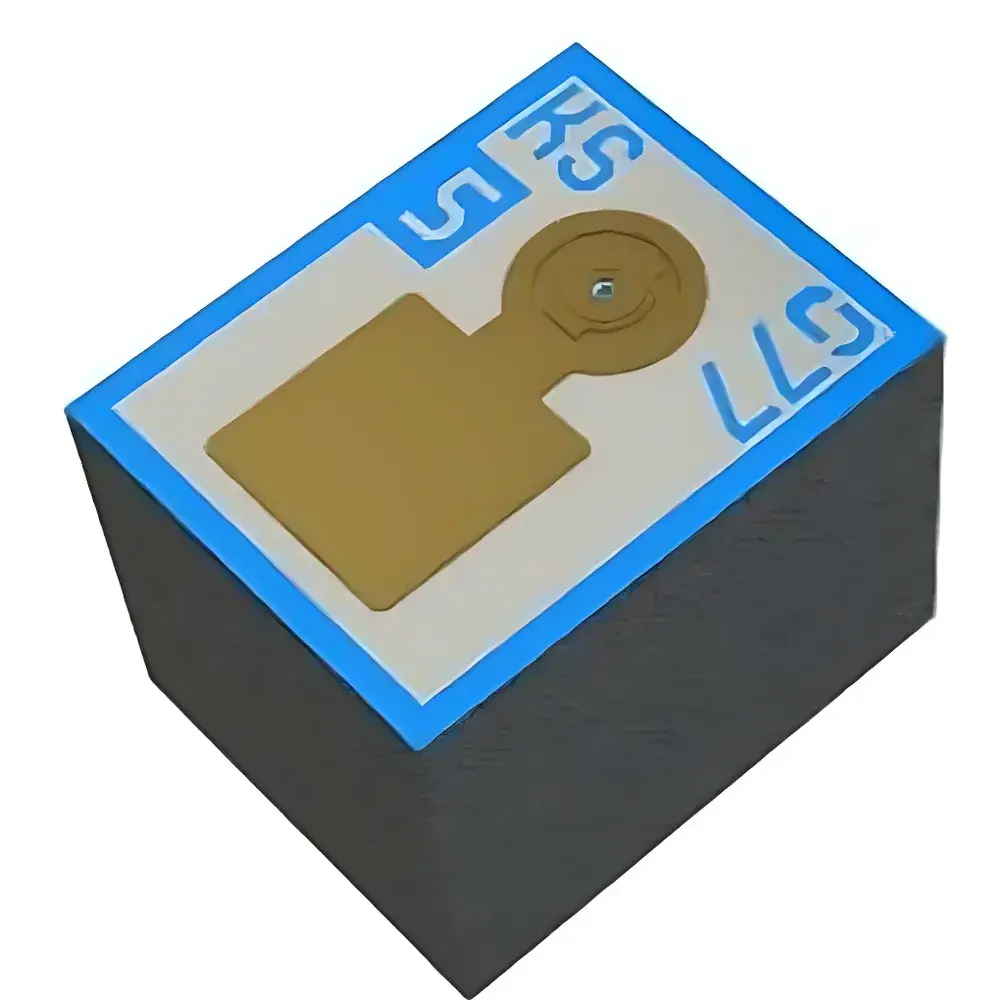
Vixar VCSEL Laser Diode for Atomic Clocks (795 nm & 895 nm)
| Brand | Vixar |
|---|---|
| Origin | USA |
| Manufacturer Type | Authorized Distributor |
| Product Category | Imported |
| Model | VCSEL Laser Diode |
| Core Component | GaAs-based Vertical-Cavity Surface-Emitting Laser |
| Wavelength | 795 nm or 895 nm |
| Output Mode | Single Transverse Mode (TEM₀₀) |
| Spectral Linewidth | <100 MHz (<±0.5 nm) |
| Package Options | Bare Die, PLCC, or TEC-integrated Module |
| Compliance | RoHS, REACH, ISO 9001-certified manufacturing |
Overview
The Vixar VCSEL Laser Diode for Atomic Clocks (795 nm & 895 nm) is a precision semiconductor laser engineered specifically for atomic frequency reference systems requiring ultra-narrow linewidth, high spectral stability, and long-term operational reliability. Operating on the fundamental principle of stimulated emission in gallium arsenide (GaAs)-based vertical-cavity surface-emitting laser (VCSEL) architecture, this device delivers single transverse mode (TEM₀₀) output with intrinsic wavelength accuracy aligned to the D₁ absorption lines of rubidium-87 (795 nm) and cesium-133 (895 nm) — critical transitions used in coherent population trapping (CPT), optical pumping, and laser cooling protocols within compact atomic clocks, chip-scale atomic clocks (CSACs), and quantum sensor platforms. Unlike edge-emitting lasers, VCSELs offer circular, low-divergence beams with inherent wavelength stability under temperature and current modulation, making them ideal for integration into miniaturized vacuum cell assemblies and fiber-pigtailed optical benches compliant with space-constrained metrology environments.
Key Features
- Wavelength options precisely matched to atomic resonance lines: 795 nm (⁸⁷Rb D₁ line) and 895 nm (¹³³Cs D₁ line)
- Ultra-narrow spectral linewidth: <100 MHz (equivalent to ±0.5 nm at specified wavelength), enabling high-fidelity optical interrogation of hyperfine ground-state transitions
- Single transverse mode (TEM₀₀) operation ensures diffraction-limited beam quality and efficient coupling into atomic vapor cells or optical fibers
- High side-mode suppression ratio (>30 dB) and low relative intensity noise (RIN < −140 dB/Hz) support low-phase-noise microwave synthesis via optical heterodyning
- Flexible packaging: available as bare die for hybrid integration, PLCC-20 surface-mount package for PCB-level assembly, or hermetically sealed TEC-integrated modules for active thermal stabilization
- Qualified for extended lifetime operation (>50,000 hours MTTF) under controlled drive conditions, meeting MIL-STD-750 and Telcordia GR-468-CORE reliability standards
Sample Compatibility & Compliance
This VCSEL diode is compatible with standard alkali metal vapor cells (Rb, Cs) sealed in borosilicate glass or sapphire windows, and supports both free-space and fiber-coupled optical configurations. Its spectral purity and power stability meet requirements for traceable timekeeping per ITU-R TF.460-6 and IEEE Std 1139-2008 for frequency standard instrumentation. Manufacturing adheres to ISO 9001:2015 quality management systems, and all devices are RoHS 2011/65/EU and REACH (EC 1907/2006) compliant. For regulated laboratory or aerospace deployment, full traceability documentation—including wafer lot IDs, burn-in reports, and individual device spectral characterization data—is provided upon request to support GLP/GMP audit readiness.
Software & Data Management
While the VCSEL operates as a hardware component without embedded firmware, it is fully compatible with industry-standard laser driver platforms (e.g., Thorlabs LDCxx series, Wavelength Electronics QCL series) supporting analog/digital modulation, closed-loop temperature control (via integrated TEC interface), and real-time current/voltage monitoring. Vixar provides comprehensive datasheets, spectral tuning curves (wavelength vs. temperature/current), and aging test reports in PDF and CSV formats. For system integrators developing automated calibration routines, Vixar offers application notes on lock-point optimization using saturated absorption spectroscopy and PID loop configuration for sub-mK thermal regulation—enabling seamless integration into LabVIEW, Python (PyVISA), or MATLAB-based control architectures compliant with IEEE 1588 PTP or NIST-traceable time synchronization workflows.
Applications
- Primary and secondary frequency standards: chip-scale atomic clocks (CSACs), miniature rubidium oscillators, and cold-atom fountain clock local oscillators
- Quantum sensing: optically pumped magnetometers (OPMs), atomic gyroscopes, and spin-exchange relaxation-free (SERF) magnetometers
- Coherent population trapping (CPT) physics experiments and educational quantum optics setups
- Frequency comb stabilization via offset-locking to atomic references
- Space-qualified timing modules for CubeSat navigation and deep-space communication beacons
FAQ
What is the typical threshold current and slope efficiency for these VCSELs?
Typical threshold current ranges from 0.8–1.2 mA; slope efficiency is 0.25–0.35 W/A depending on package type and operating temperature.
Can these VCSELs be modulated at GHz frequencies for CPT signal generation?
Yes — intrinsic modulation bandwidth exceeds 10 GHz, supporting direct RF modulation up to 3–5 GHz for CPT sideband generation without external EOMs.
Is wavelength calibration traceable to NIST standards?
Each production lot undergoes spectral verification using a calibrated wavemeter traceable to NIST SRM-2034; calibration certificates are available upon request.
Do you provide fiber-pigtailed versions?
Fiber coupling is supported through third-party integration partners; Vixar offers alignment-ready PLCC packages optimized for SMF-28 or PM fiber coupling with <0.5 dB insertion loss.
Are these VCSELs suitable for use in vacuum or radiation-hardened environments?
Bare-die and ceramic-packaged variants have been validated for operation at 10⁻⁶ Torr vacuum; radiation tolerance testing (10 krad(Si) total ionizing dose) is available under custom qualification programs.



