
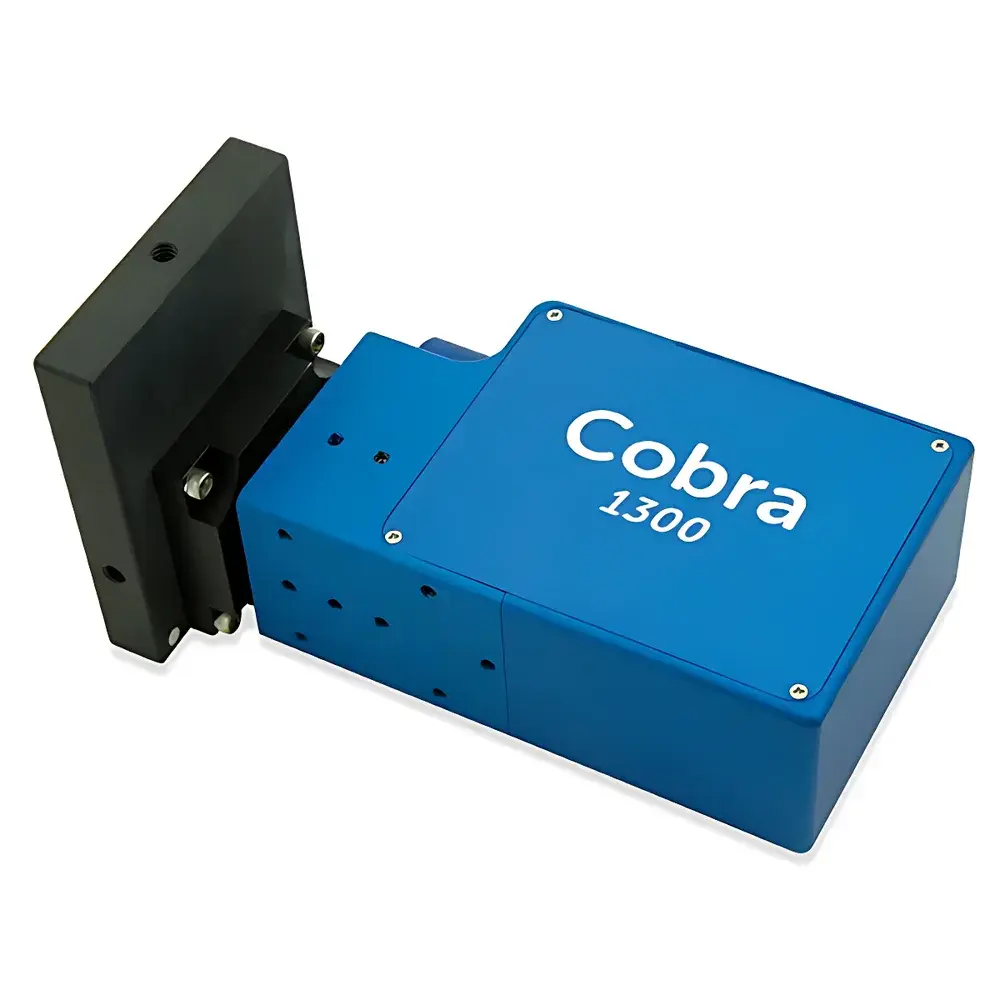
Wasatch Photonics Cobra 1300 OCT Spectrometer
| Brand | Wasatch Photonics |
|---|---|
| Origin | USA |
| Model | C1300 Series |
| Wavelength Range | 950–1450 nm |
| Spectral Bandwidth Options | 73–500 nm |
| Max Line Rate | 147 kHz |
| Detector | Sensors Unlimited GL2048 (2048 px) |
| Interface | Camera Link |
| Optical Design | VPH grating-based, diffraction-limited |
| Polarization Dependence | Low |
| Field Depth (theoretical, in air) | 1.4–11.5 mm |
| Applications | Ophthalmic anterior segment imaging, dermatology, intravascular OCT, subsurface material characterization, preclinical research |
Overview
The Wasatch Photonics Cobra 1300 OCT Spectrometer is a high-performance, line-scan spectrometer engineered for spectral-domain optical coherence tomography (SD-OCT) systems operating in the 1300 nm wavelength window. Leveraging volume phase holographic (VPH) grating technology and near-diffraction-limited optical design, the Cobra 1300 delivers exceptional throughput, low polarization sensitivity, and high spectral fidelity—critical for maximizing axial resolution and signal-to-noise ratio (SNR) in deep-tissue imaging. Unlike conventional spectrometers constrained by the trade-off between imaging depth and lateral clarity, the Cobra 1300’s optimized optical architecture preserves sub-pixel spectral sampling across its full bandwidth, enabling robust reconstruction of interference fringes from highly scattered or multiply backscattered light. This capability directly translates to extended imaging depth (up to 11.5 mm theoretical field depth in air), improved contrast at depth, and enhanced sensitivity for detecting subtle structural variations in biological and industrial samples.
Key Features
- Wide operational wavelength range: configurable models spanning 950–1450 nm, with bandwidth options from 73 nm to 500 nm
- VPH grating optics providing >90% diffraction efficiency and <0.5% polarization-dependent loss (PDL)
- Sub-pixel spectral sampling enabled by precise collimation and aberration-corrected imaging optics
- High-speed line rates up to 147 kHz, compatible with real-time volumetric OCT acquisition
- Compact, monolithic aluminum housing with passive thermal stabilization (±0.05 °C drift over 8 h at constant ambient)
- OEM-optimized mechanical and electrical interface: standardized Camera Link output, integrated trigger I/O, and M4 mounting features
- Modular configuration system: 10 distinct part-number variants defined by center wavelength (CWL), bandwidth (BW), line rate, and detector format
Sample Compatibility & Compliance
The Cobra 1300 supports non-contact, label-free, micron-resolution cross-sectional imaging of optically scattering media—including corneal tissue, dermal layers, polymer composites, and semiconductor thin films. Its 1300 nm spectral window offers optimal balance between water absorption and scattering attenuation in biological tissues, making it suitable for anterior eye imaging (e.g., cornea, iris, lens), intravascular catheter-based OCT, and dermatological lesion assessment. The spectrometer complies with ISO 13485–2016 design control requirements for medical device components and meets electromagnetic compatibility standards per FCC Part 15 Subpart B and CE EN 61326-1. When integrated into Class II OCT systems, it supports traceable calibration protocols aligned with ANSI Z80.10 (ophthalmic instruments) and ASTM F2758 (standard guide for OCT system performance testing).
Software & Data Management
The Cobra 1300 operates as a core hardware component within SD-OCT platforms and does not include embedded firmware or proprietary acquisition software. It outputs raw linearized spectral data via Camera Link to host systems running third-party or custom-developed OCT reconstruction pipelines (e.g., MATLAB-based Fourier-domain processing, CUDA-accelerated GPU engines). Wasatch Photonics provides comprehensive SDK documentation—including register maps, timing diagrams, and spectral calibration files (wavelength vs. pixel lookup tables)—to facilitate integration with LabVIEW, Python (via GenICam-compliant drivers), or C++ frameworks. All calibration data are traceable to NIST-traceable broadband sources and include uncertainty budgets per ISO/IEC 17025 guidelines. Audit trails, user access controls, and electronic signatures can be implemented at the system level to satisfy FDA 21 CFR Part 11 and EU Annex 11 requirements when deployed in GxP-regulated environments.
Applications
- Ophthalmology: High-resolution anterior segment imaging for keratoconus staging, corneal graft monitoring, and intraoperative OCT guidance
- Dermatology: Non-invasive assessment of epidermal thickness, inflammatory infiltration, and tumor margin delineation
- Cardiovascular diagnostics: Intravascular OCT (IVOCT) for stent apposition analysis and plaque characterization
- Preclinical research: Longitudinal monitoring of murine skin wound healing, tumor xenograft microstructure, and neural tissue development
- Industrial metrology: Subsurface defect detection in coated polymers, delamination mapping in laminates, and thickness profiling of transparent multilayers
- Pharmaceutical development: Real-time quantification of transdermal drug diffusion kinetics and hydrogel swelling dynamics
FAQ
What determines the effective imaging depth in biological tissue?
Imaging depth is governed by both spectrometer bandwidth (axial resolution) and system SNR (penetration limit). While the Cobra 1300’s theoretical field depth is calculated in air, actual penetration in tissue depends on sample scattering coefficient, system power budget, and detector quantum efficiency.
Can the Cobra 1300 be integrated into a swept-source OCT system?
No—it is designed exclusively for spectral-domain OCT architectures requiring line-scan spectral dispersion. Swept-source systems require tunable laser sources and single-point photodetectors.
Is factory recalibration required after mechanical shock or temperature cycling?
The monolithic optical bench and passive thermal management minimize drift; however, periodic verification using a stabilized broadband source is recommended every 6 months for GMP applications.
Do you provide spectral calibration certificates with NIST traceability?
Yes—each unit ships with a certificate of calibration including wavelength accuracy (±0.15 nm), pixel-to-wavelength mapping residuals (<0.02 px RMS), and measurement uncertainty budget.
Are custom configurations available beyond the 10 standard models?
Yes—Wasatch Photonics offers engineering support for bespoke CWL, bandwidth, or interface adaptations (e.g., CoaXPress, CLHS) under NDA and OEM agreement terms.





