
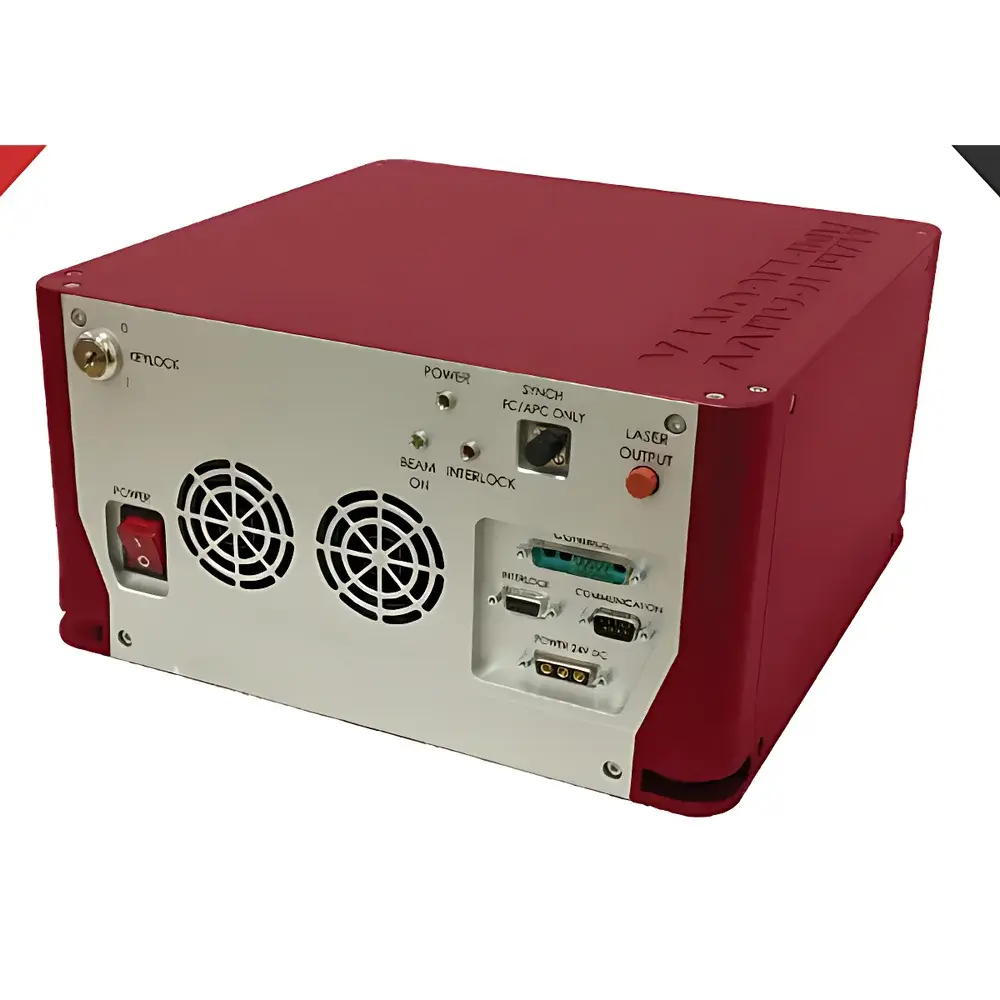
Auniontech 532 nm Narrow-Linewidth Picosecond Laser System (FWHM < 100 pm)
| Brand | Auniontech |
|---|---|
| Origin | Shanghai, China |
| Model | Scientific-Grade Picosecond Laser for Time-Resolved Raman Spectroscopy |
| Center Wavelength | 532 nm |
| Pulse Width (FWHM) | 50–100 ps |
| Repetition Rate | 100 kHz – 1 MHz |
| Average Power | 800–1500 mW |
| Pulse Energy | 0.8–1.5 µJ |
| Spectral Linewidth (FWHM, 3 dB) | < 0.1 nm (< 100 pm) |
| Polarization | Linear, Extinction Ratio ≥ 40 dB |
| Beam Diameter (1/e²) | 0.8 mm |
Overview
The Auniontech 532 nm Narrow-Linewidth Picosecond Laser System is a fiber-based, diode-pumped solid-state (DPSS) laser engineered for high-fidelity time-resolved Raman spectroscopy (TRRS), ultrafast pump-probe experiments, and precision photonic material interaction studies. Operating at the fundamental second-harmonic wavelength of 532 nm, the system leverages a master oscillator power amplifier (MOPA) architecture with a tapered double-clad fiber (T-DCF) amplifier stage followed by intracavity or external second-harmonic generation (SHG) in a nonlinear crystal (e.g., LBO or BBO). This design ensures exceptional spectral purity—achieving FWHM linewidths < 100 pm (< 0.1 nm)—while maintaining temporal fidelity with pulse durations tunable between 50 ps and 100 ps (FWHM, 3 dB). The laser delivers up to 1.5 µJ pulse energy at repetition rates adjustable from 100 kHz to 1 MHz, enabling flexible trade-offs between signal-to-noise ratio and temporal sampling density. Its compact, air-cooled, all-fiber-integrated platform supports benchtop integration into vacuum-compatible optical tables, confocal microscopes, and custom TRRS spectrometers without requiring water cooling or complex alignment.
Key Features
- Ultra-narrow optical bandwidth: < 100 pm FWHM (3 dB), optimized for high-resolution vibrational spectroscopy and coherent anti-Stokes Raman scattering (CARS) excitation
- Precisely controllable pulse duration: factory-selectable 50 ps or 100 ps (FWHM); optional post-compression modules available for sub-30 ps operation
- Stable average output: 1.0 W typical at 1 MHz, with RMS power stability < 0.7% over 8 hours (23 °C ambient, ±0.5 °C)
- High polarization fidelity: linear polarization with extinction ratio > 40 dB, enabling efficient coupling into polarizing beam splitters and waveplates
- Robust MOPA architecture: all-fiber seed oscillator + T-DCF amplifier eliminates free-space alignment drift and improves long-term pointing stability
- Comprehensive digital control interface: RS-232 and USB 2.0 ports support remote triggering, repetition rate sweeping, and real-time monitoring of diode current, temperature, and output power
Sample Compatibility & Compliance
This laser system is designed for use with standard Raman spectrometers equipped with gated ICCD or SPAD detectors, as well as ultrafast transient absorption setups requiring synchronized pump pulses. It complies with IEC 60825-1:2014 Class 4 laser safety requirements when operated within specified enclosure configurations. Beam delivery meets ISO 11146-1:2005 beam quality standards (M² < 1.3). For regulated environments—including GLP-compliant analytical laboratories and FDA-regulated pharmaceutical development—the system supports optional audit-trail-enabled firmware (compatible with 21 CFR Part 11 Annex 11 workflows) via third-party data acquisition software integration. All optical components conform to RoHS 2011/65/EU and REACH SVHC criteria. No hazardous substances are used in active gain media or nonlinear crystals.
Software & Data Management
The laser includes embedded firmware with a command-line protocol (ASCII-based SCPI subset) for integration into LabVIEW, MATLAB, Python (PySerial), or EPICS control environments. Optional Auniontech Laser Control Suite (v3.2+) provides GUI-based parameter scripting, pulse train diagnostics (pulse-to-pulse jitter < 200 fs RMS), and automated calibration logging. Raw operational logs—including timestamped diode drive current, thermistor readings, and interlock status—are exportable in CSV format for traceability. When paired with compatible spectrometers (e.g., Horiba XploRA, Renishaw inVia), the system synchronizes via TTL trigger input (5 V CMOS, ≤ 10 ns rise time) and offers programmable delay lines for pump–probe delay scanning from 0 to 5 ns with 10 ps resolution.
Applications
- Time-resolved Raman spectroscopy (TRRS) of photoexcited states in semiconductors, perovskites, and molecular catalysts
- Ultrafast photoluminescence lifetime mapping in 2D materials (e.g., MoS₂, WS₂) and quantum dots
- Nonlinear optical microscopy: CARS and SRS imaging with minimized spectral crosstalk due to narrow bandwidth
- Micro-machining of transparent dielectrics (fused silica, sapphire) where thermal diffusion must be suppressed
- Pump–probe transient absorption spectroscopy of charge carrier dynamics in organic photovoltaics
- Calibration source for high-resolution wavelength meters (e.g., HighFinesse WSx series) and Fabry–Pérot interferometers
FAQ
Is this laser suitable for integration into an existing ultrafast spectroscopy setup?
Yes—the system provides TTL-synchronized output with jitter < 300 ps, low-amplitude noise (< 0.5% RMS), and a stable spatial mode (TEM₀₀), facilitating straightforward coupling into single-mode fibers or free-space delay lines.
Can pulse energy be adjusted without changing repetition rate?
Yes—via internal analog modulation of the seed diode current, pulse energy is continuously tunable from 0.2 µJ to full scale while maintaining fixed repetition rate and pulse width.
What is the expected lifetime of the SHG crystal under continuous operation?
LBO crystals are rated for > 20,000 hours at 532 nm with proper thermal management; accelerated aging tests show no measurable degradation in conversion efficiency after 5,000 hours at 1 W average power.
Does the system include beam collimation optics?
Yes—a kinematically mounted, AR-coated (532 nm) collimator is integrated into the output module, delivering a collimated 0.8 mm (1/e²) beam with divergence < 1.2 mrad.
Are OEM integration options available?
Yes—custom mechanical housings, electrical interfaces (LVDS, Ethernet), and firmware adaptations (e.g., EtherCAT motion synchronization) are supported under NDA for volume OEM deployments.




