
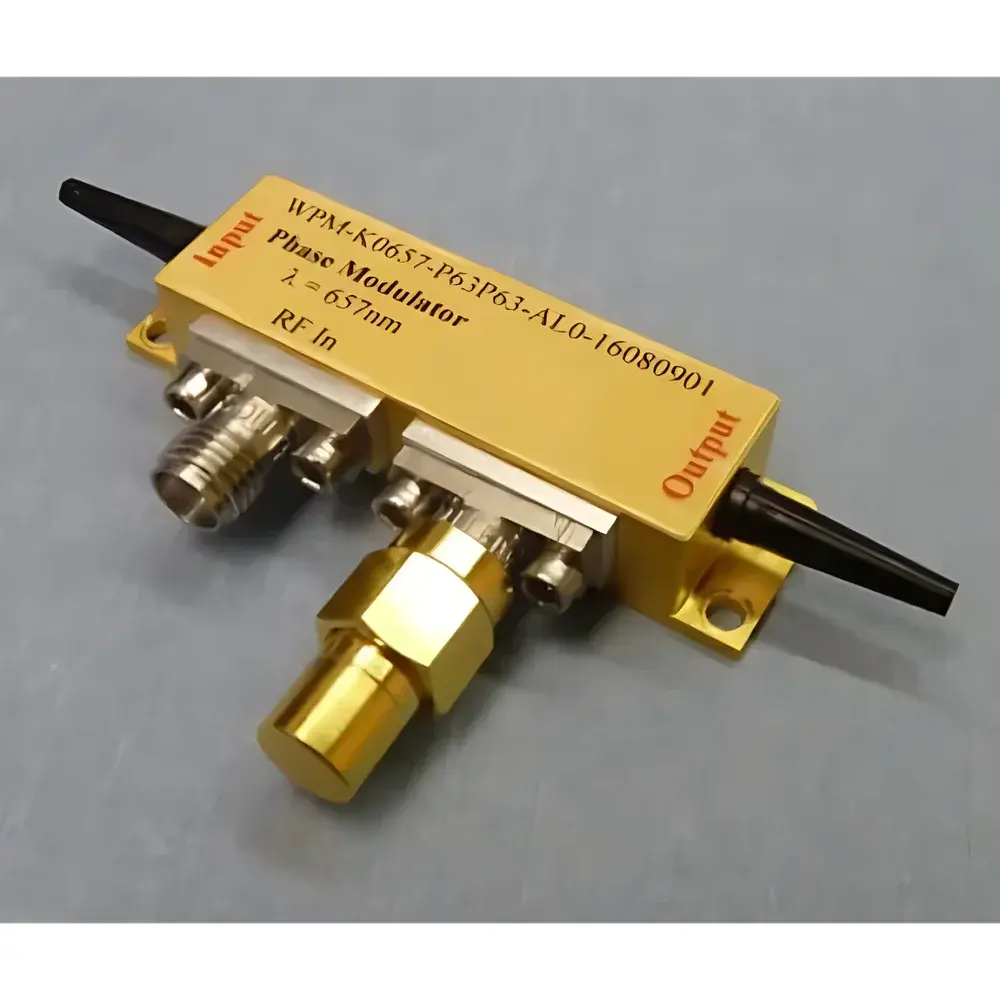
Auniontech KTP-Based Fiber-Coupled Electro-Optic Phase Modulator for Visible Wavelengths
| Brand | Auniontech |
|---|---|
| Origin | Shanghai, China |
| Model | KTP-PM-VIS Series |
| Wavelength Range | 397–780 nm (Visible to Near-UV) |
| 3 dB Bandwidth | 5 GHz or 10 GHz (selectable) |
| Vπ | ≤ 8 V (at 780 nm), ≤ 5 V (at 400–532 nm), ≤ 6 V (at 556–630 nm), ≤ 7 V (at 657–730 nm), ≤ 10 V (at 1064 nm) |
| Optical Power Handling | ≥ 250 mW |
| Insertion Loss | ≤ 4 dB |
| Polarization-Maintaining Fiber | PM400, PM480, PM630, PM780, PM850, PM980 (250 µm buffered) |
| Connector | FC/APC |
| Compliance | RoHS-compliant housing, GLP-ready optical alignment documentation |
Overview
The Auniontech KTP-Based Fiber-Coupled Electro-Optic Phase Modulator for Visible Wavelengths is a precision photonic component engineered for high-fidelity phase modulation in atomic physics, quantum optics, and laser stabilization applications. It leverages titanium-diffused potassium titanyl phosphate (KTP) waveguide technology to achieve low half-wave voltage (Vπ) and broad spectral coverage across the visible and near-ultraviolet spectrum (397–780 nm), with extended operation up to 1064 nm. Unlike bulk-crystal modulators, this device integrates monolithic KTP waveguides directly with polarization-maintaining (PM) single-mode fiber pigtails—enabling stable, alignment-free coupling into fiber-based optical systems. The electro-optic effect in KTP provides linear, broadband phase response with minimal thermal drift and high optical damage threshold (>250 mW CW), making it suitable for demanding ultra-stable laser systems where sub-radian phase noise and long-term repeatability are critical.
Key Features
- Monolithic titanium-diffused KTP waveguide platform for low Vπ and high electro-optic efficiency
- Wide operational wavelength range: 397 nm (Ca+ cooling line) to 780 nm (Rb D2 line), with optional extension to 1064 nm
- Configurable 3 dB modulation bandwidth: 5 GHz standard; 10 GHz variant available for high-speed feedback loops
- Polarization-maintaining fiber options: PM400 (397–532 nm), PM480 (480–556 nm), PM630 (630–730 nm), PM780/PM850 (780–1064 nm)
- Low insertion loss (≤ 4 dB) and high return loss (>55 dB) ensured by FC/APC connectors and anti-reflection coated facets
- Hermetically sealed, RoHS-compliant aluminum housing with thermal stabilization design for laboratory and OEM integration
- Factory-calibrated Vπ values traceable to NIST-traceable power and wavelength references
Sample Compatibility & Compliance
This modulator is optimized for use with continuous-wave (CW) diode lasers, external-cavity diode lasers (ECDLs), and frequency-doubled solid-state lasers operating in atomic spectroscopy regimes—including but not limited to 87Rb (780 nm), 85Rb (780 nm), 40Ca+ (397 nm / 866 nm), 171Yb+ (369 nm), and neutral strontium (461 nm). Its mechanical and optical interface complies with ISO 10110 surface quality standards for waveguide facets and adheres to IEC 61290-1 for optical amplifier test methods. All units undergo 100% optical power handling verification at rated wavelength and temperature (23 ± 2 °C), and full test reports—including Vπ, bandwidth, and polarization extinction ratio (PER > 25 dB)—are supplied with each shipment. Documentation supports GLP/GMP audit requirements, including calibration history, environmental test logs, and fiber pigtail certification per Telcordia GR-1209-CORE.
Software & Data Management
While the modulator itself is a passive electro-optic transducer requiring no embedded firmware, its integration into closed-loop control architectures is supported via industry-standard analog interfaces. It is routinely deployed with PID controllers (e.g., Stanford Research Systems SIM960), arbitrary waveform generators (Keysight 33600A series), and real-time FPGA platforms (NI PXIe-7976R) for Pound-Drever-Hall (PDH) locking, sideband generation, and coherent population trapping. Auniontech provides detailed electrical impedance matching guidelines (50 Ω RF input, DC-coupled), thermal derating curves, and S-parameter models (up to 10 GHz) for SPICE and ADS simulation. For system-level validation, users may request traceable measurement datasets—including phase vs. voltage transfer functions and harmonic distortion spectra—at specified wavelengths and bias points.
Applications
- Laser frequency stabilization using PDH or FM spectroscopy techniques in atomic fountain clocks and optical lattice experiments
- Coherent control of trapped ions (e.g., Ca+, Sr+, Yb+) via sideband addressing and Raman transitions
- Generation of optical sidebands for heterodyne detection, cavity ring-down spectroscopy, and dual-comb interferometry
- Phase-encoded quantum key distribution (QKD) channels in fiber-based QKD testbeds operating below 800 nm
- Active mode-locking and dispersion compensation in femtosecond Ti:sapphire oscillators
- Feedback actuation in ultra-low-noise laser intensity and phase noise suppression systems
FAQ
What is the typical Vπ at 405 nm and how is it measured?
Vπ at 405 nm is typically ≤ 5.2 V (±0.3 V) when measured under 50 Ω matched termination, using a calibrated RF power meter and lock-in referenced to a Mach-Zehnder interferometer output.
Can this modulator be used in vacuum environments?
Yes—the hermetic aluminum housing and epoxy-free fiber termination allow operation in UHV-compatible setups (<10−7 mbar); bake-out up to 80 °C is permitted with prior consultation.
Is custom fiber length or connector type available?
Standard configurations include 1.0 m PM fiber with FC/APC; custom lengths (0.5–3.0 m), alternative connectors (FC/PC, SC/APC), and fiber coiling options are available upon request with lead-time adjustment.
Does Auniontech provide driver electronics compatible with this modulator?
While not bundled, Auniontech recommends and validates compatibility with commercial low-noise bipolar HV amplifiers (e.g., Trek 623B, Piezo Systems HVA200) and supplies application notes for optimal impedance matching and ground-loop mitigation.
How is long-term phase stability characterized?
Phase drift is monitored over 24 h at constant temperature (23.0 ± 0.1 °C) and drive voltage; typical RMS deviation is <0.02 rad for 780 nm operation with thermally stabilized mounting.




