
Auniontech SPAD320 Linear Single-Photon Avalanche Diode (SPAD) Array Detector
| Brand | Auniontech |
|---|---|
| Origin | Shanghai, China |
| Manufacturer Type | Authorized Distributor |
| Product Category | Domestic |
| Model | SPAD320 Photon Counting & Time-Tagging Array Detector |
| Pricing | Available Upon Request |
Overview
The Auniontech SPAD320 is a high-performance linear single-photon avalanche diode (SPAD) array detector engineered for time-resolved photon counting in demanding scientific applications. Based on foundational research from Delft University of Technology and École Polytechnique Fédérale de Lausanne (EPFL), the SPAD320 integrates 320 monolithically fabricated SPAD pixels in a compact linear configuration. It operates on the principle of Geiger-mode avalanche photodetection, enabling deterministic photon arrival time tagging with picosecond-level timing resolution. Unlike conventional PMTs or APDs, the SPAD320 delivers photon-number-resolving (PNR) capability through parallelized pixel readout and integrated time-tagging logic—critical for quantum optics, fluorescence lifetime imaging (FLIM), and intensity correlation spectroscopy. Its active area is optimized for coupling with spectrographs, scanning confocal systems, and time-of-flight optical setups, supporting spectral response from 400 nm to 900 nm.
Key Features
- 320-pixel linear SPAD array with >80% fill factor achieved via proprietary semiconductor process and microlens integration
- Peak photon detection efficiency (PDE) exceeding 50% across visible to near-infrared (400–900 nm)
- Ultra-low dark count rate: <250 cps at room temperature (20–25°C), thermally stabilized via passive heatsinking
- Integrated time-tagging engine with timestamp resolution ≤100 ps (FWHM), supporting histogramming up to 100 MHz sustained event rate
- Photon-number-resolving (PNR) operation enabled by parallel pixel readout and real-time coincidence filtering
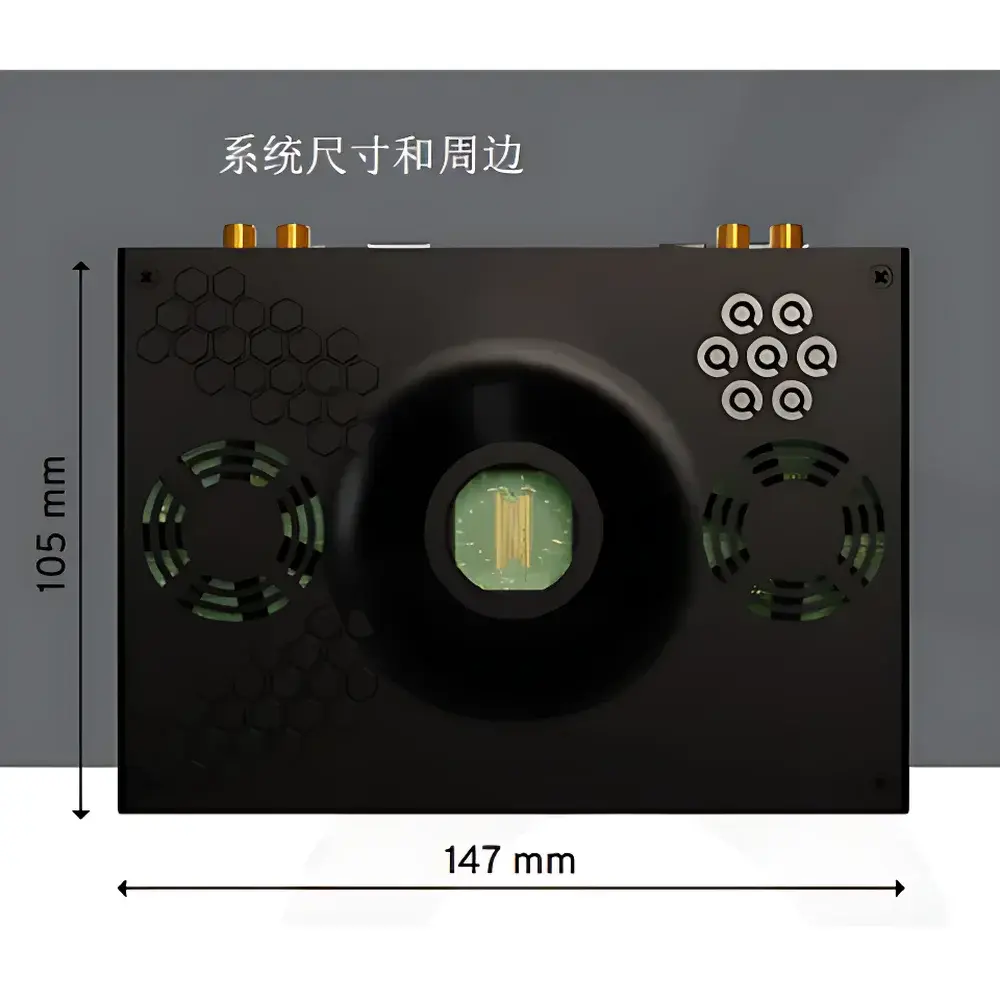
- Compact form factor (≈100 × 60 × 25 mm), powered solely by 5 V USB-C; no external bias supply or cooling required
- Low crosstalk design (<0.1% inter-pixel optical/electrical crosstalk), validated for second- and third-order intensity correlation measurements (g(2), g(3))
Sample Compatibility & Compliance
The SPAD320 is designed for integration into laboratory-grade optical platforms including confocal microscopes, time-correlated single-photon counting (TCSPC) systems, quantum optics testbeds, and fluorescence correlation spectrometers. It interfaces seamlessly with standard C-mount or fiber-coupled spectrograph inputs. The device complies with IEC 61326-1:2013 for electromagnetic compatibility (EMC) in laboratory environments and meets RoHS 2015/863/EU directive requirements. Firmware and driver architecture support audit-ready operation under GLP/GMP-aligned workflows, with optional timestamped metadata logging compatible with FDA 21 CFR Part 11-compliant data management systems when deployed with validated host software.
Software & Data Management
The SPAD320 ships with cross-platform SDKs for Python (PySPAD), MATLAB (SPADToolbox), and LabVIEW (VI libraries), all exposing low-level register access and high-throughput streaming APIs. Raw photon timestamps and pixel IDs are delivered over USB 3.0 at up to 800 MB/s sustained bandwidth. The included TCP/IP server daemon enables remote control and real-time data forwarding—ideal for synchronized multi-instrument experiments. All software modules generate HDF5-formatted output files containing calibrated timestamps, pixel mapping, trigger synchronization markers, and user-defined metadata fields. Optional firmware upgrades support hardware-accelerated histogram binning (up to 16k bins per channel) and on-device coincidence gating (Δt ≤ 1 ns window).
Applications
- Fluorescence Microscopy: Enables image scanning microscopy (ISM), quantum ISM (Q-ISM), STED nanoscopy, and FLIM with sub-diffraction spatial resolution and nanosecond temporal fidelity
- Fluorescence Correlation Spectroscopy (FCS): Supports dual- and multi-channel autocorrelation/cross-correlation analysis for diffusion coefficient quantification and molecular interaction kinetics
- Quantum Optics: Measures anti-bunching (g(2)(0) < 0.5), Hong-Ou-Mandel interference, and multi-photon entanglement signatures with minimal afterpulsing artifacts
- Quantum Random Number Generation (QRNG): Leverages intrinsic quantum randomness of photon arrival times; certified entropy sources meet NIST SP 800-90B standards when post-processed
- Time-of-Flight Sensing: Used in ultrafast laser ranging, diffuse optical tomography, and single-photon LiDAR prototypes requiring high dynamic range and timing precision
FAQ
What is the maximum sustainable photon count rate per pixel?
Each SPAD pixel supports ≥5 Mcps (mega-counts per second) in continuous mode, with global dead time managed via hardware-based arbitration logic.
Does the SPAD320 support time-gated acquisition?
Yes—external TTL triggers synchronize start/stop windows with programmable delay (10 ps steps) and width (1 ns–10 µs), configurable via register write.
Is calibration data provided with each unit?
Yes—factory-measured PDE curves, DCR vs. temperature profiles, and pixel-wise timing offsets are embedded in device EEPROM and accessible via SDK.
Can the SPAD320 be used in vacuum or cryogenic environments?
The standard enclosure is rated for ambient operation (15–35°C, non-condensing); custom hermetic packages with KF flanges are available for UHV-compatible integration.
How is photon-number resolution achieved without analog-to-digital conversion?
PNR relies on statistical multiplexing: incident photon flux is distributed across 320 independent SPADs; photon number per time bin is inferred from the count of simultaneously fired pixels, validated against Poisson statistics.



