
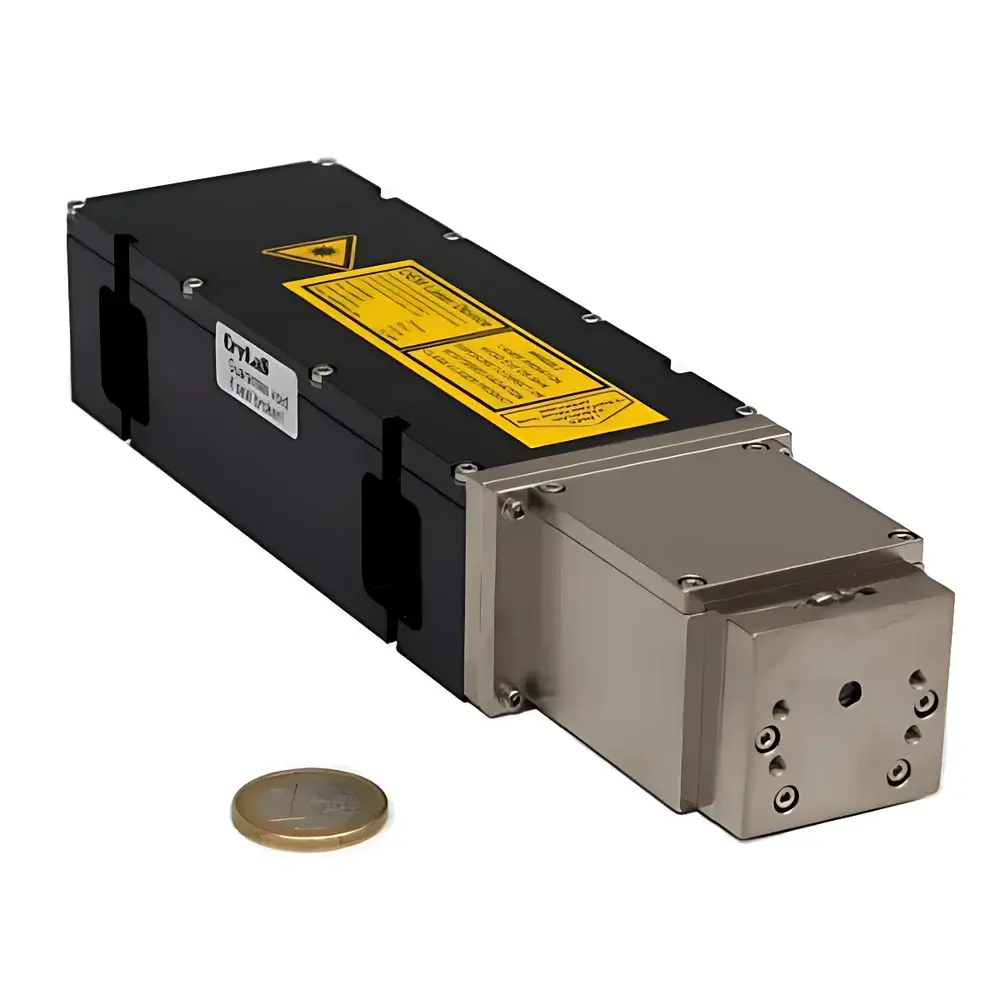
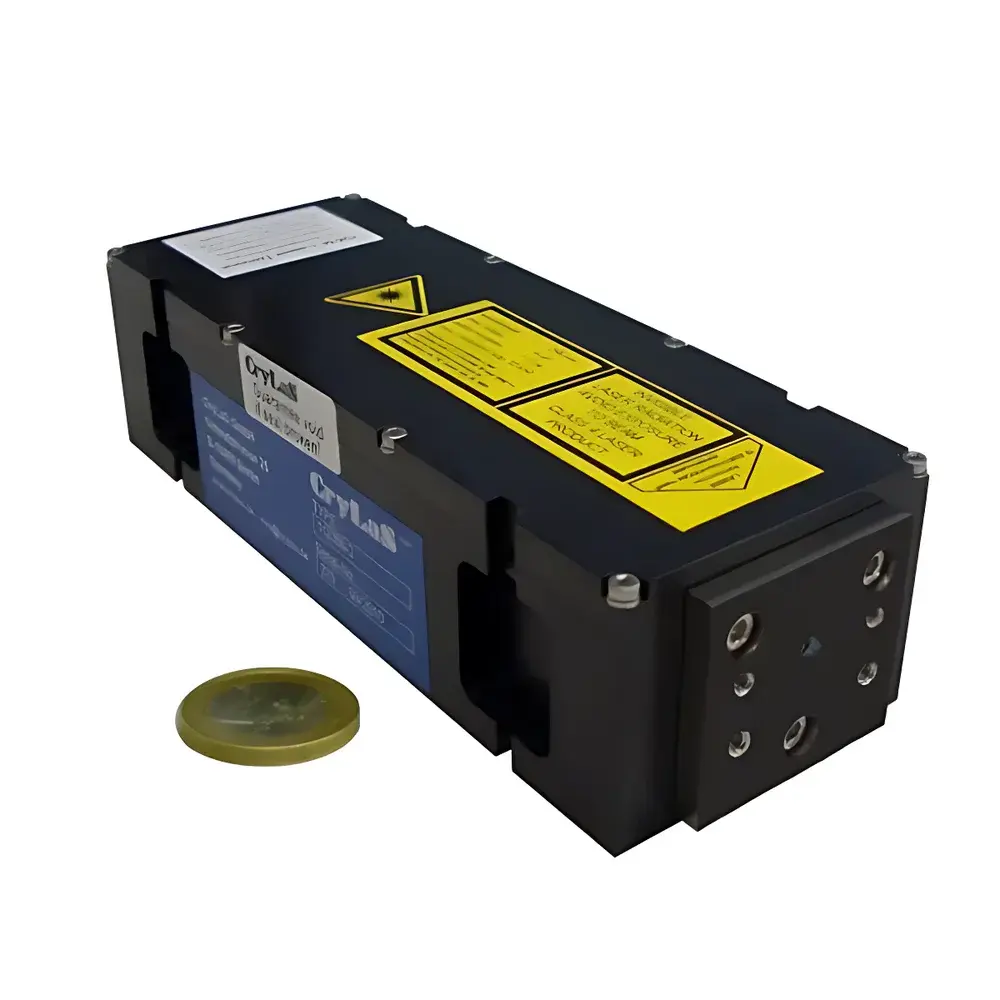
Auniontech FQSS213-Q Series 213 nm Sub-Nanosecond Pulsed DPSS Laser
| Brand | Auniontech |
|---|---|
| Origin | Shanghai, China |
| Type | Diode-Pumped Solid-State (DPSS) Laser |
| Wavelength | 213 nm |
| Pulse Width | ≤1.0 ns |
| Repetition Rate | Up to 20 kHz |
| Single-Pulse Energy | 0.05 µJ–2.5 µJ (model-dependent) |
| Peak Power | 0.05–2.5 kW |
| Beam Mode | TEM₀₀ |
| Beam Divergence | < 2.0–3.0 mrad |
| Beam Diameter | 400 ± 200 µm |
| Pulse Energy Stability | < ±5% |
| Output Configuration | Internal/External Triggering |
| Enclosure | Sealed NLO Crystal Capsule |
| Compliance | Designed for laboratory-grade optical metrology and analytical instrumentation environments |
Overview
The Auniontech FQSS213-Q Series is a compact, diode-pumped solid-state (DPSS) laser system engineered to deliver stable, sub-nanosecond pulses at the deep ultraviolet (DUV) wavelength of 213 nm. Based on passive Q-switching using a monolithic microchip resonator—comprising an Nd:YAG gain medium bonded directly to a Cr:YAG saturable absorber—the laser achieves intrinsic pulse formation without active electronics in the cavity. Fundamental 1064 nm emission undergoes quadruple frequency conversion via nonlinear optical (NLO) crystals housed in hermetically sealed, particle-resistant capsules, ensuring long-term stability against environmental degradation and UV-induced damage. With photon energy of ~5.8 eV, the 213 nm output enables efficient photoionization of small molecules, direct bandgap excitation in wide-bandgap semiconductors (e.g., GaN, SiC, diamond), and non-thermal ablation of transparent dielectrics including fused silica and optical glasses. Its short pulse duration (<1 ns), high peak power (up to 2.5 kW), and excellent spatial coherence (TEM₀₀ mode) make it suitable for time-resolved photoluminescence, aerosol mass spectrometry, and precision micromachining where minimal thermal diffusion is critical.
Key Features
- Deep-UV output at 213 nm with high photon energy (~5.8 eV) enabling single-photon ionization and wide-bandgap material excitation
- Passively Q-switched microchip architecture delivering intrinsic sub-nanosecond pulses (≤1.0 ns FWHM) without external modulation
- Four calibrated models (FQSS213-Q1 to Q4_1k) optimized for distinct pulse energy/repetition rate trade-offs: 0.05 µJ @ 15 kHz up to 2.5 µJ @ 1 kHz
- TEM₀₀ spatial profile with beam divergence < 2.0–3.0 mrad and collimated output diameter of 400 ± 200 µm
- Hermetically sealed NLO crystal module protecting frequency-conversion stages from humidity, particulates, and UV-induced aging
- Integrated internal trigger generator and TTL-compatible external synchronization input for precise timing control in pump-probe or gated detection setups
- Compact OEM-ready form factor: laser head and controller designed for integration into analytical instruments, mass spectrometers, or Raman platforms
Sample Compatibility & Compliance
The FQSS213-Q series is compatible with standard optical tables, vacuum-compatible sample chambers (when equipped with appropriate DUV-transmissive windows), and commercial time-of-flight mass spectrometers requiring nanosecond-scale gating. Its stable pulse-to-pulse energy (< ±5% RMS over 8 hours) meets requirements for quantitative aerosol analysis per ISO 21501-4 and ASTM E2581 for laser desorption/ionization sources. The sealed optical path and low outgassing housing support operation in cleanroom-class environments (ISO Class 5 or better). While not certified to IEC 60825-1:2014 Class 4 laser safety standards out-of-the-box, the system complies with engineering controls required for embedded use in CE-marked analytical instruments (EN 61000-6-3, EN 61000-6-4). Full documentation—including alignment procedures, beam profiling reports, and thermal management guidelines—is provided for GLP/GMP-aligned instrument qualification protocols.
Software & Data Management
The laser operates as a stand-alone hardware module with no proprietary software dependency. All operational parameters—including repetition rate selection, trigger mode (internal/external), and pulse enable/disable—are controlled via 5 V TTL signals or optional RS-232 interface (ASCII command set available upon request). Pulse timing jitter is < 100 ps RMS, enabling synchronization with picosecond-resolution detectors or delay generators. For system integrators, Auniontech provides detailed electrical pinouts, timing diagrams, and mechanical drawings compliant with IPC-7351B footprint standards. Firmware updates (if applicable) are delivered via UART bootloader; no cloud connectivity or remote access functionality is implemented, preserving data integrity in regulated lab environments subject to FDA 21 CFR Part 11 or EU Annex 11 requirements.
Applications
- Aerosol time-of-flight mass spectrometry (ATOFMS): 213 nm photons provide soft, single-photon ionization of organic and inorganic aerosols with minimal fragmentation
- Time-resolved photoluminescence (TRPL) in wide-bandgap semiconductors: sub-ns pulses resolve carrier recombination dynamics in GaN, AlN, and perovskite thin films
- Deep-UV Raman spectroscopy: enhanced resonance effects for carbon nanotube chirality identification and graphene layer counting
- Marking and micro-engraving of fused silica, BK7, and sapphire optics: non-thermal ablation preserves subsurface integrity and eliminates recast layers
- Laser-induced fluorescence (LIF) of aromatic biomolecules (e.g., tryptophan, NADH) with reduced photobleaching compared to 266 nm excitation
- Calibration source for DUV photodetectors and spectroradiometers traceable to NIST SRM 2241
FAQ
What is the typical lifetime of the NLO crystals under continuous operation?
The sealed capsule design extends crystal lifetime beyond 10⁹ shots at rated pulse energy; accelerated aging tests indicate >2 years of daily lab use at 10 kHz average operation.
Can the laser be fiber-coupled?
Yes—optional UV-grade fused silica fiber coupling (200 µm core, NA 0.12) is available with FC/PC or SMA905 termination; coupling efficiency exceeds 65% at 213 nm.
Is cooling required?
Air-cooling is sufficient for all models; no water chiller or thermoelectric cooler is needed. Ambient temperature must be maintained between 15–30 °C with <60% non-condensing humidity.
Does the system support burst-mode operation?
No—pulse train generation is limited to continuous periodic output. Burst triggering requires external pulse picking or AOM gating upstream of the laser head.
What safety interlocks are included?
Standard configuration includes key switch, emission indicator LED, and interlock loop (24 V DC, 1 A max) compliant with IEC 61508 SIL1 for integration into larger safety-rated systems.



