
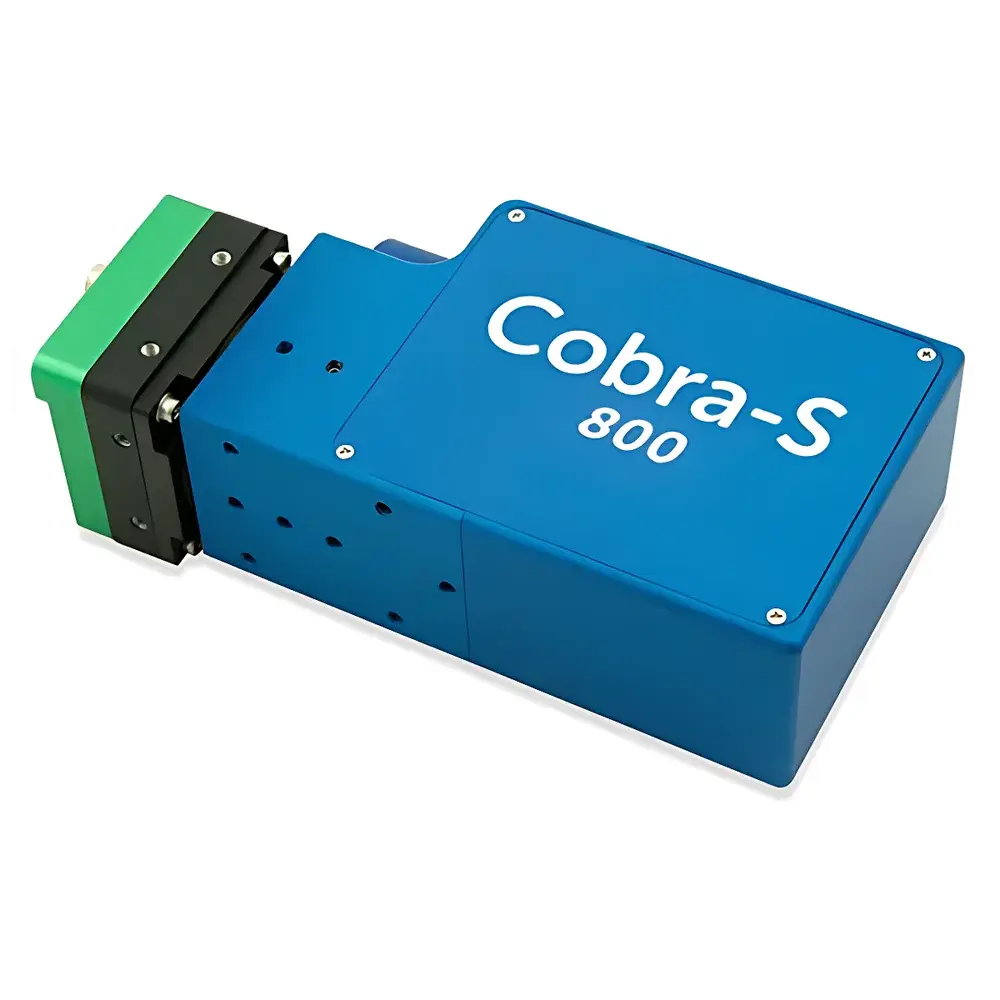
Wasatch Photonics Cobra-S 800 Spectral Domain Optical Coherence Tomography (SD-OCT) Spectrometer
| Brand | Wasatch Photonics |
|---|---|
| Origin | USA |
| Model | CS800 Series |
| Wavelength Range | 650–950 nm |
| Scan Rate | 250 kHz |
| Interface Options | USB 3.0 or Camera Link |
| Imaging Depth (air) | 1.1–12.9 mm |
| Spectral Resolution | 0.015–0.15 nm |
| Pixel Count | 2048 |
| Compliance | CE, RoHS |
| Application Domain | Research, OEM Integration, Industrial Metrology, Biomedical Imaging |
Overview
The Wasatch Photonics Cobra-S 800 is a high-performance spectral domain optical coherence tomography (SD-OCT) spectrometer engineered for ultra-high-speed, high-fidelity interferometric imaging across the visible to near-infrared spectrum. Based on Fourier-domain detection principles, it captures interference spectra from broadband light reflected from sample and reference arms, enabling axial depth profiling with micrometer-scale resolution. Unlike time-domain OCT systems, the Cobra-S 800 acquires full depth scans (A-lines) in a single exposure via dispersive spectroscopy—eliminating mechanical scanning and significantly improving acquisition speed and signal stability. Its core architecture integrates a volume phase holographic (VPH) diffraction grating, diffraction-limited optics, and a thermally stabilized optomechanical platform to ensure long-term wavelength calibration stability (< ±0.005 nm/°C drift) and minimal polarization-dependent loss (< 0.2 dB). Designed for both benchtop research and embedded OEM deployment, the instrument supports real-time volumetric imaging at up to 250 kHz line rates—enabling dynamic visualization of blood flow, tissue microstructure, and sub-surface mechanical deformation.
Key Features
- Ultra-fast line scan rates up to 250 kHz using high-sensitivity, low-crosstalk CMOS line-scan cameras (e.g., e2v OctoPlus)
- VPH grating with >90% diffraction efficiency and <0.5% polarization dependency across 650–950 nm
- Thermally compensated optical design ensuring spectral calibration stability over extended operation (±0.005 nm/°C)
- Modular configuration: interchangeable slit widths, focal lengths, and detector options to optimize resolution vs. sensitivity trade-offs
- Compact, ruggedized housing (as small as 9.5 × 19 × 6 cm; 1.4 kg) with passive thermal management for integration into portable or industrial platforms
- Dual interface support: Camera Link (up to 250 kHz) and USB 3.0 (up to 130 kHz), eliminating need for proprietary frame grabbers and enabling direct integration with standard laptops
- Sub-pixel centroiding algorithms supported in SDK for enhanced axial resolution beyond native pixel-limited sampling
Sample Compatibility & Compliance
The Cobra-S 800 accommodates diverse sample geometries through flexible optical coupling—compatible with free-space collimated input, fiber-pigtailed configurations (SMF-28, HI1060), and custom achromatic objective interfaces. It meets ISO 13485-aligned manufacturing controls and carries CE marking for EMC and safety compliance. For regulated environments—including preclinical imaging labs and medical device R&D—the system supports audit-ready data logging when used with Wasatch’s optional GLP-compliant software suite, which provides electronic signatures, version-controlled configuration files, and 21 CFR Part 11–compliant audit trails. While not an FDA-cleared medical device itself, the Cobra-S 800 is routinely deployed in ISO 13485-certified OEM systems undergoing IEC 62304 and ISO 14971 risk management processes.
Software & Data Management
Wasatch provides a cross-platform C/C++ and Python SDK (Windows, Linux, macOS) with low-level register access, real-time streaming APIs, and hardware-synchronized trigger control. The included SpectraWiz® acquisition software enables live spectral display, background subtraction, dispersion compensation, and k-space linearization. All raw interferograms are stored in HDF5 format with embedded metadata (wavelength calibration vectors, temperature logs, exposure settings), ensuring FAIR (Findable, Accessible, Interoperable, Reusable) data handling. Integration with MATLAB, LabVIEW, and Python-based analysis pipelines (e.g., NumPy, SciPy, scikit-image) is natively supported. Optional add-ons include GPU-accelerated Fourier-domain processing modules and DICOM export for multimodal clinical workflow alignment.
Applications
- Biomedical research: Retinal layer segmentation, anterior chamber dynamics, skin microvasculature mapping, and corneal hydration monitoring
- Industrial metrology: Real-time melt pool monitoring in laser powder bed fusion (LPBF), weld seam inspection, surface flatness quantification of OLED displays, and coating thickness measurement
- Dynamic process imaging: Vibration mode analysis of MEMS devices, acoustic wave propagation in composites, and fluid flow velocimetry in microfluidic channels
- OEM instrumentation: Embedded OCT engines for handheld dermatoscopes, intraoperative guidance tools, and inline quality control stations in semiconductor packaging lines
- Fundamental optics: Dispersion characterization of photonic crystals, group delay measurements in chirped mirrors, and broadband interferometric sensor development
FAQ
What is the difference between SD-OCT and SS-OCT architectures?
SD-OCT uses a broadband source and spectrometer to detect interference spectra in parallel, while SS-OCT employs a rapidly tunable laser and single-point photodetector. Cobra-S 800 achieves line rates approaching those of mid-range SS-OCT systems (e.g., 200+ kHz) without requiring complex laser tuning electronics.
Can the Cobra-S 800 be calibrated for absolute wavelength accuracy?
Yes—factory calibration includes NIST-traceable Hg/Ar lamp references, and users may perform in situ recalibration using built-in LED or external gas-cell references via the SDK.
Is dispersion compensation supported in real time?
Yes—both hardware-based (adjustable grating tilt) and software-based (numerical k-linearization and Hilbert transform) compensation methods are provided, with latency < 10 µs in streaming mode.
How does thermal drift affect imaging depth consistency?
The Cobra-S 800’s monolithic aluminum baseplate and low-expansion optical mounts limit axial shift to < 0.5 µm/°C, preserving repeatability across multi-hour acquisitions typical in longitudinal studies.
Are custom wavelength ranges available beyond the standard CS800 variants?
Yes—Wasatch offers tailored configurations including UV-enhanced (350–650 nm) and SWIR-extended (950–1700 nm) models, subject to grating and detector availability and minimum order quantities.





