
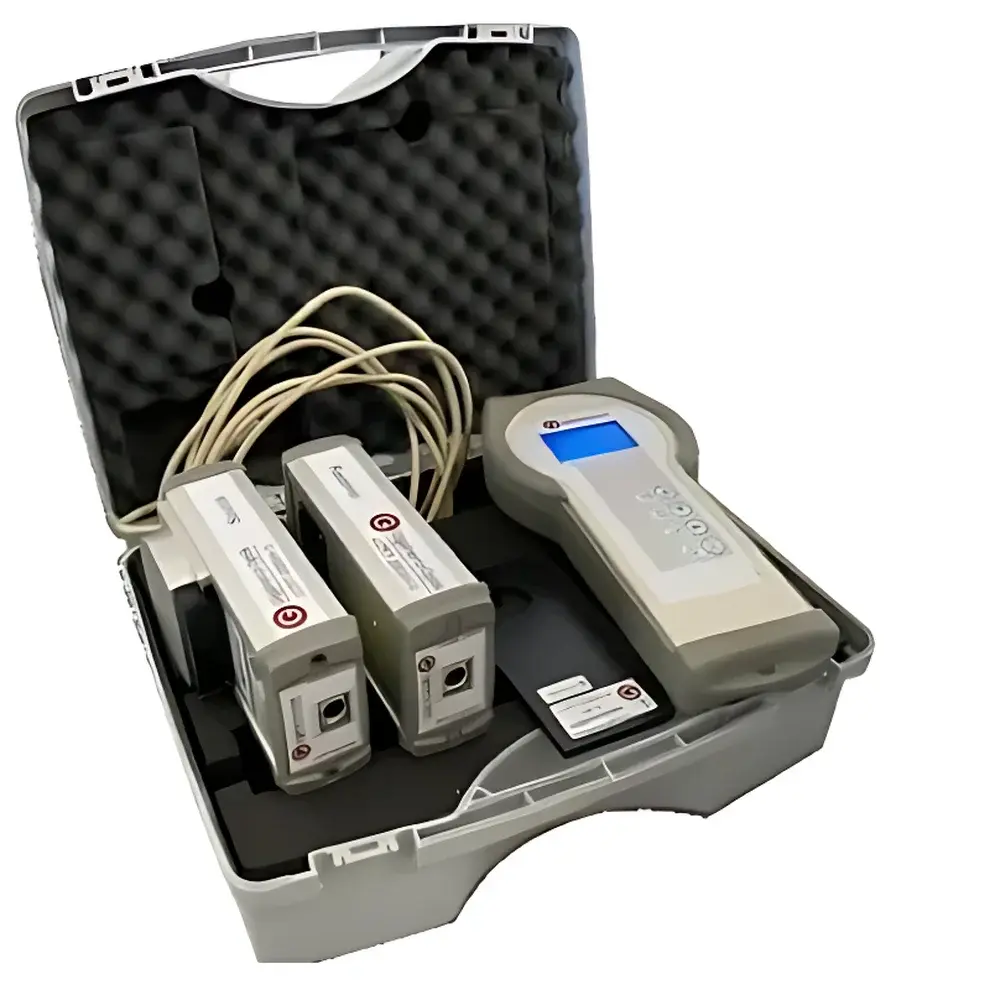
Gigahertz Optik LCRT-2005H-S Haze Meter
| Brand | Gigahertz Optik |
|---|---|
| Origin | Germany |
| Model | LCRT-2005H-S |
| Type | Automatic |
| Spectral Range | 380–780 nm |
| Compliance | ASTM D1003-13, CIE 130, DIN 5036 |
| Illuminant Simulation | A, C, D65 |
| Geometry | d/0° with integrated sphere |
| Power Supply | 4×AA batteries or USB |
| Measurement Modes | Transmittance, Haze, Spectrophotometric Reflectance/Transmittance |
Overview
The Gigahertz Optik LCRT-2005H-S Haze Meter is a portable, spectrally resolved optical measurement instrument engineered for precision transmittance and haze characterization of transparent and semi-transparent materials. It operates on the principle of d/0° geometry—utilizing an integrating sphere as both light source and detector housing—to ensure uniform illumination and high angular acceptance for diffuse transmission assessment. The system incorporates dual diode-array spectrometers: one monitors the spectral output of the LED-based broadband source (380–780 nm), while the other characterizes the spectral responsivity of the receiver, enabling real-time spectral matching to standardized illuminants (A, C, D65) and photopic luminous efficiency function V(λ). This architecture supports traceable, photometrically accurate measurements compliant with ASTM D1003-13 (Standard Test Method for Haze and Luminous Transmittance of Transparent Plastics), CIE Publication 130 (Methods of Measuring and Specifying the Performance of Integrating Spheres), and DIN 5036 (Light Transmission and Haze of Flat Glass). Designed specifically for thin, scratched, or optically delicate samples—including automotive glazing, display cover glasses, optical films, and medical device substrates—the LCRT-2005H-S delivers repeatable results under variable ambient conditions via pulsed illumination and automatic ambient light compensation.
Key Features
- Integrated d/0° measurement geometry with coated integrating sphere, optimized for low-stray-light transmittance and haze evaluation
- Dual diode-array spectrometers (source & receiver) enabling full-spectrum monitoring (380–780 nm) and dynamic spectral correction
- Automated ambient light compensation using synchronized pulse modulation, eliminating need for dark-room operation
- Manual selectable light trap for precise haze quantification per ASTM D1003-13 Section 7.3 (diffuse transmission ratio)
- Onboard camera-assisted alignment system for rapid source-receiver co-registration during handheld or benchtop use
- Flexible power options: USB-powered operation or 4×AA battery pack with ruggedized carry case for field deployment
- Intuitive touchscreen interface with guided workflows for transmittance (Tt), haze (H), and spectral transmittance (T(λ)) measurements
Sample Compatibility & Compliance
The LCRT-2005H-S accommodates flat, rigid, or flexible sheet materials up to 2 mm thickness without mechanical clamping, minimizing stress-induced birefringence artifacts. Its compact probe design enables direct contact or near-contact measurement of curved surfaces such as automotive side windows or smartphone cover lenses. For thicker specimens (up to 100 mm), optional accessories—including the PMS-RIT mounting stand and B2S-40-TRTH rail workstation—extend geometric flexibility while preserving optical alignment fidelity. All measurements adhere to internationally recognized metrological frameworks: calibration traceability to national standards (e.g., PTB, NIST), photometric compliance with CIE 130 and DIN 5036 Part 3, and haze calculation methodology validated against ASTM D1003-13 Annex A1. The instrument’s V(λ)-matched receiver ensures human-eye-relevant luminous transmittance values, critical for regulatory submissions in automotive safety (ECE R43), architectural glazing (EN 673), and medical packaging (ISO 11607).
Software & Data Management
Data acquisition and analysis are managed through Gigahertz Optik’s proprietary LCRT Control Suite, compatible with Windows OS and supporting USB or Bluetooth connectivity. The software provides real-time spectral visualization, batch export in CSV and XML formats, and automated report generation compliant with GLP documentation requirements—including user ID, timestamp, instrument serial number, calibration certificate reference, and measurement uncertainty estimation. Audit trails record all parameter changes and measurement events in accordance with FDA 21 CFR Part 11 guidelines when configured with electronic signature modules. Spectral datasets can be exported for third-party analysis in MATLAB, Python (NumPy/SciPy), or industry-standard color science platforms (e.g., CIE TC 1-93 tools). Firmware updates are delivered via secure HTTPS channel with SHA-256 integrity verification.
Applications
- Quality control of automotive laminated glass and HUD combiners for haze-related visual distortion assessment
- In-line validation of anti-reflective and oleophobic coatings on consumer electronics displays
- Regulatory testing of pharmaceutical blister packaging transparency and moisture barrier integrity
- R&D of polymer optical films, OLED encapsulation layers, and AR/VR waveguide substrates
- Material qualification for aerospace cockpit transparencies per MIL-PRF-85759 and SAE AS4302
- Academic research in scattering theory, Mie modeling, and surface roughness–haze correlation studies
FAQ
What standards does the LCRT-2005H-S comply with for haze measurement?
It conforms to ASTM D1003-13 (Section 7.3 for haze), CIE 130:2000, DIN 5036-3:2017, and ISO 14782 for transmittance and haze of flat transparent materials.
Can the instrument measure curved or non-planar samples?
Yes—its compact d/0° probe design allows manual positioning on gently curved surfaces; for reproducible curvature mapping, integration with the B2S-40-TRTH rail system is recommended.
Is spectral data export supported for custom analysis?
Yes—full-resolution spectral transmittance (380–780 nm, 1 nm step) and irradiance data are exportable in CSV and XML formats, including metadata for traceability.
How is calibration maintained across environmental variations?
The system performs real-time spectral monitoring of both source and detector, applying dynamic correction factors derived from onboard reference measurements before each test cycle.
Does the device support GMP/GLP-compliant reporting?
When used with LCRT Control Suite v3.2+, it generates audit-trail-enabled reports meeting FDA 21 CFR Part 11 and EU Annex 11 requirements for electronic records and signatures.




