
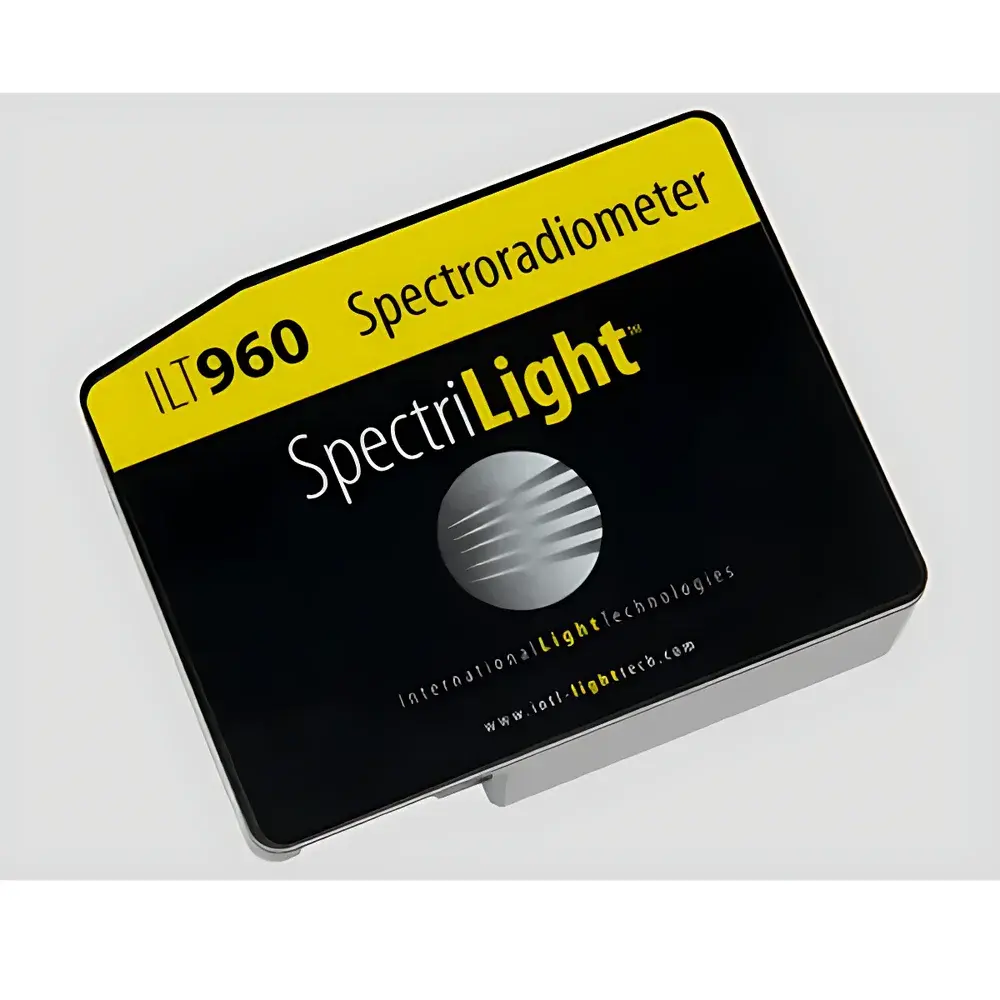
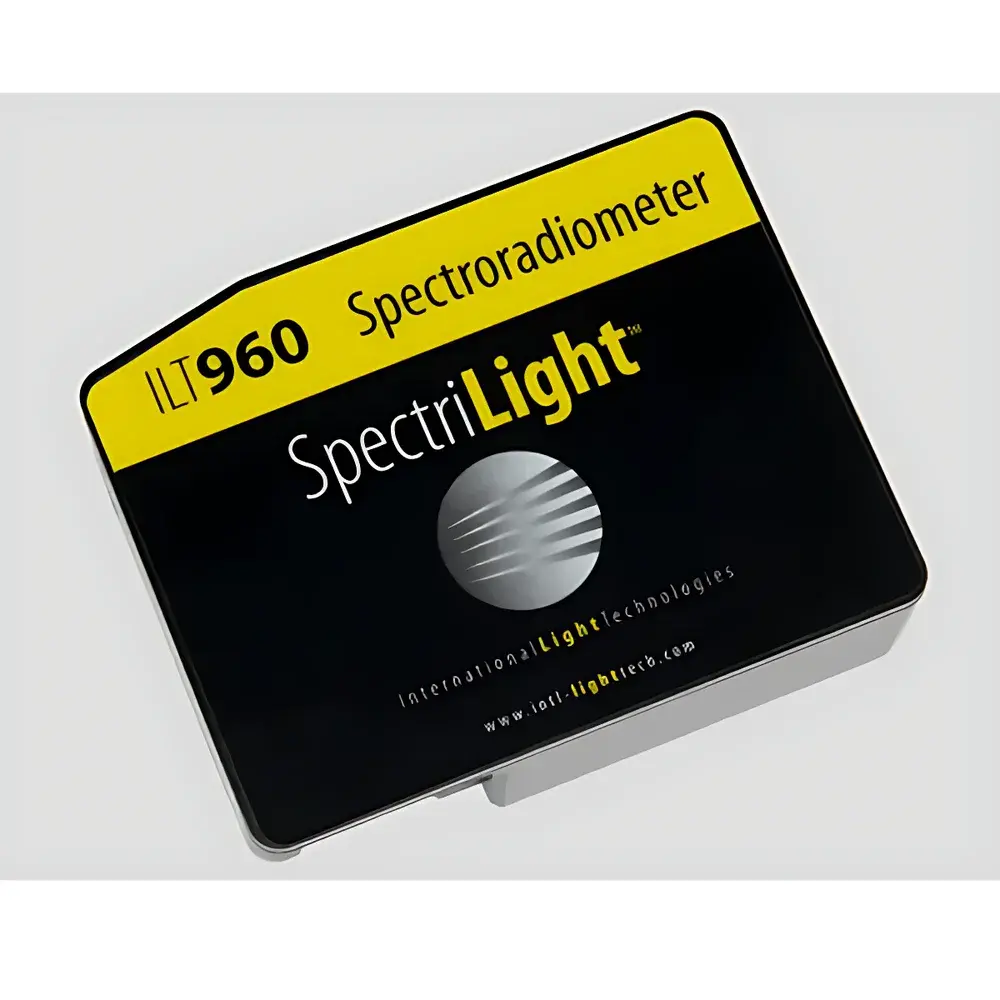
ILT960 Spectroradiometer
| Brand | Auniontech |
|---|---|
| Origin | Shanghai, China |
| Manufacturer Type | Authorized Distributor |
| Product Category | Domestic (China-manufactured) |
| Model | ILT960 Series |
| Instrument Type | Portable |
| Wavelength Ranges | ILT960-UV (200–500 nm) |
| Calibration Traceability | NIST-traceable per ISO/IEC 17025:2017 |
| Included Software | SpectrILight III (LabVIEW-based, Windows) |
Overview
The ILT960 Spectroradiometer is a compact, portable benchtop-grade spectroradiometric measurement system engineered for high-fidelity spectral radiometric characterization across ultraviolet (UV), visible (VIS), near-infrared (NIR), and broadband (UV–NIR) spectral domains. Based on a high-resolution CCD or CMOS linear array detector coupled with a precision Czerny–Turner optical bench, the ILT960 operates on the principle of dispersive spectroscopy—capturing full spectral irradiance (W·cm−2·nm−1), radiance (W·sr−1·cm−2·nm−1), radiant flux (W·nm−1), illuminance (lx), and luminance (cd·m−2) with absolute calibration traceable to the National Institute of Standards and Technology (NIST) under ISO/IEC 17025:2017 accredited procedures. Its modular architecture supports interchangeable input optics—including cosine-corrected diffusers, integrating spheres (2″, 5″, and 10″), and narrow-field-of-view (FOV) radiance tubes—enabling a single instrument platform to serve diverse metrological requirements without compromising measurement integrity.
Key Features
- Portable form factor with integrated battery option (optional), enabling field-deployable radiometric measurements in cleanrooms, production floors, and outdoor environments
- Multiple wavelength configurations: UV-optimized (200–500 nm), VIS-optimized (200–850 nm), broadband (230–1050 nm), and NIR-capable (900–1700 nm) variants
- NIST-traceable, factory-applied spectral responsivity calibration with certificate and raw calibration data files included
- Optical interchangeability: supports up to four distinct calibration profiles stored onboard—enabling seamless switching between irradiance, radiance, flux, and luminance measurement modes
- High linearity (>99.9% over 5 decades dynamic range) and repeatability (<0.3% RMS variation across repeated scans under stable thermal conditions)
- Thermally stabilized optical path and low-noise electronics to minimize dark current drift and spectral pixel shift
Sample Compatibility & Compliance
The ILT960 is designed for non-contact, non-destructive spectral characterization of lamps, LEDs, OLEDs, laser diodes, display panels, solar simulators, and ambient light sources. Its input optics comply with photobiological safety standards (IEC 62471), UV curing validation protocols (ASTM E2998), and cleanroom illumination monitoring guidelines (ISO 14644-1 Annex B). All calibrations adhere to ISO/IEC 17025:2017 requirements for competence of testing and calibration laboratories. While not inherently FDA 21 CFR Part 11 compliant, SpectrILight III software supports audit trail generation, user access control, and electronic signature readiness when deployed within validated GxP environments under site-specific SOPs.
Software & Data Management
SpectrILight III is a LabVIEW-based Windows application providing real-time spectral acquisition, radiometric unit conversion, colorimetric analysis (CIE 1931/1964, chromaticity coordinates, CCT, Duv, CRI, TM-30), and comparative overlay functions. It natively computes absolute irradiance (W·cm−2·nm−1), illuminance (lx), luminous efficacy (lm/W), and dominant wavelength without external post-processing. The software includes built-in algorithms for metamerism index (MI) and spectral similarity index (SSI). DLL libraries are available for integration into custom Python, MATLAB, or C# applications. Raw spectral data exports in CSV, TXT, and JDX formats; calibration metadata is embedded in each saved dataset per ASTM E131-22 conventions.
Applications
- LED and solid-state lighting (SSL) product development and QA/QC: spectral power distribution (SPD), color consistency, binning verification
- Cleanroom and semiconductor fab lighting validation: uniformity mapping, UV-A/UV-C dose monitoring, photoresist exposure profiling
- Photobiomodulation and medical device light source characterization: action spectrum-weighted irradiance (e.g., for ISO 15858 or IEC 60601-2-57)
- Solar simulator spectral match evaluation per IEC 60904-9 Class AAA criteria
- Display backlight and OLED emissivity measurement under controlled viewing angles
- Environmental light pollution studies requiring calibrated sky brightness spectra (300–1000 nm)
FAQ
Is the ILT960 suitable for GLP or GMP-regulated environments?
Yes—when used with documented calibration certificates, version-controlled SpectrILight III software, and defined operational procedures, the ILT960 meets foundational requirements for regulated radiometric testing. Full 21 CFR Part 11 compliance requires site-level validation of software configuration, user roles, and audit trail retention policies.
Can I perform both irradiance and radiance measurements with one ILT960 unit?
Yes—the instrument stores multiple calibration profiles internally. Swapping between a cosine diffuser (irradiance), integrating sphere (flux), and radiance tube (radiance) only requires selecting the corresponding calibration file in SpectrILight III.
What is the typical spectral resolution (FWHM) across different models?
Resolution varies by grating and slit configuration: standard VIS model achieves ~1.5 nm FWHM at 550 nm; UV and NIR variants are optimized for signal-to-noise ratio rather than ultimate resolution, delivering 2–3 nm FWHM depending on wavelength and integration time.
Does the system support automated measurement sequences or scripting?
Yes—via the provided DLL interface, users can implement scheduled acquisitions, multi-point spatial scans, or pass/fail decision logic based on spectral thresholds or color metrics.
How often should recalibration be performed?
Annual recalibration is recommended for routine laboratory use. For critical applications or after mechanical shock, thermal cycling beyond ±5°C, or optical component replacement, immediate recalibration against a NIST-traceable reference source is advised.







