
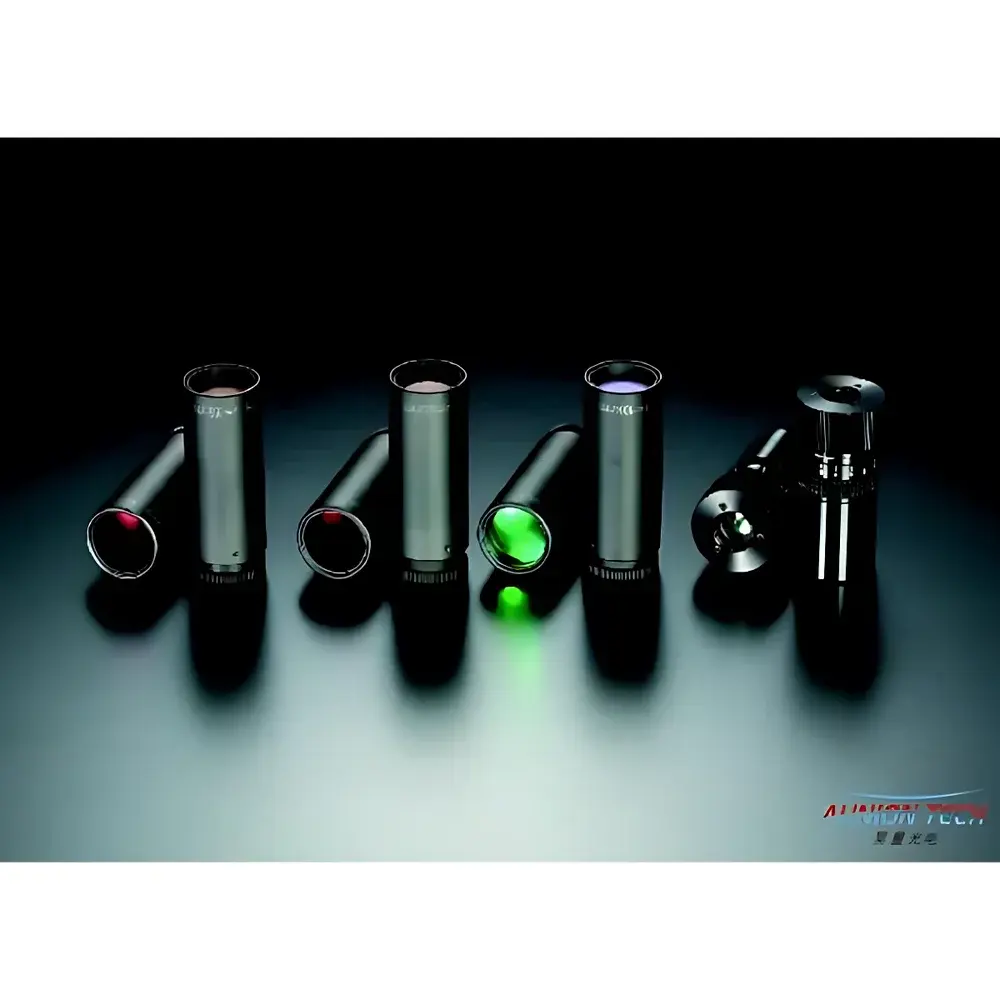
GEOMATEC YAG High-Performance Beam Expander
| Brand | GEOMATEC |
|---|---|
| Origin | Japan |
| Product Type | Laser Beam Expander |
| Wavelength Options | 1064 nm, 532 nm, 355 nm |
| Expansion Ratios | 1.5×, 2×, 3×, 4×, 6×, 8×, 10× |
| Variable Zoom Models | EPZ-13C (1–3×), EPZ-37C (3–7×), EPZ-13W (1–3×, wide-field), EPZ(THG)-13C/37C (355 nm optimized) |
| Input Beam Diameter Range | Ø1.8–Ø8.0 mm |
| Output Beam Diameter Range | Ø8.0–Ø24.0 mm |
| Transmission | ≥95% (1064 nm/532 nm), ≥95% (355 nm) |
| Design | Achromatic, air-spaced, diffraction-limited performance |
| Mounting | Standard SM1 (1.035"-40) threaded housing compatible with OEM laser systems |
Overview
The GEOMATEC YAG High-Performance Beam Expander is a precision optical component engineered for demanding continuous-wave and pulsed solid-state laser systems operating at fundamental and harmonic wavelengths of Nd:YAG lasers—specifically 1064 nm (fundamental), 532 nm (second harmonic generation, SHG), and 355 nm (third harmonic generation, THG). Designed using an optimized Galilean or Keplerian configuration depending on model, each expander maintains wavefront fidelity and minimizes beam divergence growth while delivering diffraction-limited expansion across its specified magnification range. These expanders are not simple afocal relays; they incorporate custom-coated, low-absorption fused silica and CaF₂ elements to ensure high transmission (>95% per surface), minimal thermal lensing under multi-watt irradiance, and long-term stability in industrial laser processing environments. Their mechanical architecture supports integration into Class 4 laser workstations compliant with IEC 60825-1 safety requirements and aligns with ISO 10110 surface quality standards (scratch-dig 10–5) for critical beam-shaping applications.
Key Features
- Multi-wavelength compatibility: Dedicated variants optimized for 1064 nm (EXP series), 532 nm (EXP(SHG) series), and 355 nm (EXP(THG) series), each with AR coatings tailored to minimize reflectivity at target wavelengths and their harmonics.
- Precision fixed-ratio expanders: Available in discrete magnifications from 1.5× to 10×, with input/output beam diameters rigorously characterized and traceable to NIST-traceable interferometric calibration.
- Variable zoom capability: Compact EPZ-C series (EPZ-13C, EPZ-37C) and wide-field EPZ-13W models provide continuously adjustable magnification without refocusing—enabling dynamic spot size control in scanning systems and adaptive laser machining setups.
- High damage threshold: All optics rated for >5 J/cm² at 10 ns, 10 Hz (1064 nm), supporting integration into Q-switched and mode-locked laser sources used in micromachining and thin-film ablation.
- OEM-ready mechanical design: SM1-threaded housings (1.035″-40) allow direct mounting to kinematic mounts, beam tubes, and f-theta lenses; standardized outer diameter (Ø25.4 mm or Ø30 mm) ensures interchangeability across platform architectures.
Sample Compatibility & Compliance
These beam expanders are validated for use with collimated Gaussian beams from diode-pumped solid-state (DPSS) lasers, fiber-coupled Nd:YAG oscillators, and ultrafast amplifiers where pulse energy and repetition rate remain within manufacturer-specified limits. They comply with ISO 10110-7 (surface imperfections), ISO 14999-2 (laser-induced damage testing methodology), and RoHS Directive 2011/65/EU. For regulated manufacturing environments—including medical device laser marking and aerospace component welding—the expanders support full traceability via serial-numbered calibration certificates and are compatible with FDA 21 CFR Part 11-compliant documentation workflows when integrated with validated laser system controllers.
Software & Data Management
While the beam expander itself is a passive optical element, GEOMATEC provides downloadable optical prescription data (Zemax .zmx and Code V .seq files) for all standard models, enabling accurate modeling of beam propagation, M² degradation, and focal plane shifts in system-level simulations. Integration with third-party beam profiling software (e.g., Ophir BeamWatch, DataRay WinCamD) is supported through documented beam diameter and divergence specifications. For automated production lines, mechanical adjustment interfaces (e.g., micrometer-driven zoom rings on EPZ-C series) are compatible with programmable motion controllers (Thorlabs Kinesis, Newport ESP300), allowing closed-loop magnification control synchronized with galvanometer scanners or CNC stages.
Applications
- Laser micromachining: Enabling sub-10 µm feature resolution in PCB drilling, semiconductor scribing, and flex circuit patterning via controlled beam expansion prior to f-theta focusing.
- High-speed laser marking: Stabilizing beam geometry across variable scan speeds to maintain consistent mark contrast and depth in automotive VIN engraving and medical implant serialization.
- Nonlinear frequency conversion: Pre-expanding fundamental beams before SHG/THG crystals to improve conversion efficiency and spatial homogeneity in ultrafast OPO pumping and UV lithography sources.
- Interferometric metrology: Providing stable, low-aberration reference beams in heterodyne displacement measurement systems and gravitational wave detector alignment subsystems.
- Scientific laser systems: Supporting cavity dumping, regenerative amplification seeding, and pump beam conditioning in Ti:sapphire and Yb:fiber amplifier chains.
FAQ
What is the maximum average power this beam expander can handle?
For fixed-ratio models (EXP series), the damage threshold is specified at >500 W CW at 1064 nm with proper cooling and beam centering; pulsed operation is limited by fluence, not average power.
Can I use the EPZ-13C with a 532 nm laser source?
No—EPZ-13C is optimized for 1064 nm. Use EPZ(SHG)-13C for 532 nm or EPZ(THG)-13C for 355 nm to ensure coating performance and wavefront preservation.
Is there backlash in the zoom mechanism of EPZ-C series?
The EPZ-C series employs a zero-backlash helicoid drive with preloaded ball-bearing raceways, achieving <1 µrad pointing instability over full zoom travel.
Do you supply mounting adapters for C-mount or F-mount interfaces?
Standard units include SM1 threading; custom flanges (e.g., C-mount, FC/APC) are available under OEM agreement with mechanical drawings provided.
Are test reports included with shipment?
Yes—each unit ships with a certificate of conformance including measured transmission spectrum (200–1100 nm), surface inspection report, and interferometric wavefront error map (RMS < λ/10 @ 632.8 nm).





