
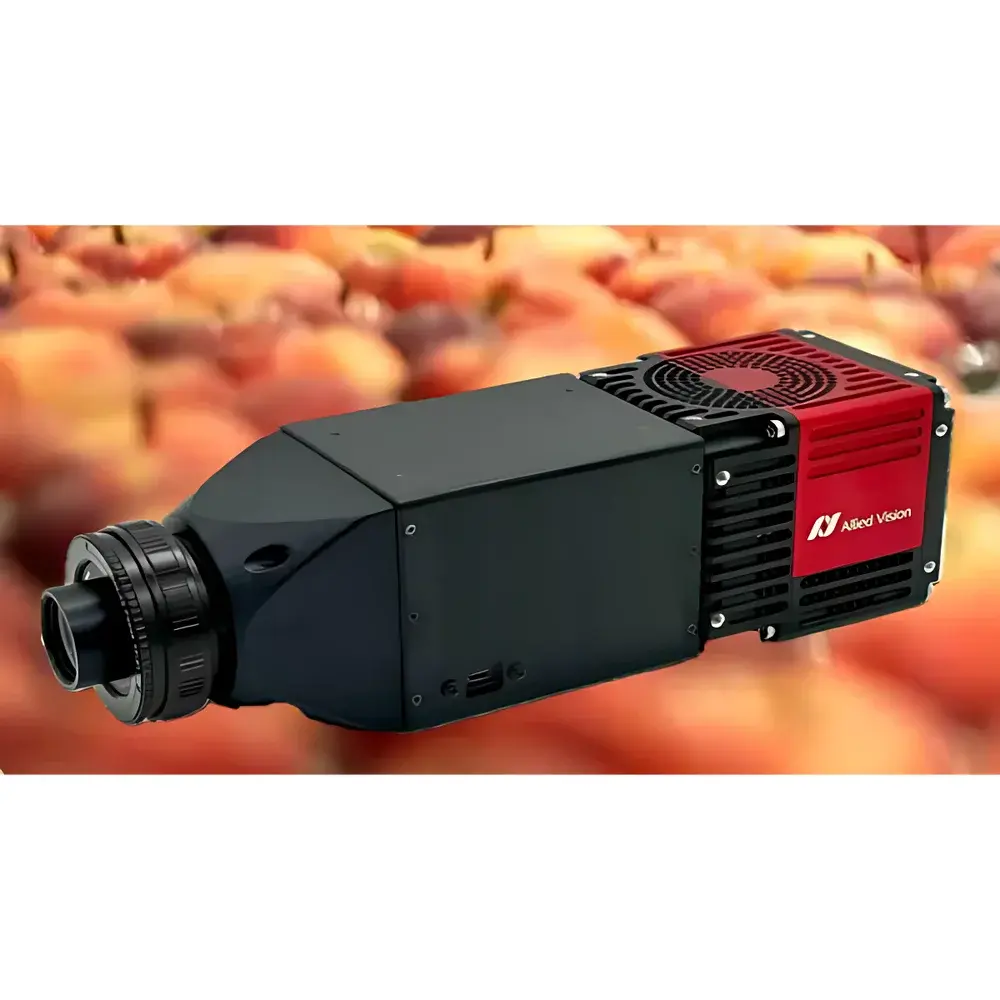
Auniontech Model 4300 VSWIR Staring Hyperspectral Imaging Camera
| Brand | Auniontech |
|---|---|
| Origin | Shanghai, China |
| Type | Staring (Snapshot) Hyperspectral Imager |
| Spectral Range | 500–1700 nm |
| Spectral Channels | 300 |
| Spectral Resolution | 15 nm (FWHM) |
| Spatial Resolution | 1.34 MP |
| Dynamic Range | 8- or 16-bit selectable |
| Operating Temperature | 15–30 °C |
| Relative Humidity | ≤65% RH (non-condensing) |
| Interface | Gigabit Ethernet, USB |
| Input Voltage | 100–240 VAC, 50–60 Hz |
| Dimensions | 72 × 150 × 300 mm |
| Weight | 3 kg |
Overview
The Auniontech Model 4300 VSWIR Staring Hyperspectral Imaging Camera is a solid-state, snapshot-capable spectral imaging system engineered for high-fidelity acquisition of spatial-spectral data cubes without mechanical scanning. It employs a tunable Fabry–Perot interferometric filter placed directly in front of a high-sensitivity InGaAs/Si hybrid sensor array, enabling full-frame spectral acquisition across the visible–shortwave infrared (VSWIR) range from 500 to 1700 nm. Unlike push-broom or whisk-broom systems reliant on precise motion synchronization, the Model 4300 captures all 300 spectral bands—each with 15 nm full-width-at-half-maximum (FWHM) resolution—in discrete, temporally aligned frames. This staring architecture eliminates motion-induced spatial misregistration and radiometric artifacts, ensuring intrinsic pixel-to-pixel spectral fidelity and geometric stability. The system is optimized for laboratory-grade quantitative analysis, field-deployable remote sensing, and integration into industrial inspection platforms where operational robustness, repeatability, and minimal alignment sensitivity are critical.
Key Features
- Snapshot acquisition: Full 2D spatial frame + 300 spectral bands acquired simultaneously—no translation stages, no line-scan motion artifacts
- VSWIR coverage: Seamless spectral response from 500 nm (silicon cutoff) to 1700 nm (InGaAs extended cutoff), supporting both organic and inorganic material characterization
- High uniformity: Fixed optical path and monolithic detector integration ensure <±1.5% pixel-to-pixel responsivity variation across the FOV
- Configurable dynamic range: Hardware-selectable 8-bit (high-speed) or 16-bit (high-dynamic-range) digitization modes
- Thermally stabilized operation: Active thermal management maintains sensor temperature within ±0.5 °C over 15–30 °C ambient, minimizing dark current drift and wavelength calibration shift
- Compact, modular form factor: 3 kg enclosure with standardized M4 mounting threads and IP52-rated environmental sealing for benchtop, airborne, or mobile deployment
Sample Compatibility & Compliance
The Model 4300 supports non-contact, reflectance/transmission-mode spectral imaging of heterogeneous solid, liquid, and particulate samples—including biological tissues, mineral specimens, polymer films, agricultural produce, pharmaceutical tablets, and cultural heritage artifacts. Its spectral calibration is traceable to NIST-traceable tungsten-halogen and deuterium standards, with factory-certified wavelength accuracy of ±0.8 nm across the full 500–1700 nm range. The system complies with IEC 61000-6-3 (EMC emission limits) and IEC 61000-6-2 (immunity requirements). While not inherently FDA 21 CFR Part 11–compliant, its software architecture supports audit trail logging, user access control, and electronic signature integration when deployed in GLP/GMP-regulated environments (e.g., USP for pharmaceutical content uniformity mapping or ASTM E2969 for soil contaminant screening).
Software & Data Management
The bundled Auniontech Hyperspectral Analysis Suite (v4.2+) provides end-to-end workflow support—from real-time preview and exposure optimization to spectral library matching, supervised/unsupervised classification (e.g., SAM, SID, K-means), and quantitative abundance mapping. All raw data are stored in open-format ENVI-compatible .hdr/.dat files with embedded georeferencing tags (for UAV-integrated use) and full metadata (exposure time, filter tuning voltage, sensor temperature, calibration coefficients). The SDK includes C/C++, Python, and MATLAB APIs for custom algorithm integration, and supports direct streaming via GigE Vision protocol into third-party platforms such as HALCON, OpenCV, or LabVIEW. Data provenance is preserved through automated timestamping, hardware ID logging, and checksum-verified write operations.
Applications
- Forensic science: Non-destructive detection of erased ink, latent fingerprints, accelerant residues, and document alterations using spectral unmixing
- Geoscience & mining: Mineral identification (e.g., clays, carbonates, sulfides) via diagnostic absorption features at 1400, 1900, and 2200 nm
- Agriculture & food safety: Quantitative assessment of chlorophyll-a/b, anthocyanins, water content, and pesticide residue distribution on leaf surfaces or fruit skins
- Pharmaceutical QA: Spatial mapping of active pharmaceutical ingredient (API) concentration and crystallinity homogeneity in tablet coatings
- Cultural heritage: Pigment stratigraphy analysis, varnish degradation monitoring, and underdrawing revelation in oil paintings
- Environmental monitoring: Detection of cyanobacterial blooms (phycocyanin peak at 620 nm), hydrocarbon spills (C–H stretch at 1730 nm), and heavy metal–induced plant stress signatures
FAQ
Does the Model 4300 require external illumination for reflectance measurements?
Yes—standard operation assumes broadband illumination (e.g., quartz-tungsten-halogen or solar-simulated sources) with calibrated reference panels. Optional fiber-coupled LED arrays with programmable spectral shaping are available for controlled illumination scenarios.
Can spectral calibration be performed in-field?
Yes—the system includes a built-in calibration routine that uses internal reference LEDs and optional external NIST-traceable standards; recalibration intervals are recommended every 12 months or after significant thermal cycling.
Is real-time processing supported on the camera’s onboard FPGA?
No—real-time classification requires host-based GPU acceleration (NVIDIA CUDA-enabled); however, the camera firmware supports sub-100 ms spectral band switching for adaptive acquisition strategies.
What is the minimum resolvable spectral feature width?
The instrument-limited spectral resolution is 15 nm FWHM; resolving power (λ/Δλ) ranges from ~33 at 500 nm to ~113 at 1700 nm, sufficient to distinguish major molecular absorption bands in most VSWIR applications.
How is geometric distortion corrected?
Each unit ships with a factory-acquired lens distortion map; the software applies polynomial correction (up to 5th order) during data cube reconstruction, achieving <0.3-pixel RMS residual error across the full FOV.




