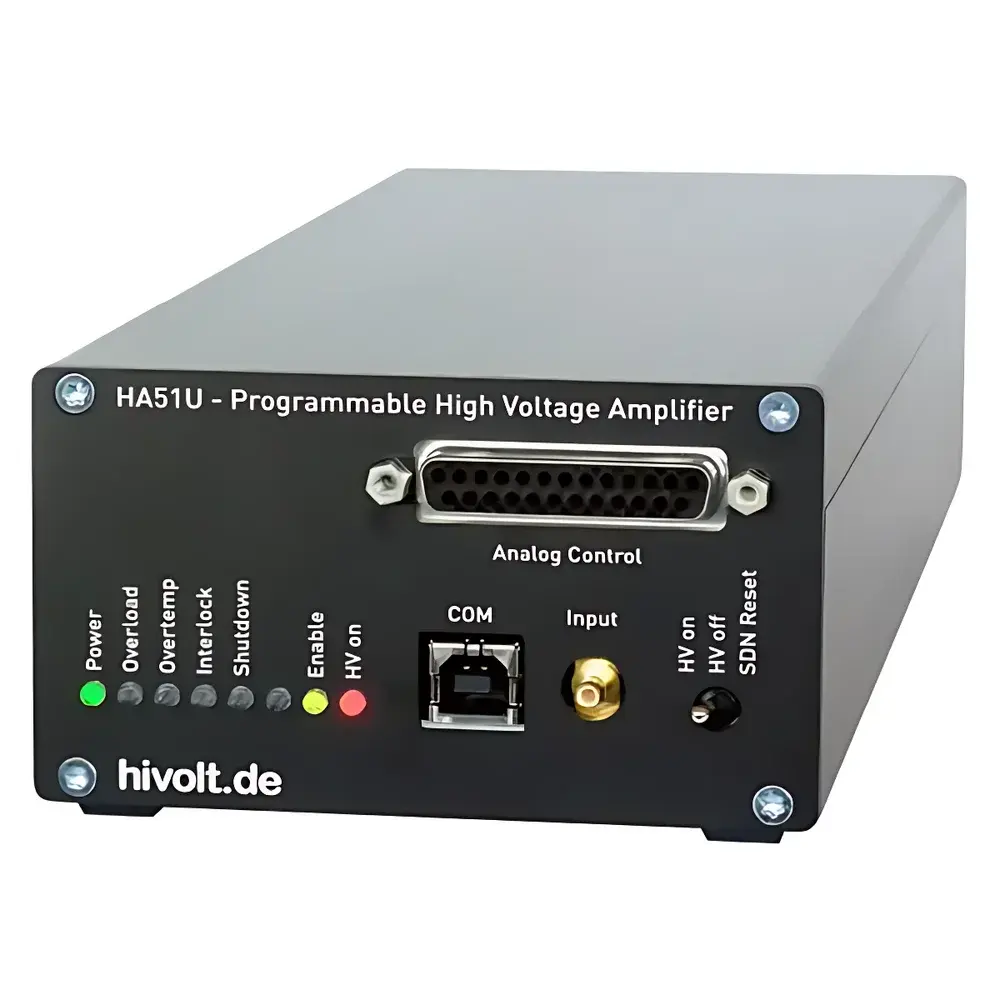
Auniontech AWG-Series Programmable High-Speed High-Voltage Amplifier
| Brand | Auniontech |
|---|---|
| Origin | Shanghai, China |
| Model | AWG-Series |
| Output Voltage Range | ±500 V to ±3000 V (multiple ranges) |
| Max Output Current | ±2.5 mA to ±40 mA (DC/AC peak) |
| Gain Accuracy | ±1% |
| Slew Rate | 15 V/μs to 100 V/μs |
| Full-Power Bandwidth | 1 kHz to 30 kHz |
| Small-Signal Bandwidth | 10 kHz to 100 kHz |
| Interface | Isolated USB 2.0 |
| Protection | Overcurrent, Short-Circuit, Overvoltage, Overtemperature, HV Arc Flash, Safety Interlock |
| Compliance | EN 61010-1 |
| Form Factor | 3U Rack-Mountable or Desktop Module |
| Operating Temperature | –20 °C to +50 °C |
| Enclosure Rating | IP-rated Sealed Housing |
Overview
The Auniontech AWG-Series Programmable High-Speed High-Voltage Amplifier is an engineered precision instrument designed for demanding applications requiring rapid, stable, and programmable high-voltage excitation. Based on a robust linear amplifier architecture with internally regulated high-voltage power supplies, it delivers exceptional transient fidelity and DC stability across a wide range of output configurations—from ±500 V to ±3000 V—with corresponding current capabilities up to ±40 mA (DC/AC peak). Its core operational principle relies on closed-loop voltage feedback combined with real-time thermal and current monitoring, ensuring consistent performance under dynamic capacitive or resistive loads—critical for electro-optic modulation, piezoelectric actuation, ferroelectric poling, and pulsed field testing. Unlike switched-mode HV amplifiers, this series maintains low output ripple (<10 mVRMS) and broadband noise floor (<50 µV/√Hz), enabling high-fidelity signal reproduction essential in scientific instrumentation and metrology-grade test environments.
Key Features
- Programmable output voltage, gain, and arbitrary waveform generation via isolated USB 2.0 interface using ASCII command protocol
- Dual-monitoring outputs: buffered analog voltage and current monitoring signals (±10 V full scale), TTL-compatible INHIBIT input for external safety interlocking
- Integrated microcontroller enabling onboard execution of user-defined control routines—supporting simple waveform synthesis, sequencing, and closed-loop calibration tasks
- Multi-range configuration support: 9 standard output voltage ranges with selectable gain (50× to 300×), all calibrated to ±1% absolute accuracy
- Thermally managed output stage with active temperature sensing and derating logic; automatic shutdown at >85 °C internal junction temperature
- Modular mechanical design: 3U 19-inch rack-mount chassis accommodates up to four independent amplifier modules with synchronized trigger and timing alignment
Sample Compatibility & Compliance
The AWG-Series amplifier is optimized for driving reactive and mixed-impedance loads typical in photonics, materials science, and vacuum-based systems—including PZT transducers, electro-optic modulators (e.g., LiNbO₃ waveguides), MEMS mirrors, F-P cavity tuners, and dielectric barrier discharge cells. It meets EN 61010-1:2010 requirements for measurement, control, and laboratory equipment, including creepage/clearance distances appropriate for CAT II 3000 V installations. The fully insulated enclosure and IP-rated sealing provide operational reliability in non-cleanroom industrial settings (e.g., coating lines, plasma processing stations) where ambient dust, vibration, and temperature fluctuations occur. While not certified for medical or intrinsically safe environments, its safety interlock circuitry supports integration into externally validated safety instrumented systems (SIS) per IEC 61508.
Software & Data Management
Auniontech provides a cross-platform USB communication library (Windows/Linux/macOS) with documented SCPI-like command set for remote configuration and real-time telemetry. Users can log voltage, current, temperature, and status flags at up to 10 kHz sampling via host PC—enabling traceable test records compliant with GLP and internal QA protocols. Firmware supports configurable watchdog timers and non-volatile storage of user presets. Though the device does not implement FDA 21 CFR Part 11 electronic signature functionality natively, audit trails generated through host-side logging—when paired with timestamped digital signatures—can satisfy basic regulatory documentation requirements for R&D validation and process qualification.
Applications
- Electro-optic tuning of fiber Fabry–Pérot filters and resonant cavities in laser stabilization and wavelength-swept OCT systems
- Pulsed electric field (PEF) treatment and dielectric breakdown studies in thin-film photovoltaic material characterization
- Ferroelectric domain engineering via controlled poling waveforms in multiferroic thin films and relaxor ceramics
- High-speed beam steering in adaptive optics using segmented mirror drivers with sub-microsecond settling
- Mass spectrometry ion optics biasing, including time-of-flight reflectron ramping and quadrupole RF/DC supply staging
- Accelerator component testing: kicker magnet pre-biasing, RF cavity tuning, and beam position monitor calibration
FAQ
What is the maximum safe continuous output power for the ±3000 V / ±5 mA configuration?
Continuous output power is limited by thermal dissipation in the output stage. At ±3000 V and ±5 mA DC, the theoretical power is 15 W; however, derating begins above 70% of max voltage when operating above 40 °C ambient. Refer to the thermal derating curve in Section 4.2 of the technical manual.
Can multiple AWG-Series amplifiers be synchronized for multi-channel phase-coherent operation?
Yes—via external TTL trigger input and programmable delay registers (10 ns resolution). All modules in a shared rack chassis share a common clock reference, supporting sub-microsecond inter-channel timing alignment for arrayed transducer driving.
Is optical isolation available for the analog monitoring outputs?
No—monitoring outputs are galvanically isolated from the HV stage but not optically isolated. For applications requiring complete ground separation, users must implement external isolation amplifiers meeting IEC 61000-4-5 surge immunity requirements.
Does the amplifier support analog voltage input mode in addition to USB programming?
Yes—BNC-input analog modulation mode is supported with 0–10 V input range and 1:100 scaling (e.g., 10 V input = 1000 V output at 100× gain), with bandwidth matching the selected small-signal specification.
What firmware update mechanism is used, and is rollback supported?
Updates are performed via USB using signed binary packages. The bootloader retains one prior firmware version for verified rollback; update history is logged in non-volatile memory with timestamps and SHA-256 checksums.