
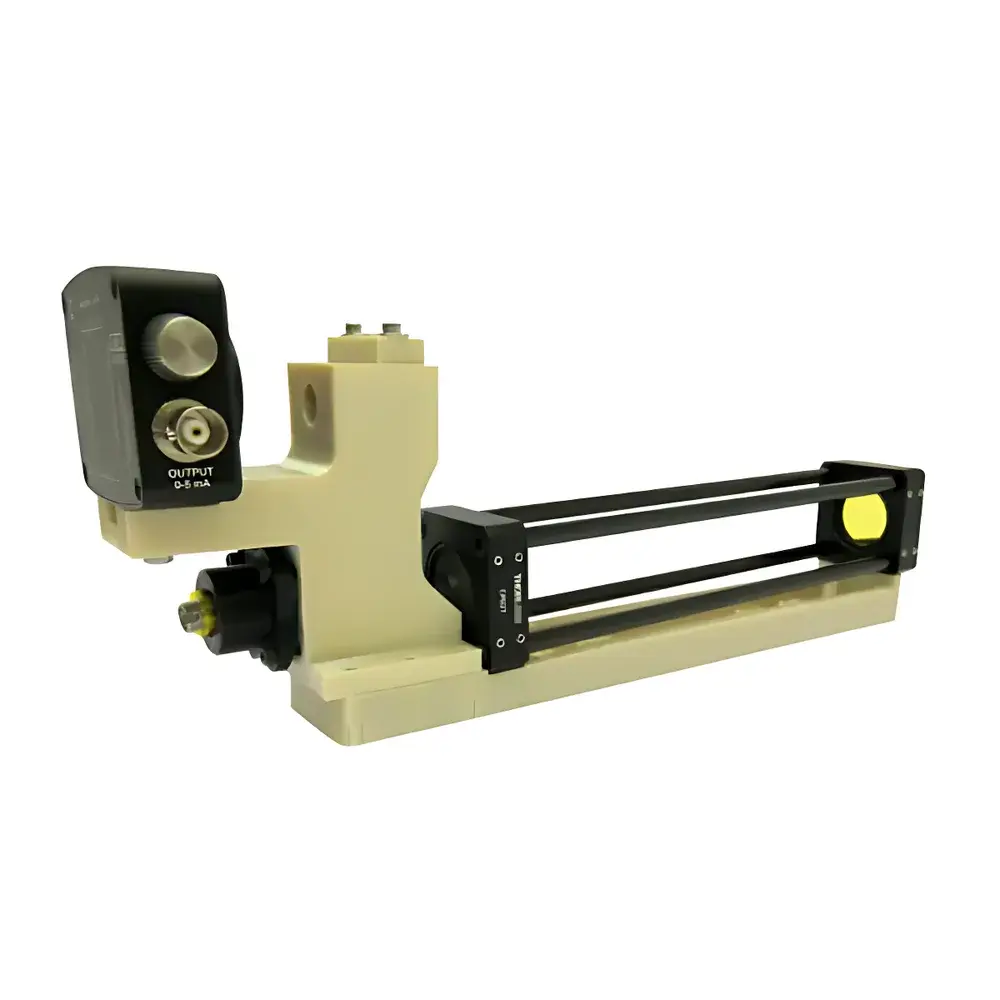
Mesa Photonics Herriott Cell — Compact Multipass Optical Absorption Cell for TDLAS
| Brand | Mesa Photonics (Distributed by Auniontech) |
|---|---|
| Origin | Shanghai, China |
| Manufacturer Type | Authorized Distributor |
| Product Category | Domestic |
| Model | MP-HC-34P |
| Optical Path Length | 5.78 m (adjustable via mirror spacing) |
| Dimensions | 30 cm (L) × Ø ~8 cm |
| Weight | 400 g |
| Mirror Coating | Au (R > 99.9% @ 1500–20,000 nm) |
| Input/Output | FC/PC Fiber Port + SMA Photodetector Output |
| Wavelength Range | 750–2600 nm (customizable to 20 µm) |
| Pass Count | 34 (pre-aligned, factory-optimized) |
| Compliance | ISO 9001-certified manufacturing environment |
Overview
The Mesa Photonics Herriott Cell is a precision-engineered multipass optical absorption cell designed for high-sensitivity tunable diode laser absorption spectroscopy (TDLAS) in field-deployable and resource-constrained environments. Based on the Herriott configuration—a two-mirror retroreflective optical cavity—the cell achieves extended effective path lengths through controlled beam re-imaging between concave spherical mirrors. Unlike White cells, which rely on three mirrors and complex alignment sensitivity, the Herriott geometry offers inherent mechanical stability, reduced alignment drift, and minimal spurious interference fringes due to its coaxial, non-overlapping beam footprint. This design enables robust performance under vibration, thermal fluctuation, and orientation changes—critical for airborne, UAV-mounted, or mobile environmental monitoring platforms. The standard configuration delivers a nominal 5.78 m optical path length within a 30 cm physical envelope, corresponding to 34 round-trip reflections. Path length is mechanically tunable by adjusting the inter-mirror distance, allowing optimization for target gas concentration, detection limit, and spectral resolution requirements. The cell operates across the near-infrared (NIR) to mid-infrared (MIR) spectrum (750–2600 nm, extendable to 20 µm with custom mirror coatings), making it compatible with widely available distributed feedback (DFB) and quantum cascade lasers (QCLs).
Key Features
- Pre-aligned, factory-optimized 34-pass configuration ensures immediate operational readiness—no optical realignment required after installation.
- Ultra-compact form factor (30 cm length, 400 g mass) enables integration into space- and power-limited platforms including battery-powered UAVs, handheld analyzers, and portable environmental monitors.
- Gold-coated spherical mirrors provide >99.9% reflectivity across 1500–20,000 nm, minimizing insertion loss and maximizing signal-to-noise ratio (SNR) at the photodetector.
- Integrated fiber-coupled input (FC/PC) and coaxial photodetector output (SMA) simplify system integration—no free-space optics, lenses, or external collimation needed.
- Coaxial beam entry/exit through a single mirror aperture reduces packaging complexity and enhances mechanical ruggedness.
- Thermally stable aluminum housing minimizes drift during ambient temperature variations (±0.5 °C stability over 24 h typical).
Sample Compatibility & Compliance
The Herriott Cell is optimized for gas-phase absorption measurements of trace atmospheric species—including CH₄, CO, CO₂, NH₃, H₂O, NO, and volatile organic compounds (VOCs)—at sub-ppb detection limits when paired with appropriate laser sources and lock-in detection electronics. Its sealed or flow-through configurations support both static and dynamic sampling modes. All optical surfaces meet ISO 10110 surface quality standards (scratch-dig 20–10), and mirror substrates are fused silica with low thermal expansion (α < 0.5 × 10⁻⁶ /°C). Manufacturing adheres to ISO 9001:2015 quality management systems. While the cell itself is not an instrument subject to regulatory certification, its design supports compliance with EPA Method TO-14A, ASTM D6348, and ISO 14644-1 cleanroom-compatible handling protocols. For GLP/GMP applications, full traceability of mirror coating deposition parameters and cavity alignment verification data is available upon request.
Software & Data Management
The Herriott Cell functions as a passive optical component and requires no embedded firmware or onboard software. It integrates transparently with third-party TDLAS control systems—including commercial platforms such as SpectraPhysics TEC-2000, Wavelength Electronics QCL drivers, and National Instruments LabVIEW-based acquisition suites. When used with lock-in amplifiers or digital signal processors (e.g., Zurich Instruments HF2LI), raw absorbance spectra are acquired with timestamped metadata compliant with HDF5 and CSV export formats. Full audit trails—including laser wavelength calibration coefficients, pressure/temperature sensor inputs, and path-length verification logs—can be maintained per FDA 21 CFR Part 11 requirements when deployed within validated analytical workflows. Auniontech provides application notes and MATLAB/Python reference scripts for baseline correction, Beer–Lambert fitting, and multi-species spectral deconvolution.
Applications
- Airborne greenhouse gas mapping: Deployed in NASA-funded UAV campaigns for high-resolution CH₄ plume quantification over landfill and agricultural sites.
- Industrial process monitoring: Real-time NH₃ slip detection in SCR systems and CO tracking in combustion exhaust streams.
- Environmental research: Long-term unattended monitoring of urban NOₓ and VOCs using solar-powered ground stations.
- Calibration transfer standards: Serving as a stable, reproducible reference cell for cross-instrument validation in metrology labs.
- Education and training: Used in university optics laboratories to demonstrate multipass absorption physics, cavity dispersion effects, and laser–matter interaction fundamentals.
FAQ
What is the maximum achievable optical path length with this Herriott Cell?
Path length is adjustable via mirror separation; standard configurations support up to 12 m (≈70 passes) with minor modifications to mounting hardware and beam clipping mitigation.
Can the cell be operated under vacuum or elevated pressure?
Yes—the housing features standardized CF-16 or KF-25 vacuum flanges (optional); pressure range: 10⁻³ mbar to 10 bar, depending on window material selection (CaF₂, ZnSe, or sapphire).
Is temperature stabilization required for ppm-level accuracy?
For sub-ppm detection, active temperature control (±0.1 °C) is recommended to suppress thermal lensing and cavity length drift; passive stabilization suffices for ppb-level field deployments.
How is alignment verified after field deployment?
No user alignment is needed—each unit ships with interferometric cavity length verification report and far-field beam profile characterization data.
Are custom mirror curvatures or coatings available?
Yes—custom R-values (f/1 to f/10), dielectric HR coatings (e.g., 4.5 µm QCL-optimized), and AR-coated windows are available under NRE agreement.






