
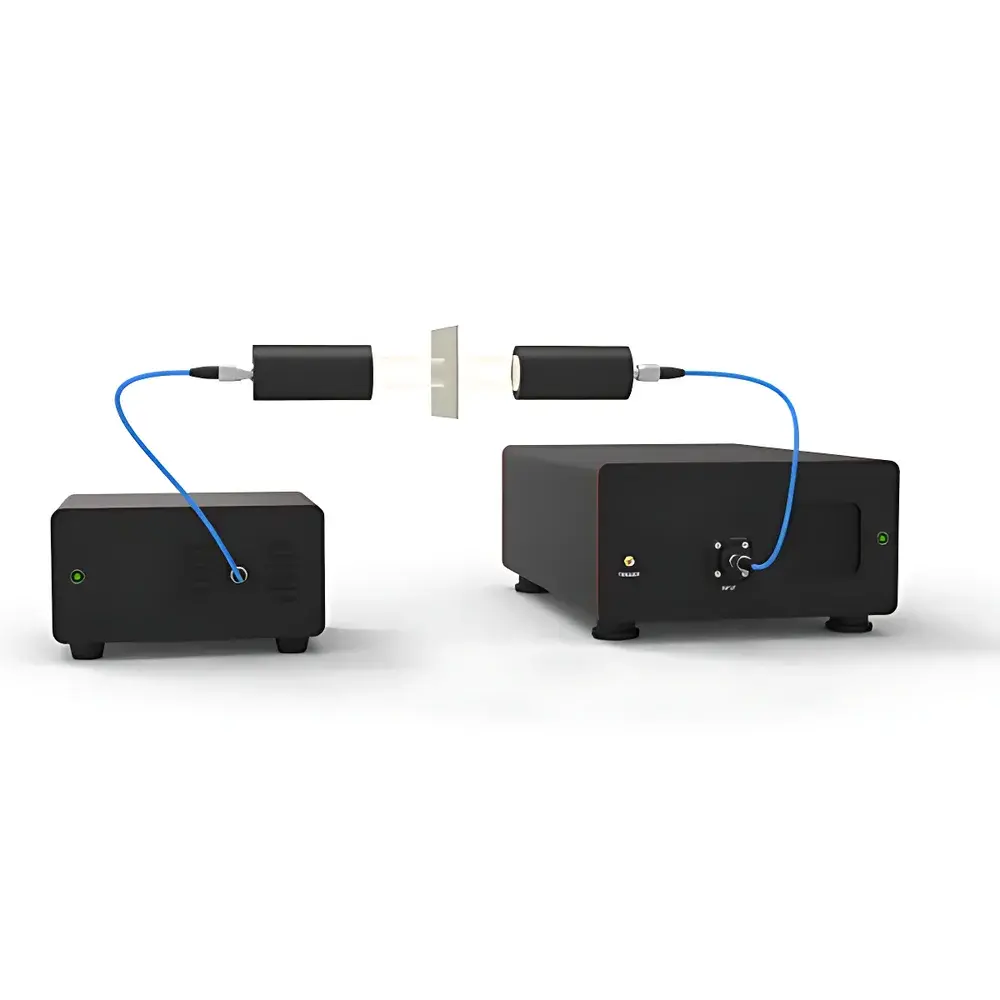
Auniontech S2050-130k High-Speed Mid-Infrared Spectrometer (2–12 µm)
| Brand | Auniontech |
|---|---|
| Origin | Shanghai, China |
| Manufacturer Type | Authorized Distributor |
| Product Category | Domestic |
| Model | S2050-130k / S76120 |
| Spectral Resolution | 2.5–10 cm⁻¹ |
| Wavelength Range | 2.0–5.0 µm (S2050 series) & 7.6–12.0 µm (S76120) |
| Max Readout Rate | 130 kHz |
| Sensitivity | 5 pW/nm (S2050-130k), 200 pW/nm (S76120) |
| Detector | Upconversion-based Si-CMOS array |
| Input Interface | SMA-905 fiber or free-space |
| Operating Temperature | ≤30 °C |
| Dimensions (H×L×W) | 100 × 306 × 200 mm³ |
| Weight | 5 kg |
Overview
The Auniontech S2050-130k and S76120 high-speed mid-infrared (MIR) spectrometers represent a paradigm shift in real-time molecular spectroscopy for industrial and laboratory applications. Unlike conventional Fourier-transform infrared (FTIR) or dispersive grating-based systems, these instruments employ patented upconversion photonics technology: incident MIR radiation (2.0–12.0 µm) is nonlinearly mixed with a pump laser to generate near-infrared (NIR) or visible photons within the 682–886 nm band—precisely matched to high-quantum-efficiency silicon CMOS detector arrays. This optical translation circumvents the fundamental limitations of cryogenic MCT or InSb detectors—including slow readout, thermal drift, and vacuum requirements—enabling uncooled, vibration-tolerant operation at ambient conditions. The core architecture delivers true snapshot spectral acquisition across broad bandwidths, with no moving parts and no interferometric path-length control. As such, it is engineered for continuous, high-duty-cycle deployment in process analytical technology (PAT), combustion diagnostics, gas-phase reaction monitoring, and rapid material identification where temporal resolution below 10 ms is critical.
Key Features
- Ultra-High Acquisition Speed: Real-time spectral capture at up to 130 kHz frame rate (S2050-130k), enabling sub-millisecond transient analysis of dynamic chemical processes.
- Broad Spectral Coverage: Dual-band configuration support: 2.0–5.0 µm (C–H, O–H, N–H stretching) and 7.6–12.0 µm (fingerprint region, C=O, C–O, S–H vibrations), covering key absorption bands for polymers, pharmaceuticals, and hydrocarbons.
- Upconversion-Enhanced Sensitivity: Achieves 5 pW/nm noise-equivalent power (NEP) in the 2–5 µm range and 200 pW/nm in the 7.6–12 µm band—enabling detection of weak emissions from low-concentration gases or micro-volume samples without signal averaging.
- Stable, Robust Architecture: Solid-state design with no moving mirrors or gratings; operates reliably under mechanical vibration and ambient temperature fluctuations (≤30 °C), eliminating the thermal stabilization overhead typical of FTIR platforms.
- Flexible Integration: Modular input options—including detachable SMA-905 fiber coupling and free-space collimated input—support fiber-optic probe integration, in-line process cells, and custom optical train configurations.
- High Dynamic Range & Linearity: 16-bit digitization (S2050-130k), <1% nonlinearity over 4-decade intensity span, and programmable integration time (1.3 µs to 40 s) ensure quantitative fidelity across diverse sample transmittance/reflectance conditions.
Sample Compatibility & Compliance
These spectrometers are compatible with transmission, reflection, and attenuated total reflectance (ATR) sampling geometries when integrated with appropriate accessories (e.g., diamond ATR crystals, gas cells, or fiber-coupled flow cells). The 2–5 µm band supports rapid identification of organic functional groups in plastics, coatings, and biological tissues; the 7.6–12 µm band enables precise fingerprinting of crystalline phases, excipients, and contaminants per ISO 1833-12 (plastics analysis) and USP (infrared identification of pharmaceutical substances). All firmware and data acquisition modules comply with GLP/GMP documentation requirements, supporting audit-trail-enabled operation and metadata tagging (time stamp, instrument ID, calibration status). While not certified to IEC 61000-6-4 or ATEX by default, the enclosure meets IP20 environmental protection standards and can be adapted for Class I, Division 2 hazardous locations with optional purge housings.
Software & Data Management
The spectrometers interface via USB 3.0 or GigE Vision to Auniontech’s SpectraView Pro software suite—a Windows-based application compliant with FDA 21 CFR Part 11 for electronic records and signatures. It provides real-time spectral visualization, batch acquisition scripting, multi-channel synchronization (via TTL trigger input/output), and export to HDF5, CSV, or JCAMP-DX formats. Calibration routines include NIST-traceable wavelength validation using CO₂ and H₂O vapor lines, and radiometric calibration against blackbody sources (e.g., Mikron M390). Raw spectra are stored with embedded metadata (exposure time, gain setting, temperature sensor reading), enabling retrospective reprocessing and traceable QA/QC workflows. API support (C++, Python SDK) allows integration into SCADA, LabVIEW, or MATLAB-based control systems for closed-loop process monitoring.
Applications
- Real-Time Polymer Sorting: Discrimination of black plastic types (PP, PE, ABS) based on subtle C–H overtone differences in the 2.0–2.5 µm window—deployed in automated recycling lines with >99.2% classification accuracy.
- Pulsed Laser Characterization: Single-shot spectral profiling of 40 kHz mid-IR optical parametric oscillators (OPOs), capturing pulse-to-pulse spectral drift and mode structure instability.
- In-Line Pharmaceutical Coating Monitoring: Non-contact measurement of film thickness and composition uniformity during pan-coating via 3.4–3.6 µm C–H absorption kinetics.
- Combustion Emissions Analysis: Simultaneous quantification of CO, CO₂, CH₄, and NO in exhaust streams using multivariate curve resolution (MCR-ALS) applied to time-resolved 4.2–4.5 µm spectra.
- Fiber-Optic Sensor Interrogation: High-speed interrogation of chirped fiber Bragg gratings (CFBGs) and Fabry–Pérot interferometers operating in the MIR for distributed temperature/strain sensing.
- Thin-Film Optical Metrology: In-situ monitoring of IR-transparent dielectric stack deposition (e.g., ZnSe, Ge) via interference fringe analysis in transmission mode.
FAQ
What is the fundamental measurement principle used in this spectrometer?
It employs nonlinear sum-frequency generation (SFG) upconversion: mid-infrared photons are mixed with a fixed-wavelength pump laser in a periodically poled lithium niobate (PPLN) crystal, generating visible/NIR photons detectable by high-speed silicon CMOS sensors.
Can the system operate without external cooling?
Yes. The upconversion detector architecture eliminates the need for liquid nitrogen or thermoelectric coolers. Stable operation is maintained at ambient temperatures up to 30 °C.
Is spectral calibration traceable to international standards?
Yes. Wavelength calibration uses atmospheric water vapor and carbon dioxide absorption features, which are NIST-traceable reference lines in the MIR region.
How is synchronization achieved for time-resolved experiments?
The spectrometer provides TTL-compatible trigger input and output ports, supporting hardware-level synchronization with lasers, shutters, or motion stages at jitter <100 ns.
What data formats are supported for export and third-party analysis?
Native export includes HDF5 (with full metadata), CSV (intensity vs. wavenumber), and JCAMP-DX v6.00—ensuring compatibility with chemometric tools such as Unscrambler, Pirouette, and Python-based scikit-learn pipelines.




