
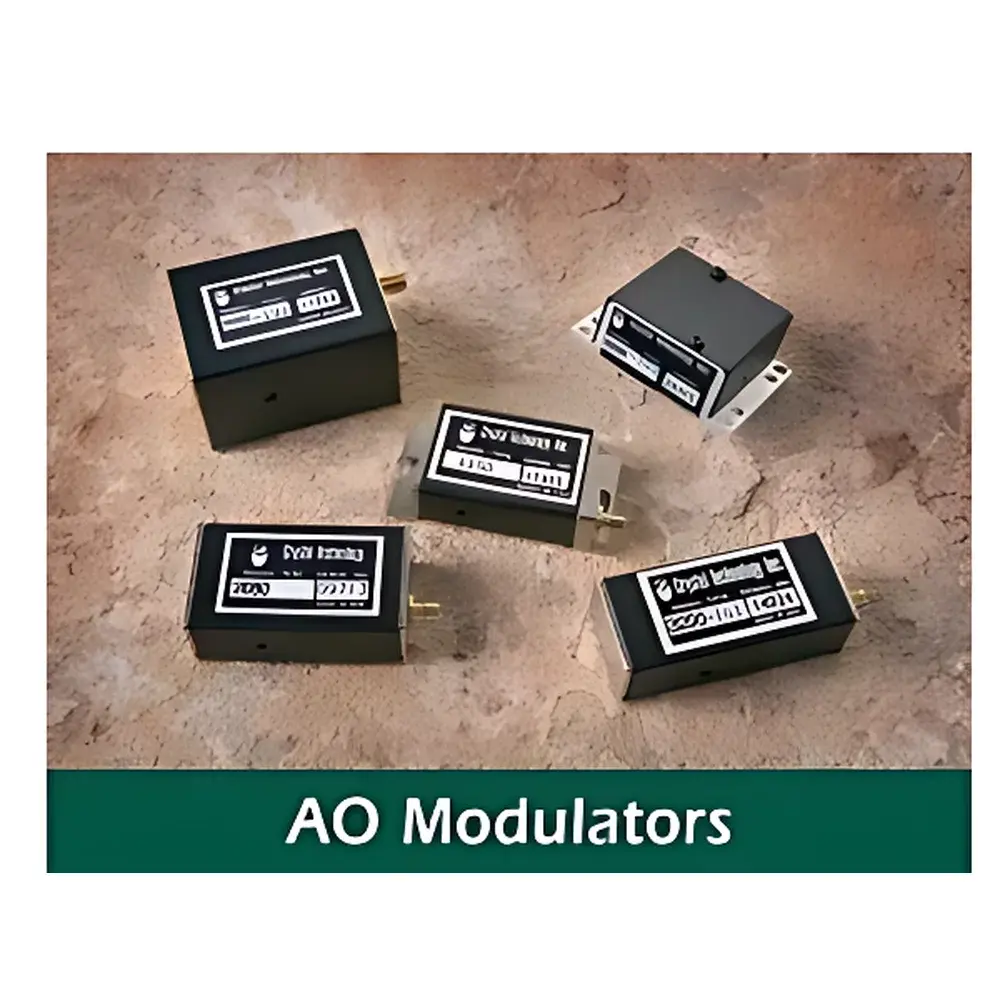
CTI AO Modulator / Acousto-Optic Frequency Shifter
| Origin | USA |
|---|---|
| Manufacturer Type | Authorized Distributor |
| Origin Category | Imported |
| Model Series | AO Modulators |
| Pricing | Available Upon Request |
Overview
The CTI AO Modulator / Acousto-Optic Frequency Shifter is a precision optical component engineered for high-fidelity intensity modulation and deterministic frequency shifting of continuous-wave (CW) and pulsed laser beams. Based on the acousto-optic Bragg diffraction principle, it utilizes piezoelectric transducers to launch ultrasonic waves into an optically transparent crystal—inducing a periodic refractive index grating that diffracts incident light. The first-order diffracted beam exhibits both amplitude modulation (proportional to applied RF drive power) and a precise Doppler shift equal to the input RF carrier frequency. This dual functionality enables seamless integration into interferometric systems, heterodyne detection setups, laser cooling architectures, and ultrafast pulse shaping chains where sub-nanosecond temporal response and kHz–MHz frequency agility are required.
Key Features
- Material-optimized crystal selection: Quartz for UV (257–365 nm) and deep-UV applications; TeO2 for visible to near-IR (413–1550 nm), leveraging its high acousto-optic figure of merit (M2) for superior diffraction efficiency per watt of RF drive power
- Modular mechanical packaging across five standardized styles (Style 1–5), supporting SMB, SMA, BNC, and custom RF interface configurations
- Rise times as low as 10 ns—achievable via optimized acoustic transit time design and tight laser beam focusing at the interaction region
- Center RF frequencies spanning 80 MHz to 335 MHz, with corresponding optical bandwidths up to 90 MHz (FWHM), enabling broad spectral coverage for tunable laser stabilization and multi-channel AOTF-based spectroscopy
- Aperture dimensions tailored from 0.5 × 0.25 mm to 2.5 × 2.00 mm to balance diffraction efficiency, beam clipping losses, and alignment tolerance in OEM and laboratory environments
- Hermetically sealed, thermally stabilized housings compliant with ISO 10110 surface quality standards and RoHS Directive 2011/65/EU
Sample Compatibility & Compliance
CTI AO modulators support collimated or mildly focused Gaussian beams with M2 ≤ 1.3 and polarization aligned to the crystal’s designated optic axis. Each unit undergoes full spectral calibration over its specified wavelength range (e.g., 442–488 nm, 780–850 nm, or 1047–1060 nm) and is certified for operation under Class 1 laser safety conditions when integrated with appropriate beam containment. Devices meet IEC 61000-6-3 (EMC emission) and IEC 61000-6-2 (immunity) requirements. For regulated pharmaceutical or medical device manufacturing environments, optional traceable calibration reports are available—including NIST-traceable RF power and optical throughput verification—supporting GLP/GMP documentation workflows and FDA 21 CFR Part 11-compliant data archiving when paired with CTI’s validated control software suite.
Software & Data Management
CTI provides a vendor-neutral SCPI-compatible command set (IEEE 488.2) for integration with LabVIEW, Python (PyVISA), MATLAB, or EPICS-based control systems. The standard firmware supports analog voltage-controlled amplitude modulation (0–10 V input), TTL-triggered gating, and digital frequency sweep modes. Optional firmware upgrades enable real-time rise/fall time monitoring via embedded photodiode feedback, automatic RF impedance matching compensation, and audit-trail logging of all parameter changes—meeting ALCOA+ principles for data integrity. All configuration files are stored in non-volatile memory with CRC-32 checksum validation and support versioned firmware rollback.
Applications
- Laser intensity stabilization in cavity-dumped Ti:sapphire and fiber amplifier systems
- Doppler-shifted reference generation for atomic physics experiments (e.g., Rb, Cs magneto-optical traps)
- High-speed laser scanning in maskless lithography and direct-write microfabrication
- Frequency-domain optical coherence tomography (FD-OCT) source sweeping
- Multi-wavelength beam routing in reconfigurable optical add-drop multiplexers (ROADMs)
- Active mode-locking in ultrafast oscillators and regenerative amplifiers
- Real-time holographic display refresh using spatial light modulator (SLM) synchronization
FAQ
What determines the minimum achievable rise time?
Rise time is fundamentally limited by the acoustic transit time—the duration required for the sound wave to traverse the optical beam diameter. It scales inversely with RF frequency and directly with beam height; thus, tighter focusing and higher-frequency devices (e.g., 335 MHz models) achieve sub-10 ns performance.
Can the same device operate simultaneously as a modulator and frequency shifter?
Yes—Bragg-diffracted first-order light inherently carries both amplitude modulation (via RF envelope) and carrier frequency offset (equal to RF center frequency); no hardware reconfiguration is needed.
Is polarization sensitivity critical during installation?
Yes—TeO2 and quartz crystals exhibit strong birefringent anisotropy. Input polarization must be aligned within ±1° of the manufacturer-specified orientation to maintain >95% diffraction efficiency and avoid polarization-dependent loss (PDL) drift.
How is thermal drift managed in long-duration experiments?
CTI units incorporate low-thermal-expansion mounts and passive heat-sinking geometries. For temperature-critical applications (e.g., interferometry), optional Peltier-stabilized versions maintain crystal temperature to ±0.1°C over 8-hour periods.
Are custom wavelengths or RF frequencies supported?
Yes—CTI offers engineering collaboration for non-standard configurations, including dual-band designs, angled apertures for reduced zero-order leakage, and hermetic fiber-pigtailed variants compatible with SMF-28 or PM980 fiber coupling.




