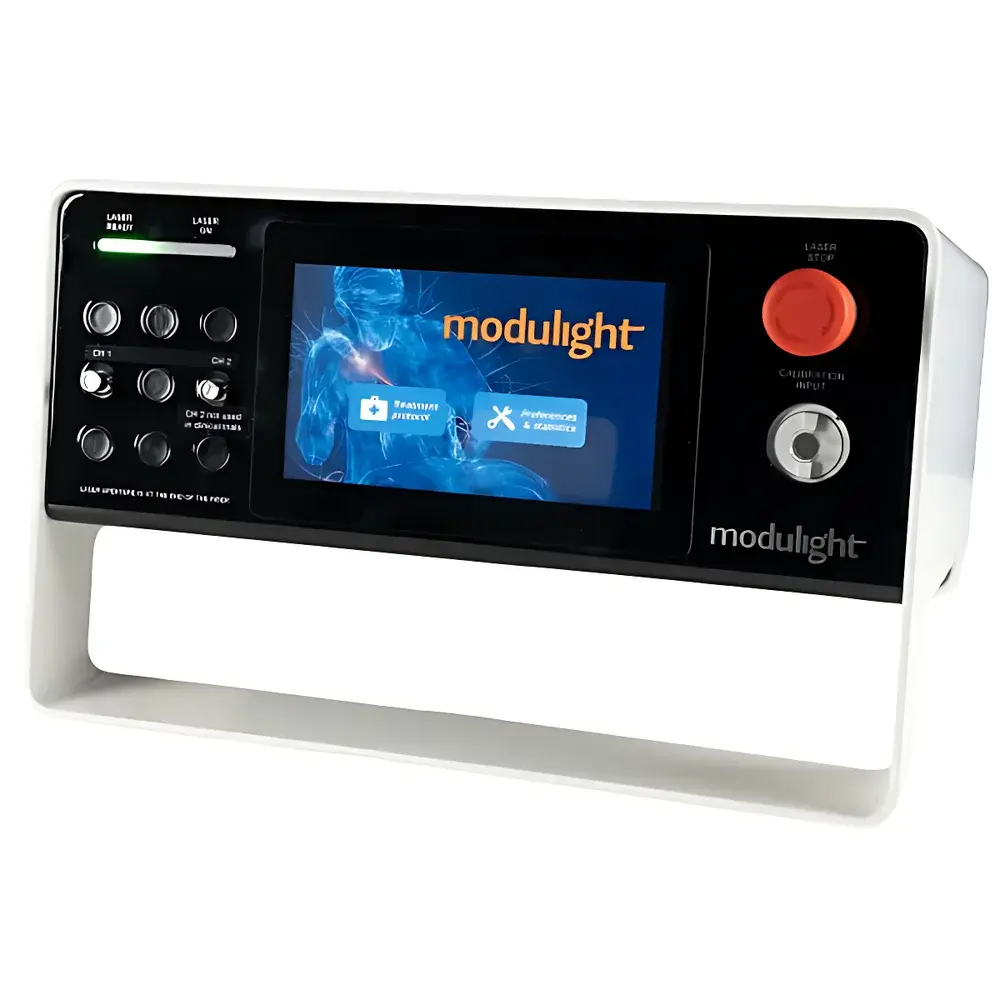
Modulight ML7710 Clinical Multi-Wavelength Laser Platform
| Brand | Modulight |
|---|---|
| Origin | Finland |
| Manufacturer Type | Authorized Distributor |
| Origin Category | Imported |
| Model | Solid-State Semiconductor Laser System |
| Output Channels | Up to 8 independent laser channels |
| Wavelength Range | 365 nm – 2000+ nm (UV–NIR) |
| Output Power per Channel | 0–15 W (configurable) |
| Compliance | ISO 13485 certified design |
| Safety Features | Integrated fiber-optic power sensors, foot/hand switches, hardware interlocks, real-time dose monitoring (optional), aiming beams |
| Software | Touchscreen GUI, cloud-connected via Modulight Cloud platform, remote parameter configuration, audit-trail logging, FDA 21 CFR Part 11–ready data export |
Overview
The Modulight ML7710 Clinical Multi-Wavelength Laser Platform is a CE- and PMA-certified, ISO 13485–designed medical laser system engineered for precision photodynamic therapy (PDT), fluorescence-guided surgery (FGS), photothermal therapy (PTT), and quantitative fluorescence imaging in clinical and translational research settings. Based on solid-state semiconductor laser architecture, the ML7710 delivers up to eight independently addressable optical outputs—each tunable across a continuous spectral range from deep ultraviolet (365 nm) to short-wave infrared (2000+ nm). Its modular design supports wavelength-specific activation of clinically approved photosensitizers—including 5-ALA/Gliolan®, Verteporfin/Visudyne®, Photofrin®, Foscan®, ICG, IRDye 700DX, and methylene blue—while enabling simultaneous excitation and real-time emission monitoring without external beam combiners or dichroic optics. The platform operates under strict adherence to IEC 60601-1 safety requirements and FDA CDRH 21 CFR Part 1040.10 laser hazard classifications, with integrated Class 1 enclosure architecture and redundant hardware interlocks ensuring operational compliance during intraoperative use.
Key Features
- Eight-channel solid-state semiconductor laser engine with individually controllable output power (0–15 W per channel) and wavelength selection across 365–2000+ nm
- Real-time, fiber-integrated optical power monitoring with traceable calibration to NIST-traceable standards
- Embedded aiming beams (635 nm visible diode) co-aligned with therapeutic outputs for anatomical targeting verification
- Integrated touchscreen HMI with intuitive workflow-driven interface, supporting pre-programmed treatment protocols and user-defined parameter sets
- Onboard intelligent self-calibration module ensuring long-term radiometric stability and minimizing routine service intervals
- Comprehensive safety architecture: dual-redundant hardware interlocks, foot/hand switches, emergency stop circuitry, and automatic power cutoff upon fiber disconnect detection
- Optional real-time photobleaching monitoring, tissue optical property mapping, and dynamic fluence rate adjustment based on in situ feedback
Sample Compatibility & Compliance
The ML7710 is validated for use with all major FDA- and EMA-approved photosensitizing agents and fluorescent tracers across oncology, urology, neurosurgery, and gastroenterology applications. It supports standard clinical fiber delivery systems—including cylindrical diffusers, balloon illuminators, flexible endoscopic light guides, and microlens-tipped probes—without requiring external coupling optics. All configurations undergo rigorous electromagnetic compatibility (EMC) testing per IEC 60601-1-2 and are manufactured under an ISO 13485–certified quality management system. Device documentation includes full technical files compliant with EU MDR Annex II/III requirements. Certain configurations carry CE marking under Directive 2017/745 and U.S. FDA Premarket Approval (PMA) for specific indications including glioblastoma PDT and NMIBC ablation. The system meets GLP/GMP-aligned data integrity standards, with optional audit trail functionality compliant with FDA 21 CFR Part 11 for electronic records and signatures.
Software & Data Management
The ML7710 runs on a deterministic embedded Linux OS with a web-enabled application layer supporting both local touchscreen operation and secure remote access via Modulight Cloud. Treatment parameters—including wavelength, power, exposure time, fiber type, and anatomical site—are automatically logged with timestamp, operator ID, and device serial number. Cloud synchronization enables centralized review of procedural data across multi-site trials, facilitating retrospective dosimetry analysis and longitudinal outcome correlation. Raw photodetector signals (e.g., PpIX fluorescence decay, backscattered intensity, thermal rise kinetics) are exported in HDF5 format for integration with MATLAB, Python-based AI pipelines, or institutional PACS/EHR systems. Software updates are delivered over-the-air with version-controlled rollback capability and cryptographic signature verification. All data exports support DICOM-SR extensions for structured reporting in clinical imaging workflows.
Applications
- Glioblastoma resection guidance: Simultaneous 405 nm PpIX excitation and 635 nm fluorescence detection using eight-channel illumination of resection cavities with cylindrical diffusers and balloon illuminators
- Bladder cancer PDT: Dual-channel 689 nm irradiation—one focused beam (2 W) for papillary lesions, one wide-field beam (>10 W) for carcinoma in situ—delivered via flexible cystoscopic fibers
- Endoscopic fluorescence imaging: Programmable white-light (445/515/635 nm) and targeted excitation (488 nm for fluorescein, 785 nm for ICG, 689 nm for IRDye 700DX) with active speckle suppression
- Translational PDT optimization: In vivo photobleaching kinetics tracking, interstitial fluence mapping, and real-time feedback-driven power modulation to maintain therapeutic window
- Clinical trial infrastructure: Standardized protocol deployment, cross-institutional data harmonization, and AI-ready dataset curation for biomarker discovery
FAQ
Is the ML7710 classified as a Class IV laser system under FDA regulations?
Yes—each output channel is classified as Class IV per FDA 21 CFR Part 1040.10, with full compliance achieved through integrated engineering controls, administrative procedures, and mandatory user training.
Can the system be integrated into existing hospital IT infrastructure?
Yes—the ML7710 supports HL7 v2.x and DICOM connectivity for bidirectional integration with EMR/EHR systems and PACS environments, with configurable network segmentation and TLS 1.2+ encryption.
What level of traceability does the internal calibration provide?
Calibration is traceable to NIST SRM 2241 (optical power) and NIST SRM 2034 (spectral irradiance), with annual recalibration certificates available through Modulight’s ISO/IEC 17025–accredited service lab.
Does the platform support custom wavelength combinations not listed in the standard configuration?
Yes—Modulight offers bespoke laser module integration for wavelengths between 365–2000 nm, subject to optical damage threshold validation and regulatory pre-submission consultation.
How is patient data privacy maintained in Modulight Cloud?
All data transmissions use AES-256 encryption; stored data is anonymized by default and hosted in GDPR-compliant EU data centers with SOC 2 Type II certification.