
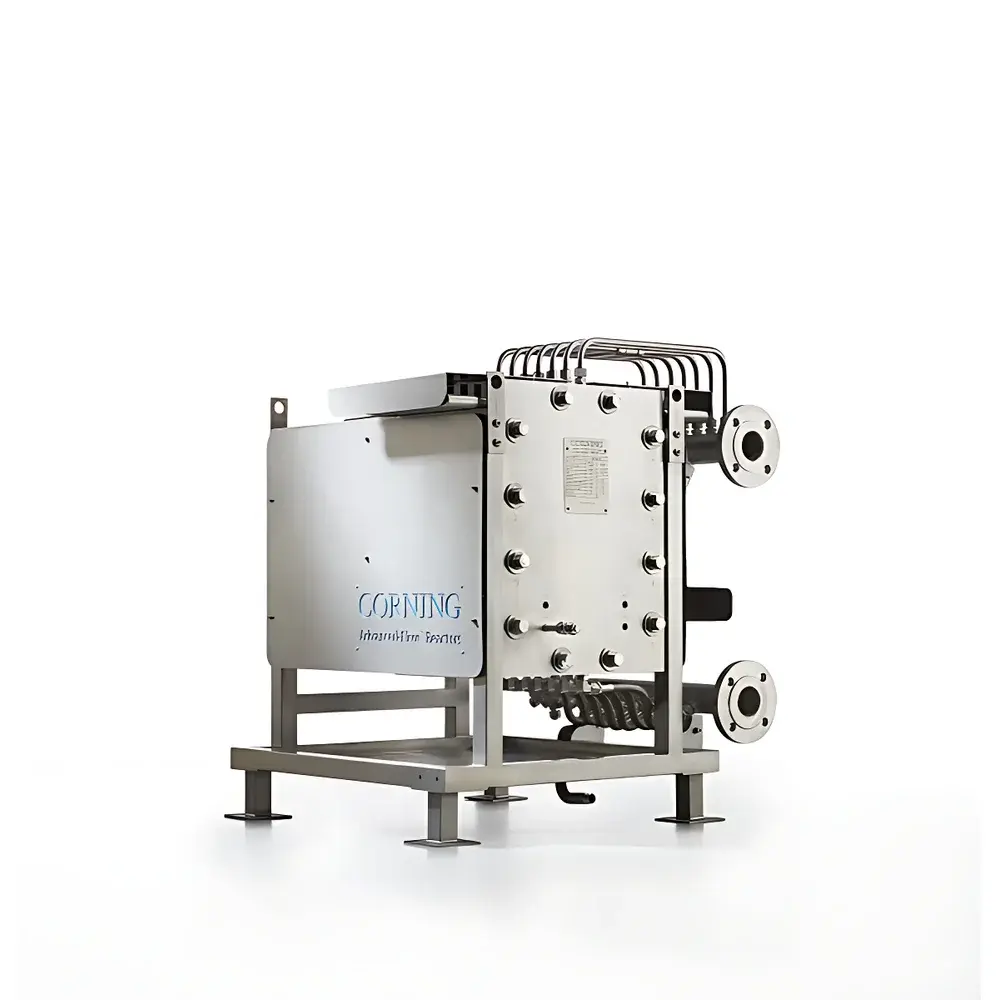
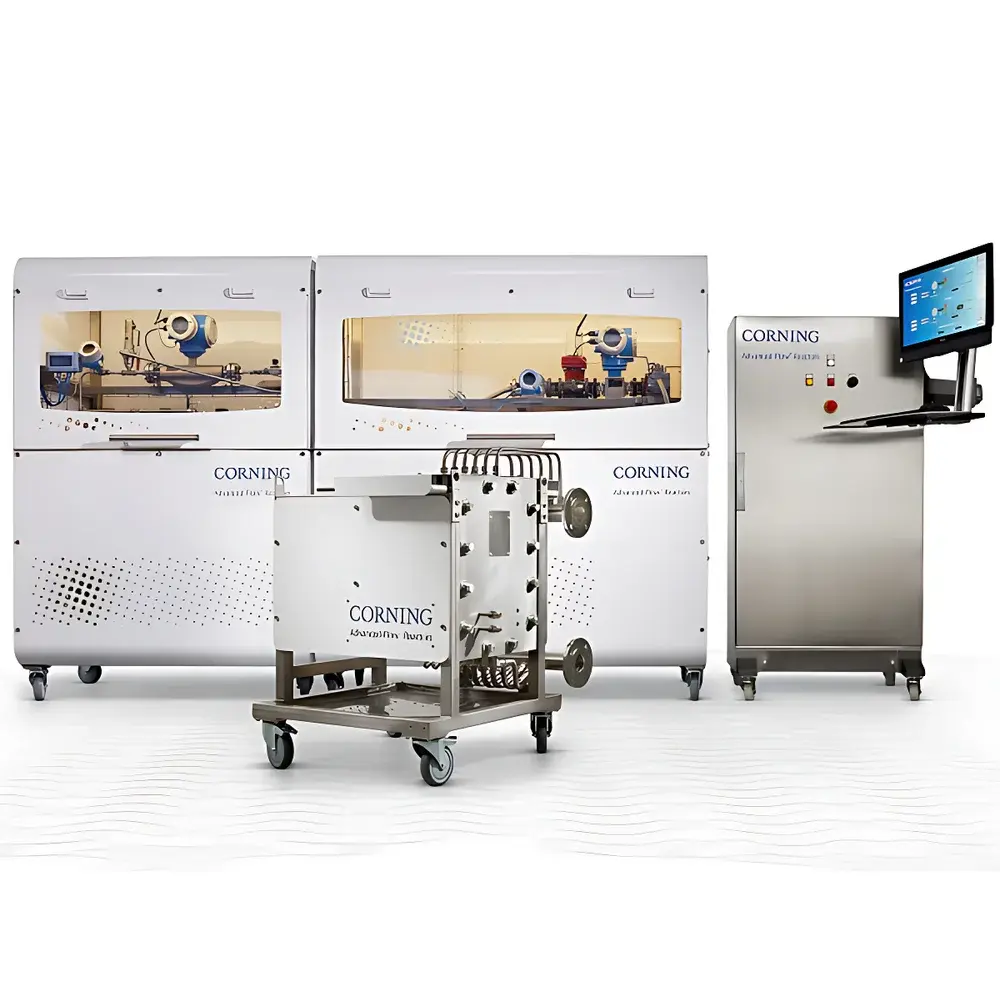
Corning G4 Advanced-Flow Reactor (AFR®) – Silicon Carbide Production-Scale Microchannel Reactor
| Brand | Corning |
|---|---|
| Origin | France |
| Model | G4 |
| Fluid Throughput Capacity | Up to 2,000 m³/year (≈2,000 metric tons/year) |
| Operating Temperature Range | –25 °C to 200 °C |
| Maximum Operating Pressure | 1.8 MPa (18 bar) |
| Total Active Reaction Volume | 250 mL |
| Construction Material | Silicon Carbide (SiC) |
| Pressure Class | Medium-pressure |
| Vacuum Capability | Not applicable (designed for positive-pressure continuous flow operation) |
| Regulatory Compliance | Designed for GMP-compliant chemical manufacturing environments |
| Scalability | Direct geometric and performance-based scale-up from Corning AFR® G1/G2/G3 platforms |
Overview
The Corning G4 Advanced-Flow Reactor (AFR®) is a production-scale, silicon carbide (SiC) microchannel reactor engineered for continuous, safe, and highly controlled chemical synthesis in industrial manufacturing settings. Unlike conventional batch reactors, the G4 leverages Corning’s proprietary monolithic SiC architecture—featuring precisely etched, parallel microchannels with high surface-area-to-volume ratios—to deliver exceptional heat transfer coefficients (>10,000 W/m²·K) and mass transfer rates under turbulent laminar flow conditions. This enables precise residence time control (±0.5 s), near-isothermal operation across the entire reaction zone, and suppression of hot spots or runaway exotherms—even for highly energetic transformations. The G4 is not a scaled-up lab device; it is a purpose-built engineering system validated for 24/7 operation in API intermediate synthesis, fine chemical manufacturing, nitration, hydrogenation, halogenation, and photochemical processes where thermal management, corrosion resistance, and reproducibility are mission-critical.
Key Features
- Silicon carbide (SiC) monolithic core: Chemically inert across pH 0–14, resistant to HF, strong oxidizers (e.g., HNO₃/H₂SO₄ mixtures), and high-temperature chlorination agents—eliminating metal leaching and enabling catalyst compatibility with Pd, Pt, Ni, and heterogeneous acid systems.
- True process intensification: 250 mL total active volume delivers throughput equivalent to multi-cubic-meter batch reactors—up to 2,000 m³/year fluid processing capacity with <1% inter-batch variability in conversion and selectivity.
- Integrated thermal management: Dual-zone jacketed heating/cooling capability supports rapid temperature ramping (≤5 °C/min) and stable setpoint maintenance (±0.3 °C) from –25 °C to 200 °C under full pressure load.
- Medium-pressure rated design: ASME Section VIII Div. 1 compliant vessel with maximum allowable working pressure (MAWP) of 1.8 MPa (18 bar)—validated for continuous operation at 1.5 MPa with full traceable pressure cycling history.
- Modular skid integration: Pre-piped, pre-instrumented frame with DIN 11851 sanitary fittings, integrated Coriolis mass flow meters, RTD arrays, and pressure transducers—designed for seamless connection to existing DCS or PLC control systems (Profibus DP, Modbus TCP, or OPC UA).
Sample Compatibility & Compliance
The G4 reactor accommodates homogeneous, heterogeneous, and multiphase (gas–liquid, liquid–liquid) reaction systems without channel clogging, thanks to its 500 µm minimum hydraulic diameter and self-cleaning flow dynamics. It complies with ISO 9001:2015 manufacturing quality standards and is designed to support regulatory submissions under ICH Q5, Q7, and Q11 guidelines. Documentation packages include FAT/SAT protocols, material traceability (ASTM C648-certified SiC), 3.1 material test reports, and full ASME U-1A data reports. For pharmaceutical applications, the system supports 21 CFR Part 11-compliant electronic records and signatures when integrated with validated SCADA software.
Software & Data Management
Corning provides the AFR® Control Suite—a Windows-based, FDA 21 CFR Part 11-ready application supporting audit trail logging, user role management (admin/operator/technician), electronic signature capture, and automated report generation (PDF/CSV). All sensor data—including real-time pressure differentials across microchannel banks, inlet/outlet temperatures, and mass flow rates—are timestamped with NIST-traceable UTC synchronization. Raw data files are stored in HDF5 format for long-term integrity and third-party analysis compatibility (MATLAB, Python pandas, SIMCA).
Applications
- Continuous manufacturing of active pharmaceutical ingredients (APIs) per FDA’s Emerging Technology Program guidance.
- High-selectivity asymmetric epoxidations and dihydroxylations requiring sub-second mixing and precise thermal control.
- Nitration of aromatic compounds under inherently safer conditions (reduced inventory, no accumulation of unstable intermediates).
- Catalytic hydrogenations using immobilized Pd/C or Pt/Al₂O₃ with in situ catalyst lifetime monitoring via pressure drop trend analysis.
- Photochemical [2+2] cycloadditions using integrated LED arrays (365 nm, 405 nm) with quartz-SiC optical coupling interfaces.
FAQ
How does the G4 differ from glass or stainless-steel microreactors?
The G4’s silicon carbide construction provides >10× higher thermal conductivity than glass and complete immunity to corrosion by aggressive reagents—enabling direct use with fuming nitric acid, oleum, or anhydrous HF without liners or coatings.
Is the G4 suitable for GMP manufacturing?
Yes—the reactor is supplied with full documentation packages aligned with EU Annex 15 and ASTM E2500-13 for equipment qualification (DQ/IQ/OQ/PQ), including calibration certificates for all field instruments.
Can existing G1 or G2 lab-scale data be directly scaled to G4?
Yes—Corning’s AFR® platform uses constant dimensionless numbers (Péclet, Graetz, and Damköhler) across generations, enabling predictive scale-up without empirical re-optimization.
What maintenance is required during continuous operation?
No scheduled internal maintenance is required within 12 months of continuous operation; only external seal inspection and pressure relief valve certification per local jurisdictional requirements.
Does Corning provide process development support?
Yes—Corning Life Sciences offers dedicated AFR® Application Engineering services, including kinetic modeling, residence time distribution (RTD) analysis, and hazard evaluation (HIRA/LOPA) for new chemistries.



