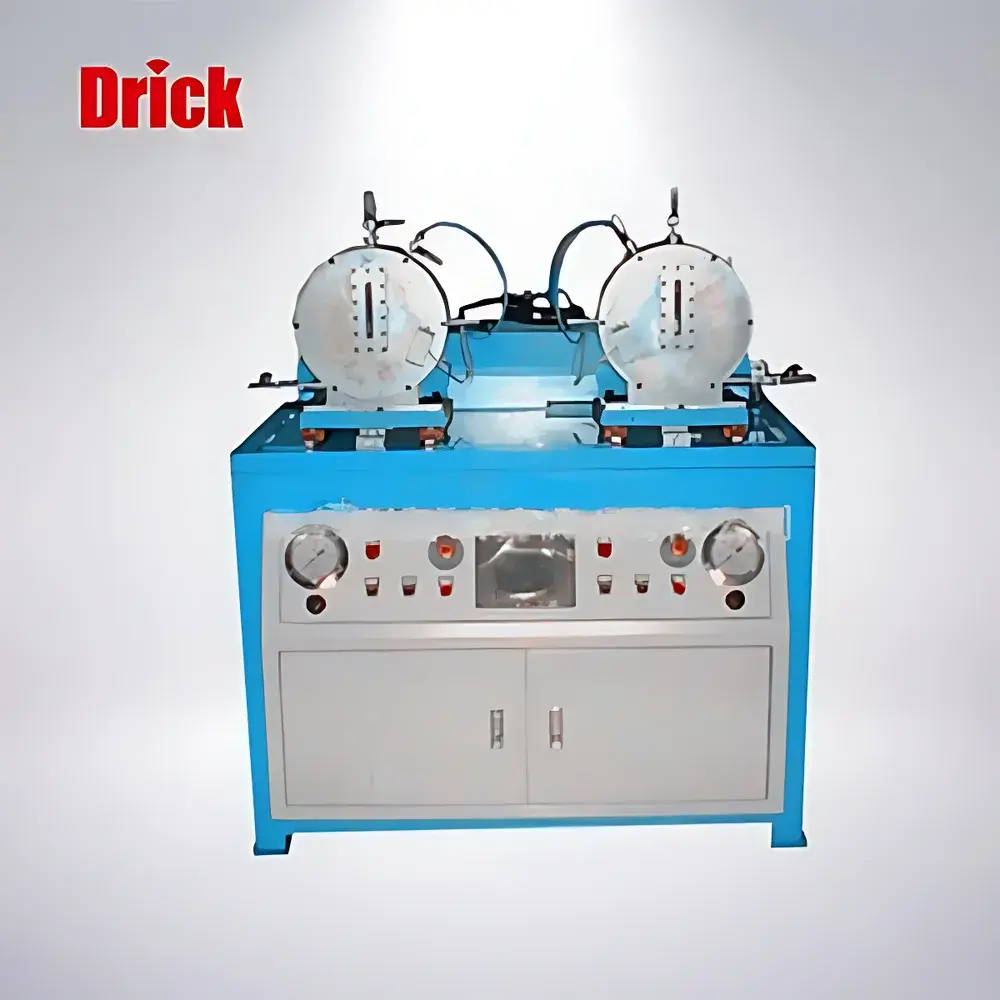
Drick DRK-JJ-3080 Rotary Oil Seal Performance Tester
| Brand | Drick |
|---|---|
| Origin | Shandong, China |
| Manufacturer Type | Direct Manufacturer |
| Country of Origin | China |
| Model | DRK-JJ-3080 |
| Price | USD 7,000 (FOB Qingdao) |
| Max. Spindle Speed | 6000 rpm |
| Spindle Radial Runout | < ±0.03 mm |
| Axial Offset Adjustment Range | 0–5 mm |
| Testable Shaft Bore Diameter | Φ7–Φ200 mm |
| Dual Motor Power | 2 × 2.2 kW |
| Pressure Range | 0–0.03 MPa |
| Temperature Range | Ambient to 130 °C |
| Supply | AC 380 V, 3-phase 5-wire, ±10%, 50 Hz |
| Dimensions (L×W×H) | 1300 × 1000 × 1500 mm |
| Weight | 420 kg |
| Compliance | GB/T 13871.4 (formerly GB/T 14273) |
Overview
The Drick DRK-JJ-3080 Rotary Oil Seal Performance Tester is an engineered test platform designed for standardized evaluation of dynamic sealing performance under controlled rotational, thermal, and pressure conditions. It operates on the principle of simulating real-world shaft rotation in contact with elastomeric or composite lip seals—measuring leakage onset, seal wear progression, and functional stability over time. The system complies with GB/T 13871.4 (equivalent in scope to ISO 9920 and ASTM D3780 for comparative seal qualification), enabling laboratories to conduct repeatable, traceable assessments aligned with quality assurance protocols in automotive, industrial gearbox, hydraulic, and aerospace component manufacturing.
Key Features
- High-precision dual-motor drive architecture supporting bidirectional rotation (CW/CCW) at speeds up to 6000 rpm, with programmable acceleration/deceleration profiles and stable speed regulation (<0.5% variation over 8-hour continuous operation).
- Adjustable spindle eccentricity (0–5 mm) and radial runout compensation (<±0.03 mm) to replicate misalignment-induced stress—a critical failure mode in field applications.
- Integrated temperature-controlled chamber (ambient to 130 °C) with PID-regulated heating elements and calibrated RTD sensors, ensuring uniform thermal exposure across the seal interface.
- Controlled pressure application (0–0.03 MPa) via regulated air supply, allowing simulation of light-pressure lubricant containment scenarios typical in low-viscosity oil systems.
- Modular fixture design accommodating oil seals with shaft bore diameters from Φ7 mm to Φ200 mm—compatible with standard NBR, FKM, ACM, and silicone-based sealing materials.
- PLC-based control system with HMI touchscreen interface, supporting user-defined test sequences, real-time parameter logging (speed, temp, pressure, runtime), and digital output for external data acquisition.
Sample Compatibility & Compliance
The DRK-JJ-3080 accepts standard rotary shaft lip seals conforming to ISO 6194-1, DIN 3760, JIS B2402, and SAE J1972 dimensional specifications. Each test cycle accommodates two identical or dissimilar seals mounted on a common rotating shaft, facilitating comparative analysis (e.g., material A vs. material B under identical boundary conditions). All mechanical and thermal parameters adhere to the test condition requirements defined in GB/T 13871.4, including specified shaft surface roughness (Ra ≤ 0.8 µm), run-in procedures, and minimum test duration thresholds. The system’s structural rigidity and vibration-damped base ensure measurement integrity during high-speed operation, minimizing extraneous variables that could compromise repeatability in GLP-compliant environments.
Software & Data Management
The embedded PLC controller records timestamped operational data—including actual spindle speed, chamber temperature, applied pressure, and cumulative runtime—at configurable intervals (1–60 s). Export is supported via USB or RS-485 to CSV format for post-processing in MATLAB, Excel, or LIMS platforms. Audit trails are maintained for all parameter changes and test initiations, satisfying basic documentation requirements for internal QA processes. While the system does not include FDA 21 CFR Part 11-compliant electronic signatures or role-based access control out-of-the-box, its deterministic I/O architecture allows integration with validated third-party SCADA or MES systems where full GMP traceability is mandated.
Applications
- Qualification testing of new oil seal formulations prior to OEM approval.
- Comparative wear analysis between alternative elastomer compounds under elevated temperature and marginal lubrication.
- Verification of seal performance after exposure to aggressive fluids (e.g., biofuels, synthetic esters) per ASTM D471 immersion protocols.
- Root cause investigation of premature seal leakage in production assemblies—correlating lab test results with field failure modes.
- Supporting technical documentation for PPAP submissions in Tier-1 automotive supply chains.
- Academic research into tribological behavior at the seal-lip/shaft interface under variable PV (pressure × velocity) loads.
FAQ
What standards does the DRK-JJ-3080 directly support?
It is configured and validated for GB/T 13871.4, which governs test methods for rotary shaft lip seals—including speed, temperature, pressure, and duration parameters.
Can the system be calibrated to international metrological standards?
Yes—spindle speed is verified using traceable optical tachometry; temperature sensors are calibrated against NIST-traceable RTD references; pressure transducers meet ISO 17025 calibration intervals when maintained per manufacturer guidelines.
Is dual-seal testing performed simultaneously or sequentially?
Both seals rotate concurrently on the same shaft under identical environmental conditions, enabling direct side-by-side comparison without inter-test variability.
Does the unit support automated pass/fail reporting?
The base system logs raw data but does not generate automated compliance reports; however, custom scripting (via exported CSV) can implement pass/fail logic based on user-defined leakage thresholds or runtime limits.
What maintenance intervals are recommended for long-term reliability?
Motor bearings require relubrication every 2000 operating hours; thermal insulation and seal mounting fixtures should be inspected quarterly for deformation or carbon buildup; PLC firmware updates are issued biannually via Drick’s authorized service portal.