
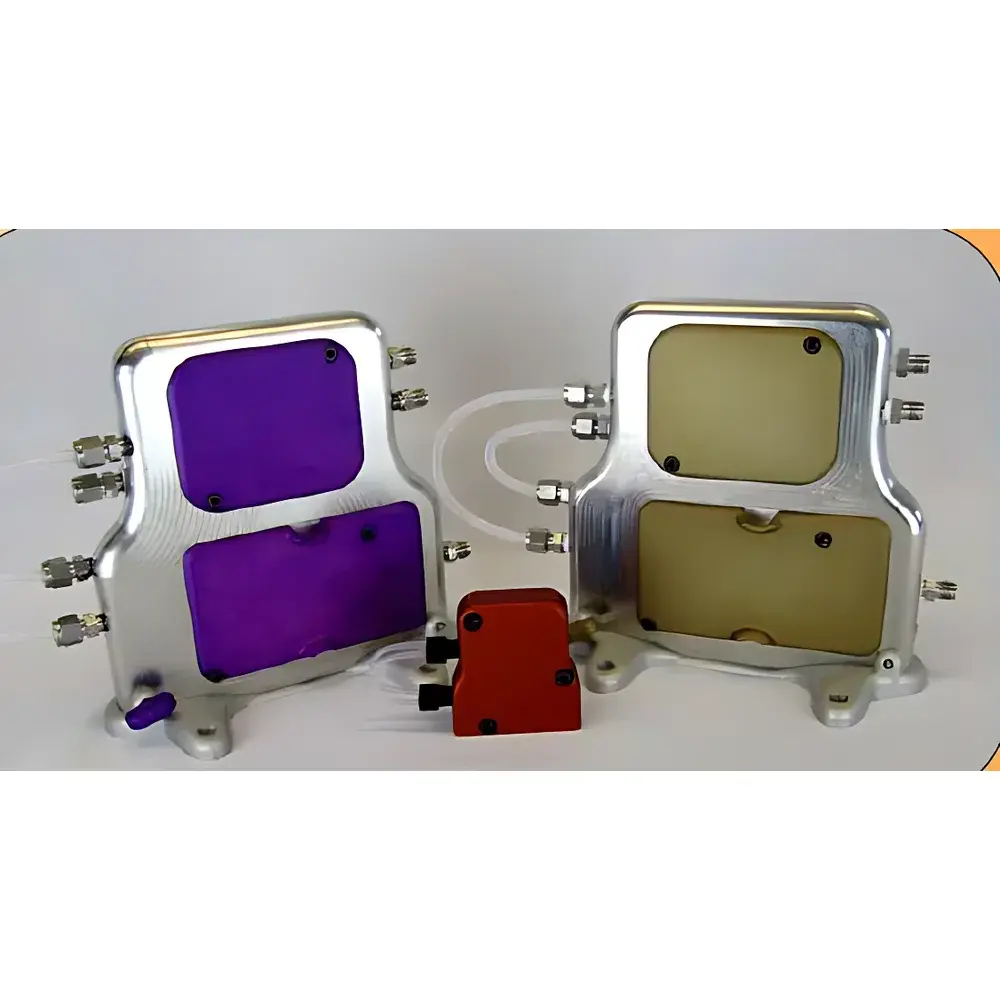
Zaiput High-Efficiency Liquid-Liquid Separator
| Origin | Imported |
|---|---|
| Manufacturer Type | Authorized Distributor |
| Model | Liquid-Liquid Separator |
| Pricing | Available Upon Request |
Overview
The Zaiput High-Efficiency Liquid-Liquid Separator is an engineered membrane-based continuous-phase separation device designed for real-time, inline segregation of immiscible liquid streams—primarily aqueous and organic phases—without reliance on gravitational settling or density differentials. It operates on the principle of selective membrane wetting: a hydrophobic, chemically resistant porous membrane preferentially wets the organic phase while repelling the aqueous phase (or vice versa, depending on membrane surface chemistry), enabling phase-selective permeation under controlled transmembrane pressure. This mechanism eliminates emulsion carryover and ensures stable, uninterrupted separation during flow-through operation—critical for reaction-integrated workups, telescoped synthesis, and continuous manufacturing of pharmaceuticals and fine chemicals.
Key Features
- Phase separation independent of density difference—enables robust handling of low-density-contrast systems (e.g., water/ethyl acetate, water/MTBE) and highly stabilized emulsions
- Ultra-low dead volume (<400 µL in SEP-100; <30 mL in SEP-200 series)—minimizes residence time and preserves labile intermediates, including thermally sensitive, oxidatively unstable, or enzymatically active species
- Chemically inert fluidic path: wetted materials include perfluoropolymers (e.g., PFA, FEP), 316 stainless steel, or Hastelloy® C-276—compatible with strong acids, bases, halogenated solvents, and reactive reagents (e.g., SOCl₂, n-BuLi, DIBAL-H)
- Integrated pressure-balancing manifold maintains constant differential pressure across the membrane—prevents membrane flooding or drying, ensuring reproducible separation efficiency over extended runtimes
- Plug-and-play modular design with standardized 1/4″ or 1/8″ Swagelok®-compatible ports—facilitates rapid integration into existing flow chemistry platforms (e.g., Vapourtec, Syrris, Uniqsis) or custom-built continuous reactors
- Scalable architecture: identical separation physics and membrane surface chemistry from benchtop (SEP-100) to pilot-scale (SEP-200) and near-industrial throughput (upcoming SEP-3000)—supports seamless process transfer without re-optimization
- Reduces solvent consumption by >40% compared to batch extraction—directly lowers E-factor and supports green chemistry metrics (e.g., ACS GCI Principles, ISO 14040)
Sample Compatibility & Compliance
The separator accommodates a broad range of organic-aqueous biphasic systems, including but not limited to: water/THF, water/DCM, water/toluene, water/acetonitrile, and water/IPA. It is validated for use with corrosive media (e.g., 6 M HCl, 5 M NaOH, concentrated HNO₃) and low-surface-tension solvents (e.g., 1,2-dichloroethane, chloroform). All models comply with ASME B31.3 process piping design guidelines for pressure equipment and meet CE marking requirements for electromagnetic compatibility (EMC Directive 2014/30/EU) and low-voltage safety (LVD Directive 2014/35/EU). For regulated environments, the system supports audit-ready documentation packages aligned with ICH Q5, Q7, and FDA 21 CFR Part 11 when paired with compliant data acquisition software.
Software & Data Management
While the Zaiput separator operates as a standalone hardware module, it is fully compatible with third-party flow control and monitoring ecosystems—including LabVIEW-driven PID pressure controllers, PLC-based SCADA systems, and cloud-connected IoT platforms (e.g., Siemens Desigo, Emerson DeltaV). Real-time pressure telemetry (inlet, outlet, transmembrane) can be logged at 10 Hz resolution for trend analysis, fault detection, and PAT (Process Analytical Technology) implementation per FDA Guidance for Industry (2019). Optional analog/digital I/O modules enable closed-loop feedback control of upstream pumps or back-pressure regulators to maintain optimal ΔP window (±0.02 MPa tolerance).
Applications
- In-line quenching and extraction in continuous-flow API synthesis (e.g., Suzuki couplings, amidations, diazotizations)
- Continuous removal of catalyst residues (e.g., Pd, Cu) or acidic/basic scavengers post-reaction
- Integrated workup for biocatalytic processes requiring pH-sensitive enzyme retention
- On-demand solvent switching between reaction and purification zones in multistep flow sequences
- Reducing hold times for unstable intermediates (e.g., aryl diazonium salts, acyl nitroso compounds)
- GMP-compliant continuous manufacturing of oncology and antiviral drug substances
FAQ
Does the separator require pre-equilibration with solvents before use?
No—perfluoropolymer membranes are supplied pre-conditioned and ready for immediate installation. A brief 5-minute flush with the primary organic phase is recommended to stabilize interfacial tension.
Can the device handle solid-containing streams?
Not directly—particulates >1 µm may foul the membrane. In-line filtration (e.g., 0.45 µm PTFE cartridge) upstream is required for slurries or heterogeneous reactions.
What maintenance is required for long-term operation?
Membrane lifetime exceeds 500 operational hours under typical conditions. Regeneration involves sequential rinsing with IPA, acetone, and nitrogen purge—no disassembly needed.
Is validation support available for regulatory submissions?
Yes—Zaiput provides IQ/OQ protocols, material traceability certificates (EN 10204 3.1), and membrane integrity test procedures compliant with ASTM F838-22 for bacterial retention verification.



