
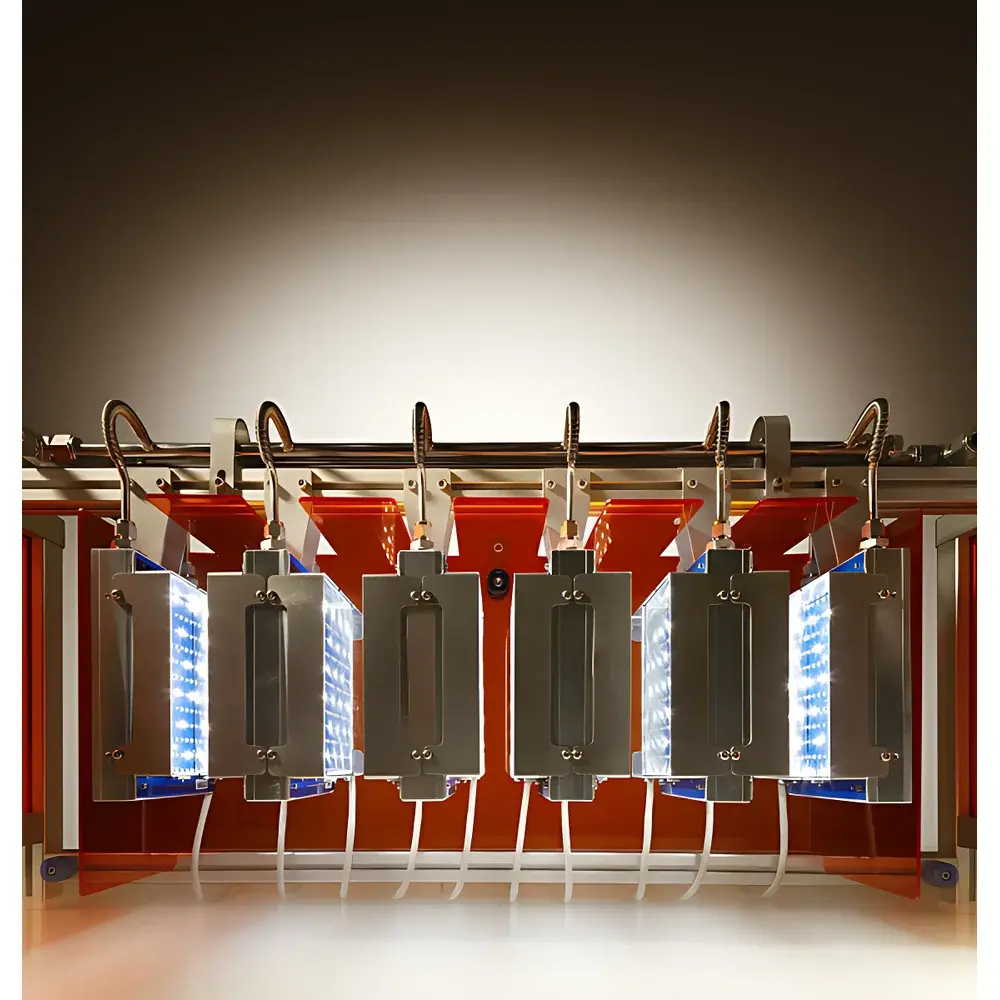
Corning Advanced-Flow® G1 Photochemical Microreactor
| Brand | Corning |
|---|---|
| Origin | France |
| Model | G1 Photochemical Reactor |
| Instrument Type | Microchannel Reactor |
| Construction Material | Borosilicate Glass |
| Operating Pressure | Up to 1.8 MPa (18 bar) |
| Module Volume | 8.2 mL |
| Illumination | Dual-side LED Arrays |
| Wavelength Options | 365 nm, 385 nm, 405 nm, 485 nm, 610 nm, and 4000 K White Light |
| Irradiance | Adjustable up to 100 mW/cm² |
| Flow Rate Range | 15–250 mL/min |
| Scalability | Compatible with Corning G3 Photochemical Reactor for seamless scale-up |
| Cooling | Integrated liquid cooling for LED thermal management |
| Compliance | Designed for GLP-compliant process development and cGMP-aligned pilot-scale synthesis |
Overview
The Corning Advanced-Flow® G1 Photochemical Microreactor is an engineered continuous-flow platform specifically optimized for photochemically driven synthetic transformations. Leveraging Corning’s proprietary Advanced-Flow® microchannel architecture—fabricated from high-purity, optically transparent borosilicate glass—the system enables precise control over photon flux, residence time, temperature, and mass transfer. Unlike batch photochemistry, where light attenuation and thermal gradients limit reproducibility and scalability, the G1 reactor employs a dual-sided, wavelength-selectable LED illumination system integrated directly into the fluidic module housing. This design ensures uniform photon delivery across the entire active reaction volume, minimizing shadowing effects and enabling first-principles-based kinetic modeling. The reactor operates under controlled pressure (up to 1.8 MPa), facilitating reactions requiring elevated pressure or volatile reagents, while its low thermal mass and efficient liquid-cooled LED arrays maintain stable irradiance output over extended operation—critical for long-duration optimization studies or multi-day screening campaigns.
Key Features
- Optically optimized borosilicate glass microchannel modules with 92% UV-VIS transmission (250–700 nm), enabling high-fidelity photonic coupling across all supported wavelengths
- Dual-face illumination geometry ensuring symmetrical photon flux distribution and eliminating axial intensity decay typical in single-source configurations
- Modular LED array system with 10 independently addressable zones, each configurable for discrete wavelength selection and intensity control (0–100 mW/cm²)
- Integrated thermally regulated coolant loop maintaining LED junction temperatures below 45 °C—extending diode lifetime beyond 20,000 hours
- Pressure-rated fluidic interface compatible with standard Swagelok® and VICI® fittings; validated for continuous operation at 1.8 MPa (18 bar)
- Scalable architecture supporting up to five G1 modules in series, with synchronized flow, pressure, and irradiance control via centralized software interface
Sample Compatibility & Compliance
The G1 Photochemical Reactor accommodates a broad range of organic, organometallic, and aqueous photochemical systems—including [2+2] cycloadditions, C–H functionalizations, photocatalytic oxidations/reductions, and singlet oxygen-mediated ene reactions. Its inert glass surface minimizes adsorption or catalytic decomposition of sensitive intermediates (e.g., aryl diazonium salts, acyl radicals). The system meets material compatibility requirements per ASTM E2912 (standard guide for photochemical reactor validation) and supports documentation workflows aligned with FDA 21 CFR Part 11 for electronic records and signatures. Full audit trails—including irradiance calibration logs, flow-pressure timestamps, and module temperature histories—are exportable in CSV and PDF formats for regulatory submission.
Software & Data Management
Control and monitoring are executed via Corning’s AF-Link™ software suite, a Windows-based application supporting real-time visualization of flow rate, backpressure, LED intensity per zone, and coolant temperature. The software implements automated method sequencing, including ramped irradiance profiles and segmented residence time protocols. All operational parameters are timestamped and stored with cryptographic hashing to ensure data integrity. Exported datasets include metadata compliant with ISA-88/ISA-95 frameworks, facilitating integration into LIMS and MES platforms used in pharmaceutical process development labs. Remote diagnostics and firmware updates are supported via secure TLS 1.3 connections.
Applications
- Rapid screening of photocatalyst performance under varied spectral conditions (e.g., comparing Ir(ppy)₃ vs. Ru(bpy)₃²⁺ at 455 nm)
- Development of photoredox C–N cross-coupling processes with strict oxygen exclusion and millisecond-level residence time control
- Safe handling of hazardous intermediates (e.g., diazo compounds, azides) through inherently small inventory (<8.2 mL per module) and immediate quench capability
- Process intensification of API photosteps—demonstrated in published case studies for vitamin D analogs and fluorinated heterocycles
- Seamless transition from G1 lab-scale optimization (15–250 mL/min) to G3 pilot production (up to 10 L/h) without re-optimization of photochemical kinetics
FAQ
Is the G1 reactor compatible with corrosive reagents such as concentrated HCl or bromine solutions?
Yes—provided reagent compatibility is verified against Corning’s chemical resistance chart for borosilicate glass 3.3; hydrofluoric acid and hot concentrated phosphoric acid are excluded.
Can irradiance be calibrated traceably to NIST standards?
Yes—each LED array is supplied with a factory-issued calibration certificate referencing NIST-traceable spectroradiometric measurements at 25 °C ambient.
What safety interlocks are implemented for UV exposure?
The system features dual redundant hardware interlocks: a physical light-shutter mechanism that engages upon door opening, and a Class 1 laser safety-rated enclosure meeting IEC 60825-1:2014 requirements.
Does the G1 support gas–liquid photochemistry (e.g., photooxidation with O₂)?
Yes—via optional T-mixers and back-pressure regulators; gas solubility is enhanced by the reactor’s high surface-area-to-volume ratio and segmented flow regime.
How is temperature controlled during exothermic photoreactions?
Jacketed cooling channels surrounding the glass module enable precise thermal regulation (±0.5 °C) using external chillers; heat transfer coefficients exceed 1,200 W/m²·K under typical flow conditions.



