
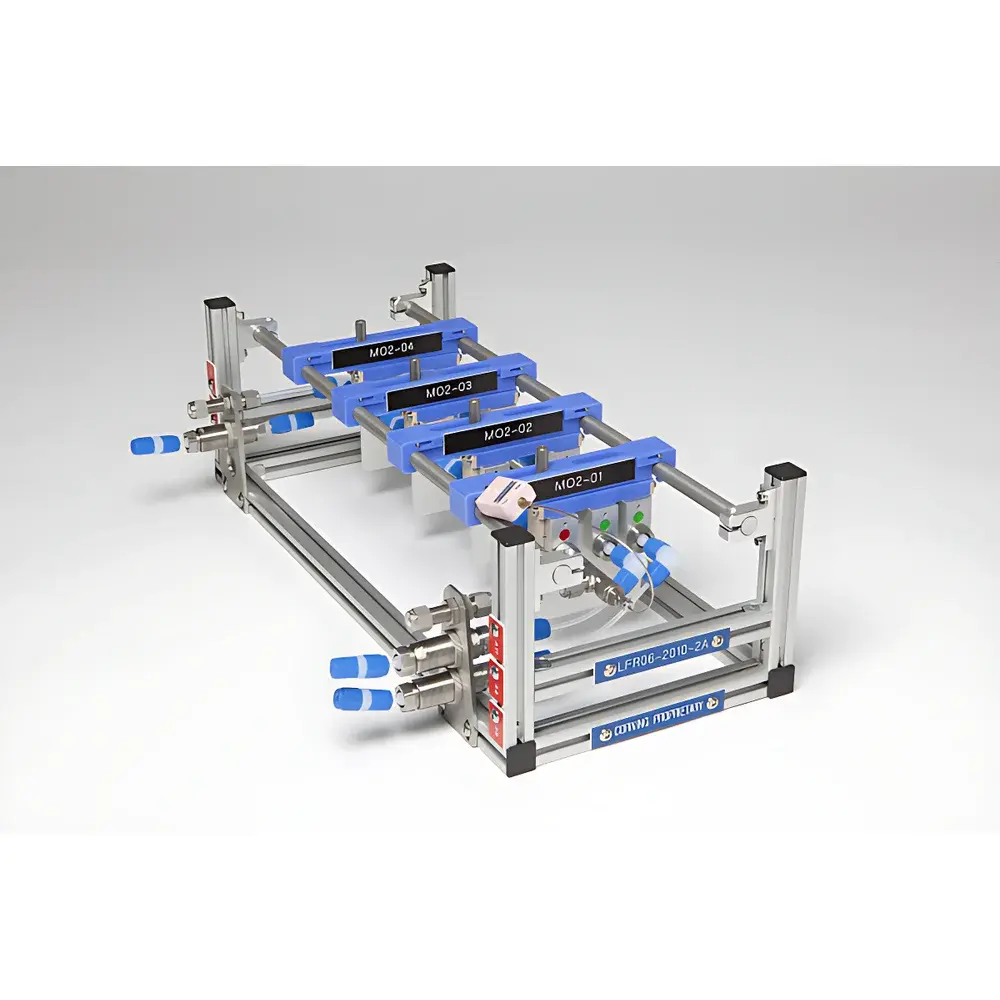
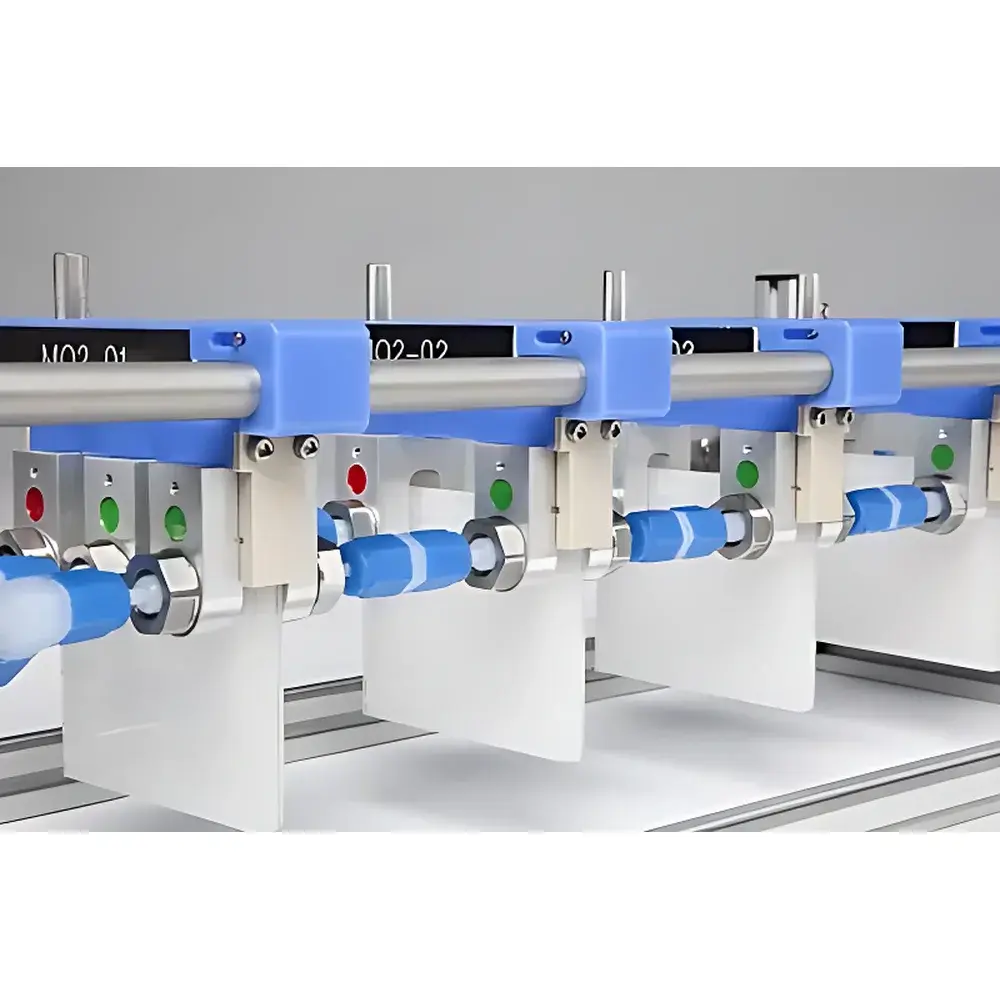
Corning LFR Low-Flow Microchannel Reactor Platform
| Brand | Corning |
|---|---|
| Origin | France |
| Model | LFR Reactor |
| Reactor Type | Microchannel Continuous Flow Reactor |
| Construction Material | Borosilicate Glass |
| Operating Temperature Range | −25 °C to +200 °C |
| Maximum Operating Pressure | 18 bar |
| Total Internal Volume (per module) | Module A ≈ 2.5 mL, Module B ≈ 2.0 mL |
| Flow Rate Range | 0.01–200 mL/min |
| Pressure Drop (at 5 mL/min, 20 °C) | ~1.5 bar (Module A), ~1.5 bar (Module B) |
| Pressure Drop (at 200 mL/min, 20 °C) | ~0.4 bar (Module A), ~0.5 bar (Module B) |
| Reactor Configuration | Modular (A & B units operable independently or in series) |
Overview
The Corning® Low-Flow Reactor (LFR) platform is a precision-engineered microchannel continuous flow reactor system designed for laboratory-scale process development, reaction screening, and kilogram-scale synthesis of fine chemicals and pharmaceutical intermediates. Built on Corning’s proprietary glass microfluidic architecture, the LFR leverages laminar flow, high surface-area-to-volume ratios, and rapid thermal mass transfer to deliver exceptional control over residence time, temperature, mixing efficiency, and interfacial contact—enabling reproducible, scalable, and inherently safer chemical transformations. Unlike batch reactors, the LFR operates under steady-state conditions with defined hydrodynamic profiles governed by Poiseuille flow principles, minimizing axial dispersion and enabling precise kinetic characterization. Its all-glass fluidic path ensures chemical inertness across broad pH and solvent compatibility ranges—including strong acids, bases, and halogenated organics—while supporting photochemical activation via UV-transparent borosilicate construction.
Key Features
- Modular Architecture: Comprises two interchangeable reactor modules (Module A and Module B), each with independent thermal management and pressure control—enabling parallel experimentation or sequential multi-step synthesis in a single integrated flow path.
- High-Fidelity Process Control: Integrated temperature zones allow independent heating/cooling of each module (−25 °C to +200 °C), supported by calibrated Pt100 sensors and PID controllers achieving ±0.5 °C stability under dynamic flow conditions.
- Robust Pressure Handling: Certified for continuous operation up to 18 bar, with full ASME B31.3-compliant pressure boundary design and integrated safety relief mechanisms compliant with PED 2014/68/EU.
- Optimized Mass & Heat Transfer: Microchannel geometry (hydraulic diameter < 500 µm) delivers volumetric heat transfer coefficients exceeding 10,000 W/m²·K and mixing times < 10 ms—critical for exothermic, fast, or highly selective reactions.
- Minimal Reagent Consumption: Total active reaction volume per module is ≤2.5 mL, reducing raw material requirements by >95% compared to conventional batch vessels—ideal for precious substrates, isotopically labeled compounds, or early-stage toxicology candidates.
- Visual Process Monitoring: Fully transparent borosilicate glass construction enables real-time observation of phase behavior, precipitation, gas evolution, and fouling—supporting rapid troubleshooting and mechanistic insight.
Sample Compatibility & Compliance
The LFR platform accommodates liquid–liquid, gas–liquid, and heterogeneous slurries (particle size < 50 µm) without clogging, validated per ISO 1127:2017 for glass tubing integrity and ASTM E2915-21 for thermal shock resistance. It supports GMP-aligned workflows through optional audit-trail-enabled control software compliant with FDA 21 CFR Part 11. All wetted components meet USP Class VI biocompatibility standards and are compatible with cleaning validation protocols per ICH Q5C. Reaction data generated on the LFR satisfies regulatory expectations for process understanding under ICH Q8(R2) and Q9 frameworks, particularly for defining design space and critical process parameters (CPPs).
Software & Data Management
The Corning LFR is operated via Corning Reactor Control Software (v4.2+), a Windows-based application providing synchronized control of syringe pumps, thermal zones, back-pressure regulators, and inline analytics interfaces (e.g., FTIR, UV-Vis). The software records timestamped, encrypted process logs—including flow rate, pressure, temperature, and valve position—with configurable sampling intervals down to 100 ms. Raw data exports comply with ASTM E2500-18 for raw data integrity and support automated report generation aligned with ALCOA+ principles (Attributable, Legible, Contemporaneous, Original, Accurate, Complete, Consistent, Enduring, Available). Optional integration with ELN systems (e.g., LabArchives, Benchling) via RESTful API enables seamless traceability from lab notebook to pilot plant scale-up.
Applications
- Kinetic studies and mechanism elucidation of fast organic transformations (e.g., lithiations, diazotizations, nitration)
- Safe handling and synthesis of thermally unstable or energetic intermediates (e.g., diazonium salts, peroxides, azides)
- Photocatalytic C–H functionalization and [2+2] cycloadditions using integrated LED arrays
- Heterogeneous catalysis with immobilized Pd, Ni, or enzyme cartridges
- Multi-step telescoped syntheses—eliminating isolation of hazardous intermediates
- Process intensification of API manufacturing steps subject to ICH Q5A–Q5E comparability assessments
FAQ
Can the LFR be used for gas–liquid hydrogenation reactions?
Yes—the platform supports co-current and segmented gas–liquid flow with mass-transfer-limited kinetics characterized via Danckwerts’ correlation; H₂ dissolution rates exceed 0.8 mmol/min·mL at 10 bar and 80 °C.
Is the system compatible with corrosive reagents such as oleum or anhydrous HF?
Borosilicate glass exhibits excellent resistance to most mineral acids below 150 °C; however, prolonged exposure to concentrated HF or hot phosphoric acid is not recommended—alternative fluoropolymer-lined configurations are available upon request.
How does Corning ensure scalability from LFR to production scale?
Corning’s numbering-up strategy maintains identical channel geometry, Reynolds number, and dimensionless residence time distribution (RTD) across scales—from LFR (mm-scale) to G1 (litre-scale) to AFGR (tonne-scale)—ensuring direct translation of kinetic models and safety margins per ISO 8502-1:2022.
What maintenance is required for long-term operational reliability?
Routine inspection of O-rings (FKM), calibration of pressure transducers every 6 months, and quarterly verification of thermal uniformity using IR thermography per ASTM E1933-19 are recommended.
Does the LFR support PAT integration for real-time reaction monitoring?
Yes—standard ¼″ NPT ports accommodate inline flow cells for Raman, UV-Vis, or ATR-FTIR probes, with analog/digital I/O for closed-loop feedback control of residence time or stoichiometry.



