
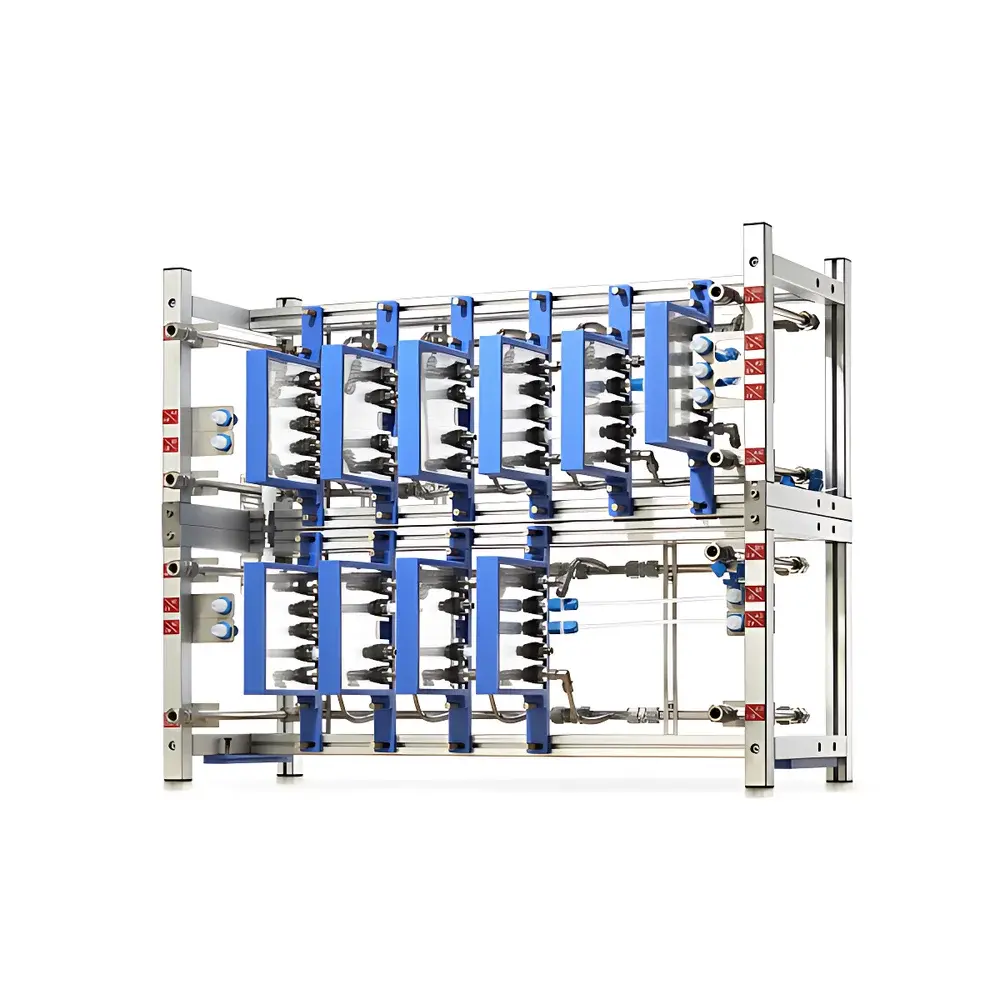
Corning G1 Glass Microchannel Reactor
| Brand | Corning |
|---|---|
| Origin | France |
| Model | G1 Reactor |
| Instrument Type | Microchannel Reactor |
| Construction Material | Borosilicate Glass |
| Operating Pressure | Up to 1.8 MPa (gauge) |
| Temperature Range | –60 °C to +200 °C |
| Module Volume | 8.2 mL |
| Flow Rate Range | 15–250 mL/min |
| Residence Time | 5.0 s at 100 mL/min |
| Pressure Drop | 0.075–6.0 bar (dependent on flow rate, fluid density = 1000 kg/m³, viscosity = 1–10 mPa·s) |
| Compliance | Designed for GLP-compliant process development and scalable continuous manufacturing |
Overview
The Corning G1 Glass Microchannel Reactor is an engineered platform for continuous-flow chemical synthesis, grounded in microfluidic principles and precision glass fabrication. It operates on the principle of laminar flow within etched borosilicate glass channels—enabling exceptional heat and mass transfer, precise residence time control, and intrinsic safety through small holdup volume (<8.2 mL per module). Unlike traditional batch reactors, the G1 leverages high surface-area-to-volume ratios (≈10,000 m²/m³) to achieve rapid thermal equilibration and near-instantaneous mixing via diffusion and segmented flow regimes. This architecture supports kinetic studies, exothermic reaction management, photochemical transformations, and gas–liquid–solid multiphase reactions under tightly controlled conditions. Its design aligns with ICH Q5 and Q8 guidelines for quality-by-design (QbD) implementation in early-stage process development.
Key Features
- Borosilicate glass construction ensures full transparency for real-time visual monitoring and eliminates metallic leaching—critical for catalysis, pharmaceutical intermediates, and high-purity electronic chemicals.
- Modular configuration: Two independent reactor decks (top and bottom) can operate in parallel or be hydraulically and thermally coupled in series for extended residence time or multi-step cascade reactions.
- Multi-zone temperature control: Each deck interfaces with a dedicated thermal exchange plate, enabling discrete setpoints across zones (e.g., –40 °C for cryogenic lithiation followed by +180 °C for cyclization).
- Multi-feed capability: Four independent inlet ports support co-feeding of reagents, catalysts, quenching agents, or gaseous streams (e.g., O₂, H₂, Cl₂) with synchronized flow regulation.
- Pressure-rated operation up to 1.8 MPa (260 psi) enables superheated solvent processing, hydrogenations, and carbonylations without phase separation or pump cavitation.
- Scalable fluidic performance: Validated flow range of 15–250 mL/min delivers linear scalability from lab screening (mg–g scale) to pilot production (up to 80 metric tons/year per unit).
Sample Compatibility & Compliance
The G1 reactor accommodates homogeneous solutions, slurries (particle size <50 µm), emulsions, and gas–liquid systems—including corrosive media such as concentrated HCl, HNO₃, H₂SO₄, and organic acids (excluding hydrofluoric acid and elemental fluorine). Its all-glass wetted path complies with USP Class VI biocompatibility requirements and meets ASTM E2913-13 for glass corrosion resistance testing. The system supports audit-ready documentation per FDA 21 CFR Part 11 when integrated with validated SCADA or LIMS interfaces. Design documentation conforms to ISO 14040 (life cycle assessment) and IEC 61511 (functional safety for SIS integration).
Software & Data Management
While the G1 hardware operates standalone with analog/PID controllers, it is fully compatible with third-party automation platforms (e.g., Siemens Desigo, LabVIEW, or DeltaV) via 4–20 mA and Modbus RTU interfaces. Real-time pressure, temperature, and flow data are timestamped and exportable in CSV/Excel format. When deployed in regulated environments, optional electronic logbook modules provide ALCOA+ compliant data integrity—including user authentication, change tracking, and immutable audit trails aligned with GMP Annex 11 and PIC/S TR 79.
Applications
- Rapid screening of reaction parameters (temperature, stoichiometry, residence time) for Grignard, Suzuki, and photoredox couplings.
- Safe handling of highly energetic nitration, diazotization, and ozonolysis reactions via instantaneous heat removal.
- Continuous crystallization and nanoparticle synthesis (e.g., metal oxides, MOFs) with narrow PDI control.
- Enzymatic transformations requiring pH- and temperature-sensitive immobilized biocatalysts.
- Development of continuous API manufacturing trains compliant with FDA’s Emerging Technology Program.
- Education and training in flow chemistry fundamentals, process intensification, and green chemistry metrics (E-factor, PMI, solvent intensity).
FAQ
What is the maximum allowable operating temperature for the G1 reactor?
The reactor is rated for continuous operation from –60 °C to +200 °C; short-term excursions up to +220 °C are permissible with derated pressure limits.
Can the G1 handle solid-containing feeds?
Yes—slurries with particles ≤50 µm and solids loading ≤10 wt% are supported; optional inline ultrasonic actuators mitigate channel fouling.
Is the G1 compatible with hazardous gases such as chlorine or hydrogen sulfide?
Yes, provided appropriate gas detection, ventilation, and ASME B31.3-compliant downstream scrubbing are implemented per site-specific HAZOP analysis.
How is residence time calculated and verified?
Residence time (τ) is defined as V/Q, where V = 8.2 mL (active volume) and Q = volumetric flow rate (mL/min); experimental validation uses tracer pulse response (e.g., acetone UV absorbance) with ±0.2 s reproducibility.
Does Corning offer validation support for GMP deployment?
Yes—Corning provides IQ/OQ protocol templates, material traceability dossiers (EN 10204 3.1), and joint commissioning with qualified vendors for 21 CFR Part 11–compliant installations.



