
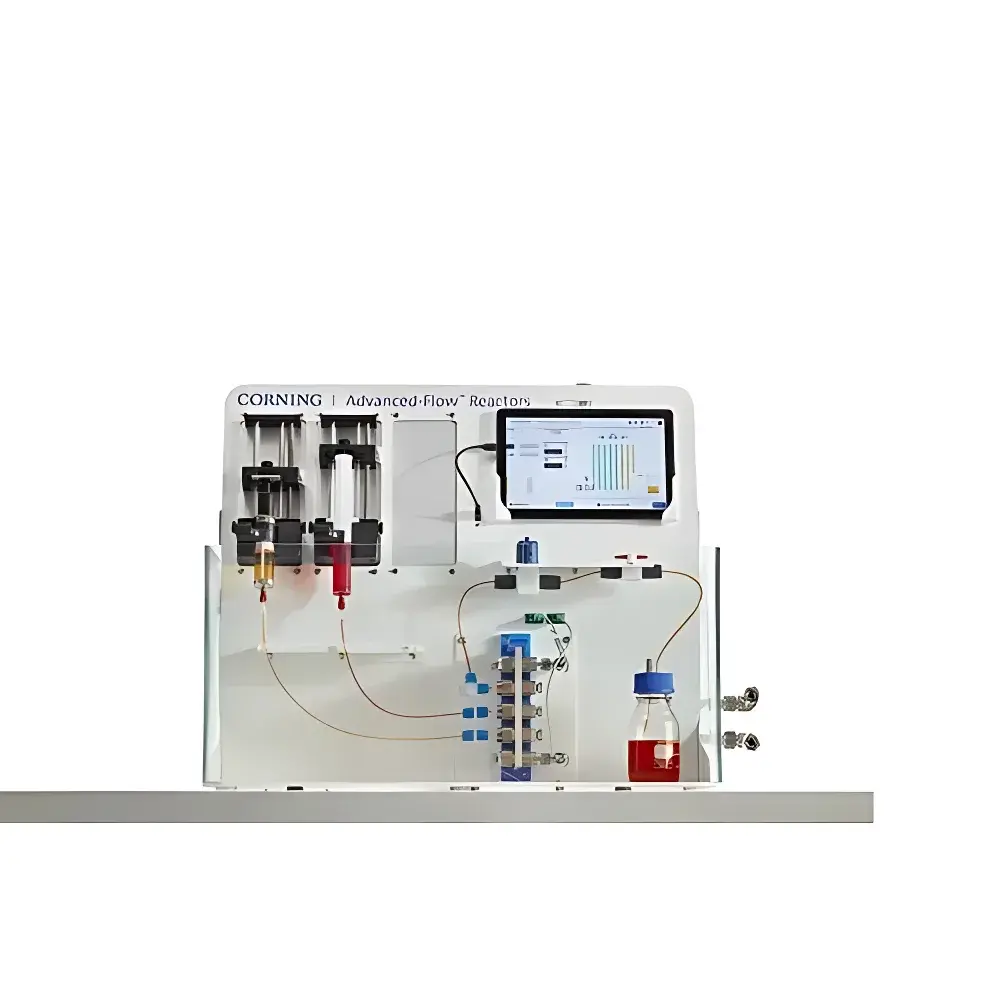
Corning Nebula™ Education Platform – Microchannel Continuous Flow Reactor for Teaching
| Brand | Corning |
|---|---|
| Origin | France |
| Manufacturer Type | Authorized Distributor |
| Product Category | Imported Instrument |
| Model | Nebula™ |
| Instrument Classification | Microchannel Reactor |
| Usable Volume | Small-scale |
| Construction Material | Specialty Glass |
| Operating Pressure | Medium Pressure (up to 6 bar) |
| Capacity | 2.7 mL or 8.2 mL |
| Vacuum Capability | Up to 6 bar (gauge) |
Overview
The Corning Nebula™ Education Platform is a purpose-built, glass-based microchannel continuous flow reactor system engineered for undergraduate and graduate-level instruction in chemistry and chemical engineering. It operates on the fundamental principles of laminar flow fluid dynamics and rapid interfacial mass/heat transfer within precisely fabricated microstructured channels—enabling precise residence time control, exceptional thermal management, and intrinsic process safety. Unlike conventional batch reactors, this platform eliminates risks associated with exothermic runaway, accumulation of unstable intermediates, and operator exposure by minimizing hold-up volume and maximizing surface-to-volume ratio. Designed specifically for pedagogical use, the Nebula™ system integrates transparent Corning specialty glass modules that allow real-time visual observation of fluid behavior, mixing patterns, phase separation, and reaction progression—transforming abstract kinetic and transport concepts into tangible, experiential learning outcomes.
Key Features
- Patented heart-shaped microchannel geometry optimized for uniform flow distribution, enhanced radial mixing, and minimized dispersion—critical for reproducible kinetic studies and residence time distribution (RTD) analysis.
- Chemically resistant, optically transparent Corning specialty glass construction ensures long-term stability under acidic, basic, and organic solvent conditions while enabling direct optical monitoring (e.g., UV-Vis spectroscopy, colorimetric endpoint detection).
- Dual configuration options: Chemistry Edition (focused on synthetic methodology, catalysis, and photochemistry) and Chemical Engineering Edition (emphasizing heat/mass transfer coefficients, pressure drop characterization, and scale-up correlation metrics).
- Integrated digital interface with capacitive touchscreen, intuitive icon-driven workflow navigation, and Bluetooth/Wi-Fi connectivity for remote parameter adjustment and real-time data logging.
- Inherently scalable architecture: All geometric and hydraulic parameters (e.g., channel aspect ratio, Péclet number, Graetz number) are dimensionally consistent with Corning’s industrial-scale G1 and G4 microchannel reactors—enabling seamless transition from classroom experiment to pilot-scale process validation without empirical re-optimization.
Sample Compatibility & Compliance
The Nebula™ platform accommodates a broad range of liquid-phase reactions—including nucleophilic substitution, Grignard additions, diazotization, nitration, hydrogenation (with immobilized catalyst cartridges), and photoredox transformations—under controlled temperature (ambient to 120 °C via optional heated jacket) and pressure (up to 6 bar gauge). Its all-glass wetted path complies with ISO 8573-1 (compressed air purity) and ASTM E2656 (standard guide for microreactor performance evaluation). The system supports GLP-aligned documentation practices through timestamped audit trails, user-access controls, and exportable CSV/JSON datasets—facilitating alignment with university laboratory safety protocols and industry-aligned curriculum frameworks.
Software & Data Management
The Nebula™ Control Suite provides a browser-based dashboard compatible with Windows, macOS, and ChromeOS. It records volumetric flow rates (via integrated Coriolis or gear-pump feedback), pressure differentials (across chip inlet/outlet), and optional external sensor inputs (e.g., inline IR, conductivity, or temperature probes). All sessions generate FAIR-compliant (Findable, Accessible, Interoperable, Reusable) metadata packages, including flow map overlays, RTD histograms, and calibration certificates. Data exports meet ASTM E1910 requirements for electronic lab notebook integration and are compatible with MATLAB, Python (Pandas/NumPy), and Aspen Custom Modeler for advanced kinetic modeling exercises.
Applications
- Teaching core concepts: residence time distribution analysis, Damköhler number interpretation, adiabatic vs. isothermal reaction profiling, and selectivity–conversion trade-off visualization.
- Student-led process intensification projects: comparing yield/selectivity between batch and continuous modes for esterification or Suzuki coupling.
- Safe introduction to hazardous chemistry: handling diazonium salts, azides, or ozonolysis intermediates at sub-milliliter inventory levels.
- Interdisciplinary labs bridging chemistry, mechanical engineering (fluid mechanics), and computer science (PID loop tuning, IoT-enabled monitoring).
- Capstone design modules evaluating techno-economic metrics: space-time yield (kg·m⁻³·h⁻¹), energy intensity (kWh·kg⁻¹), and inherent safety index (HSI) scoring per CCPS guidelines.
FAQ
Is the Nebula™ platform compatible with standard syringe pumps and HPLC systems?
Yes—it features standardized 1/16″ Swagelok® ports and accepts flow rates from 0.01 to 10 mL·min⁻¹ using commercially available peristaltic, syringe, or diaphragm pumps.
Can students perform kinetic modeling directly using collected data?
Absolutely—the software exports time-stamped concentration, temperature, and pressure arrays suitable for nonlinear regression in tools like COPASI or KinTek Explorer.
Does the system support multi-step reaction sequences?
Yes—modular chip stacking and external T-mixers enable up to four sequential reaction zones with independent thermal zones and residence time control.
What training resources accompany the platform?
Corning provides an instructor’s manual with 12 validated experiments, pre-lab quizzes, safety checklists, and alignment tables mapping each activity to ABET Criterion 3 student outcomes.
How is maintenance and cleaning performed?
All glass chips are ultrasonically cleanable; no consumable gaskets or seals are required—reducing total cost of ownership and eliminating cross-contamination risks between experiments.



