
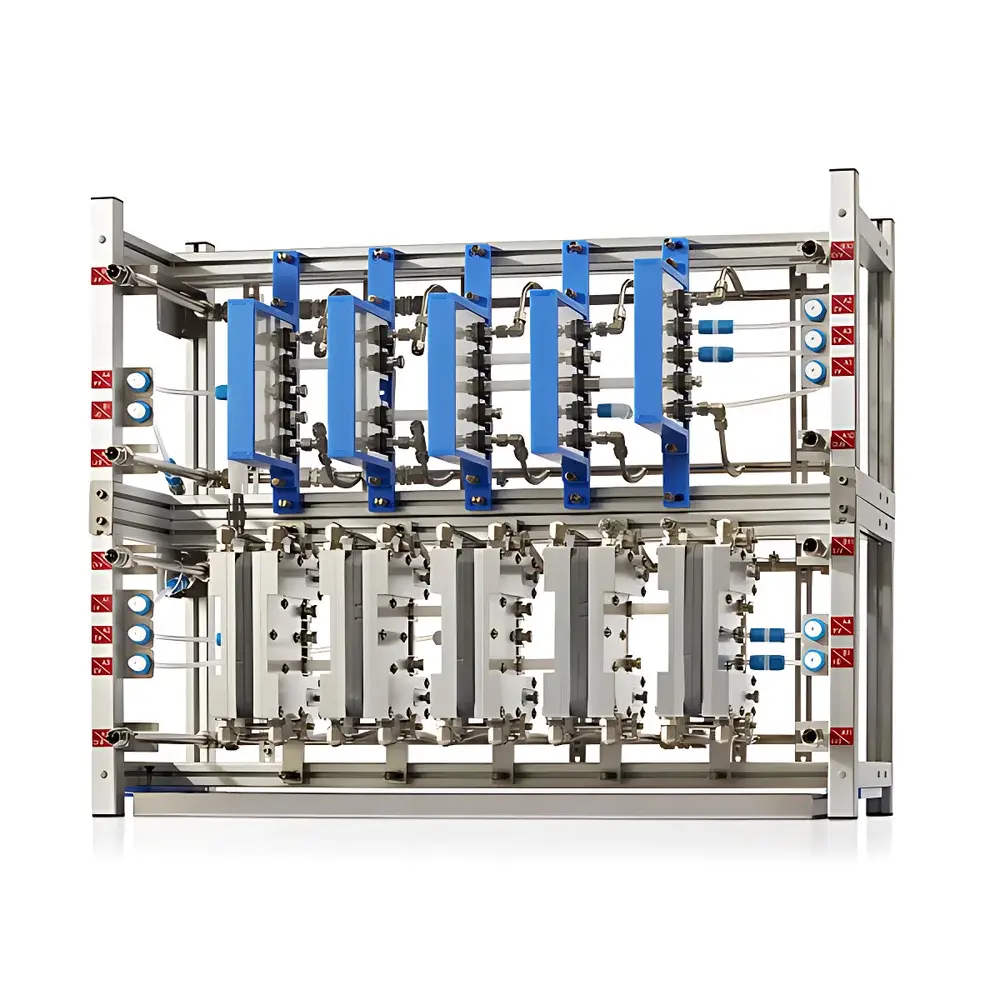
Corning G1 Hybrid Microchannel Reactor
| Brand | Corning |
|---|---|
| Origin | France |
| Model | G1 Hybrid |
| Instrument Category | Microchannel Reactor |
| Usable Volume | 8 mL |
| Operating Pressure | Up to 1.8 MPa (gauge) |
| Temperature Range | −60 °C to 200 °C |
| Flow Rate Range | 15–250 mL/min |
| Material Configuration | Borosilicate Glass + Silicon Carbide Modules |
| Vacuum Capability | Not applicable (designed for pressurized operation) |
| Compliance | CE-marked, ASME B31.3 process piping design principles applied |
Overview
The Corning G1 Hybrid Microchannel Reactor is an engineered platform for continuous-flow synthesis and process intensification in research and early-stage development laboratories. Built upon Corning’s proprietary microstructured reactor architecture, the G1 Hybrid integrates two functionally distinct reaction modules—borosilicate glass and silicon carbide—within a single, modular, and pressure-rated system. Its operational principle relies on laminar flow within precisely fabricated microchannels (typically 100–500 µm hydraulic diameter), enabling rapid heat and mass transfer, precise residence time control, and exceptional reproducibility across reaction scales. Designed for compatibility with both thermal and photochemical transformations, the system supports safe, scalable exploration of highly exothermic, hazardous, or kinetically demanding reactions—including nitrations, halogenations, lithiations, and catalytic hydrogenations—under tightly controlled conditions.
Key Features
- Modular dual-material architecture: Interchangeable borosilicate glass and silicon carbide reaction cartridges mounted on a common manifold baseplate, allowing rapid reconfiguration without hardware modification.
- Optical transparency: The glass module enables real-time visual monitoring of fluid behavior, phase separation, precipitation, and photochemical activation using UV–vis light sources (e.g., 365 nm LED arrays).
- Chemical resilience: The silicon carbide module exhibits outstanding resistance to strong bases (e.g., >30% NaOH), hydrofluoric acid, molten salts, and aggressive oxidants—enabling in-line quenching, neutralization, or corrosive workup steps.
- Wide operational envelope: Validated for continuous operation from −60 °C (with external cryogenic cooling) to 200 °C (with integrated electric heating jackets); maximum allowable working pressure of 1.8 MPa (gauge), supporting high-boiling solvents and supercritical conditions.
- Flexible flow routing: Independent inlet/outlet ports per module permit parallel, serial, or bypass configurations—ideal for multi-step cascades, residence time distribution studies, or comparative kinetic screening.
- Standardized fluidic interface: 1/4″ NPT and Swagelok®-compatible connections; integrated pressure transducers and PT100 temperature sensors at all critical nodes for closed-loop process monitoring.
Sample Compatibility & Compliance
The G1 Hybrid accommodates homogeneous, heterogeneous, and multiphase reaction mixtures—including slurries with particles <50 µm—without clogging, owing to its optimized channel geometry and absence of dead volumes. It complies with EU Machinery Directive 2006/42/EC and carries CE marking for laboratory use. All wetted parts meet USP Class VI biocompatibility requirements. System validation documentation supports IQ/OQ protocols aligned with GLP and early-phase GMP environments. While not certified for pharmaceutical manufacturing under Annex 1, it is routinely employed in API route scouting and impurity profiling per ICH Q5A and Q8(R2) guidelines.
Software & Data Management
The reactor operates with Corning’s optional Reactor Control Suite (RCS v3.2), a Windows-based application providing synchronized control of flow rates (via connected syringe or HPLC pumps), temperature setpoints, and pressure limits. RCS logs timestamped sensor data at 1 Hz resolution, exports CSV/Excel-compatible files, and supports audit trails compliant with FDA 21 CFR Part 11 when deployed with electronic signatures and role-based access control. Raw data integrity is preserved through SHA-256 hashing of acquisition sessions; no cloud storage is enabled by default.
Applications
- Photochemical C–H functionalization under visible-light irradiation
- Safe handling of diazonium intermediates and azide chemistry
- High-selectivity asymmetric epoxidation using immobilized chiral catalysts
- In-line quenching of Grignard reagents with CO₂ followed by carboxylation
- Continuous crystallization of active pharmaceutical ingredients (APIs) with narrow PSD control
- Reaction calorimetry via temperature-rise profiling across adiabatic segments
FAQ
Can the glass and SiC modules be operated simultaneously under different temperature/pressure conditions?
Yes—the modules are thermally and hydraulically isolated; independent heating/cooling circuits and pressure regulation allow concurrent operation at divergent setpoints.
Is cleaning validation supported for GMP-aligned workflows?
Yes—Corning provides swab recovery test protocols and residue detection limits (≤1 ppm residual solvent) using GC-MS/HPLC-UV methods.
What pump types are recommended for stable low-flow delivery (e.g., <20 mL/min)?
Precision syringe pumps with pulse-dampening accumulators or dual-piston HPLC pumps calibrated for aqueous/organic mobile phases are advised.
Does the system support automated pH or conductivity inline monitoring?
Yes—standard 12 mm probe ports (DIN 19267) are available for integration with third-party electrochemical sensors.
Are spare cartridges and gasket kits available as consumables?
Yes—glass and SiC cartridges, Kalrez® O-rings, and stainless-steel compression fittings are stocked with lead times <2 weeks ex-France warehouse.



