
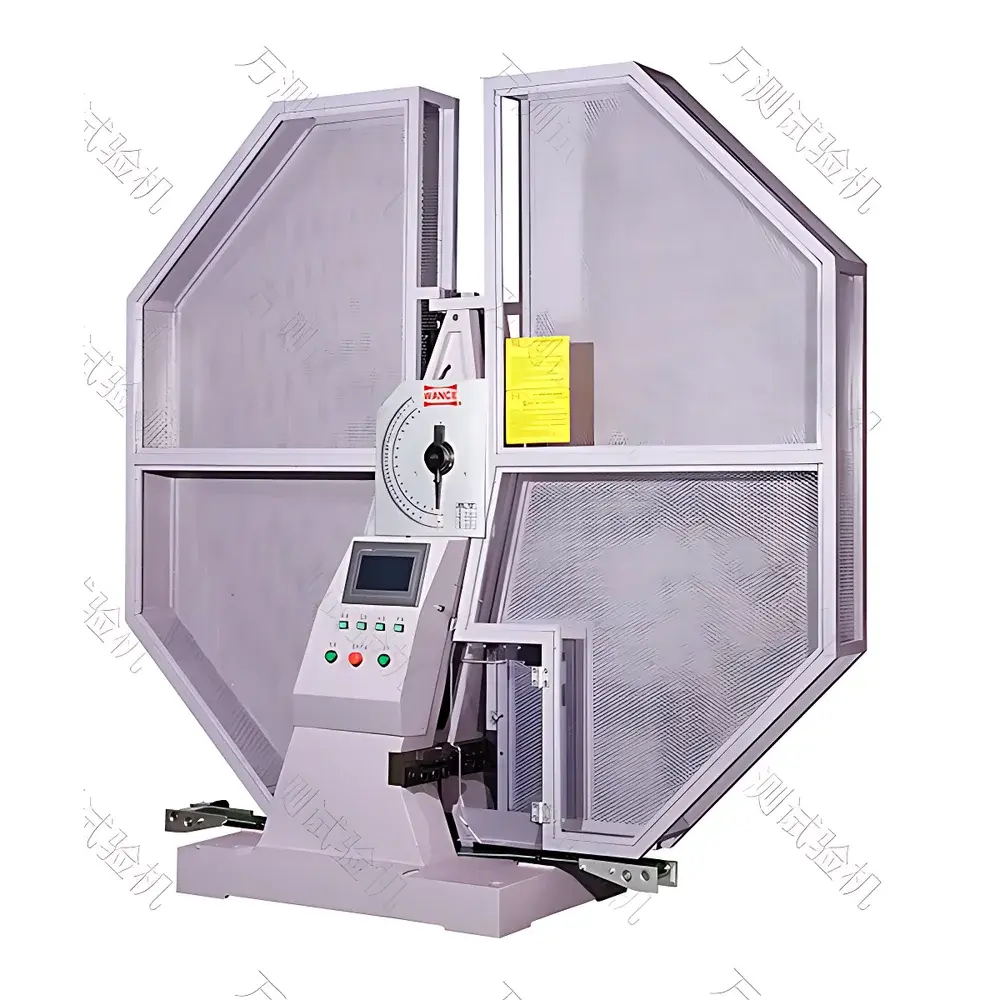
WANCE PIT Series D Dual-Column Pendulum Impact Tester
| Brand | WANCE |
|---|---|
| Origin | Beijing, China |
| Model | PIT Series D |
| Instrument Type | Pendulum Impact Tester |
| Impact Energy | Up to 750 J (configurable with interchangeable pendulums: 150 J, 300 J, 450 J, 600 J, 750 J) |
| Impact Velocity | 5.24 m/s |
| Pendulum Moment (Impact Constant) | Standardized per ISO 148-1 and ASTM E23 |
| Load Cell Range | Configurable per pendulum energy rating (e.g., ±5 kN for 300 J |
| Maximum Lifting Height | 750 mm (center of percussion to pivot axis) |
Overview
The WANCE PIT Series D Dual-Column Pendulum Impact Tester is a precision-engineered instrument designed for standardized Charpy and Izod impact testing of metallic materials under dynamic loading conditions. It operates on the principle of gravitational potential energy conversion: a calibrated pendulum is raised to a defined initial angle (150°), released, and allowed to strike a notched specimen supported on a rigid anvil. The energy absorbed during fracture—calculated from the difference between initial and residual pendulum height—is measured with high fidelity via a high-resolution rotary encoder (0.025° angular resolution) and validated load-cell instrumentation. Compliant with ISO 148-1:2016, ASTM E23-22, GB/T 229-2020, and EN 10045-1, the system delivers traceable, reproducible impact absorption energy (in joules), notch toughness indices, and rotational kinematic data essential for quality control, material certification, and R&D validation in metallurgy, aerospace, automotive, and energy sectors.
Key Features
- Monolithic cast base and dual symmetrical columns ensure exceptional structural rigidity and long-term dimensional stability—critical for minimizing frame deflection and maintaining alignment accuracy across thousands of test cycles.
- Pivot shaft mounted in a simply supported beam configuration, paired with precision-ground angular contact bearings, reduces bearing friction to <0.3% of nominal impact energy—meeting ISO 148-1’s stringent “empty swing” loss requirement.
- Industrial-grade two-stage helical gear reducer replaces legacy chain-and-pulley systems, eliminating backlash, wear-induced calibration drift, and mechanical failure modes associated with complex transmission paths.
- Hydraulically damped pendulum hanging mechanism prevents shock loading during setup, preserving pendulum geometry and ensuring consistent impact angle over time.
- Aerodynamically optimized circular pendulum body minimizes air resistance effects at 5.24 m/s impact velocity, improving energy consistency across repeated tests.
- Modular wedge-clamp impact blade assembly (R2 or R8 radius options) enables rapid, tool-free replacement without recalibration—supporting multi-standard compliance (Charpy V-notch, U-notch, Izod).
- Full-height polycarbonate safety enclosure with interlocked access doors meets EN ISO 13857 and OSHA 1910.212 requirements; integrated light curtains and emergency stop circuitry provide Category 3 PLd functional safety per ISO 13849-1.
Sample Compatibility & Compliance
The PIT Series D accommodates standard metallic specimens per ISO 148 and ASTM E23: 55 mm × 10 mm × 10 mm (full-thickness), 7.5 mm, 5 mm, and 2.5 mm thickness variants—with full-thickness and 7.5 mm specimens compatible with optional automated sample handling. Notch geometry is verified using CST-50 shadow projection metrology. The system supports both manual and motorized specimen positioning, with optional cryogenic (-180 °C) and high-temperature (up to +900 °C) environmental chambers (LTC182B-2, HTF902B-2) for temperature-dependent toughness mapping. All configurations are validated for GLP/GMP environments, supporting 21 CFR Part 11-compliant electronic records when paired with the optional audit-trail-enabled software module.
Software & Data Management
The embedded Siemens S7-1200 PLC controller synchronizes real-time pendulum kinematics acquisition with a 100 kHz sampling rate load cell and 0.025°-resolution encoder. The Windows-based WANCE TestMaster software provides modular architecture: user permission management (ISO/IEC 27001-aligned role hierarchy), parameterized test method templates (ASTM E23 Mode A/B/C, ISO 148-1 Method A), real-time curve overlay (force vs. time, energy vs. angle), and database-driven report generation (MS Access .mdb backend). Reports include customizable headers, configurable decimal precision, font/position editing, and Office-integrated export (Excel, Word, PDF). Multi-criteria historical data search (by date, operator, material grade, energy range, temperature) enables statistical process control (SPC) and trend analysis. Firmware and software updates support remote package download, physical media, or technician-assisted deployment.
Applications
This tester serves as a primary qualification tool for structural steel producers validating ductile-to-brittle transition curves (DBTT); nuclear component manufacturers verifying fracture toughness per ASME Section III Appendix G; additive manufacturing labs assessing build-direction anisotropy in Ti-6Al-4V and Inconel 718; and research institutions studying hydrogen embrittlement mechanisms under sub-zero thermal cycling. Its dual-column architecture ensures minimal vibration coupling during high-energy (750 J) impacts—making it suitable for heavy-section forgings and weldment qualification per AWS D1.1 and API RP 2A-WSD. Optional instrumented pendulum configurations enable full force-time history capture for J-integral and crack propagation analysis per ASTM E1820.
FAQ
What standards does the PIT Series D comply with?
It conforms to ISO 148-1:2016, ASTM E23-22, GB/T 229-2020, EN 10045-1, and supports method-specific validation per NADCAP AC7101/7.
Can the system be integrated into a laboratory information management system (LIMS)?
Yes—via ODBC-compliant database connectivity and configurable XML/CSV export protocols for seamless LIMS ingestion.
Is calibration traceability provided?
All pendulums are factory-calibrated against NIST-traceable reference standards; calibration certificates include uncertainty budgets per ISO/IEC 17025.
What maintenance intervals are recommended?
Bearing inspection every 5,000 impacts; encoder verification quarterly; full mechanical alignment check annually—or after relocation or impact overload events.
Does the system support instrumented impact testing?
Yes—optional piezoelectric force sensors (R2/R8 blades) enable full dynamic load recording at up to 1 MHz sampling, compliant with ISO 14556 for instrumented Charpy testing.



