
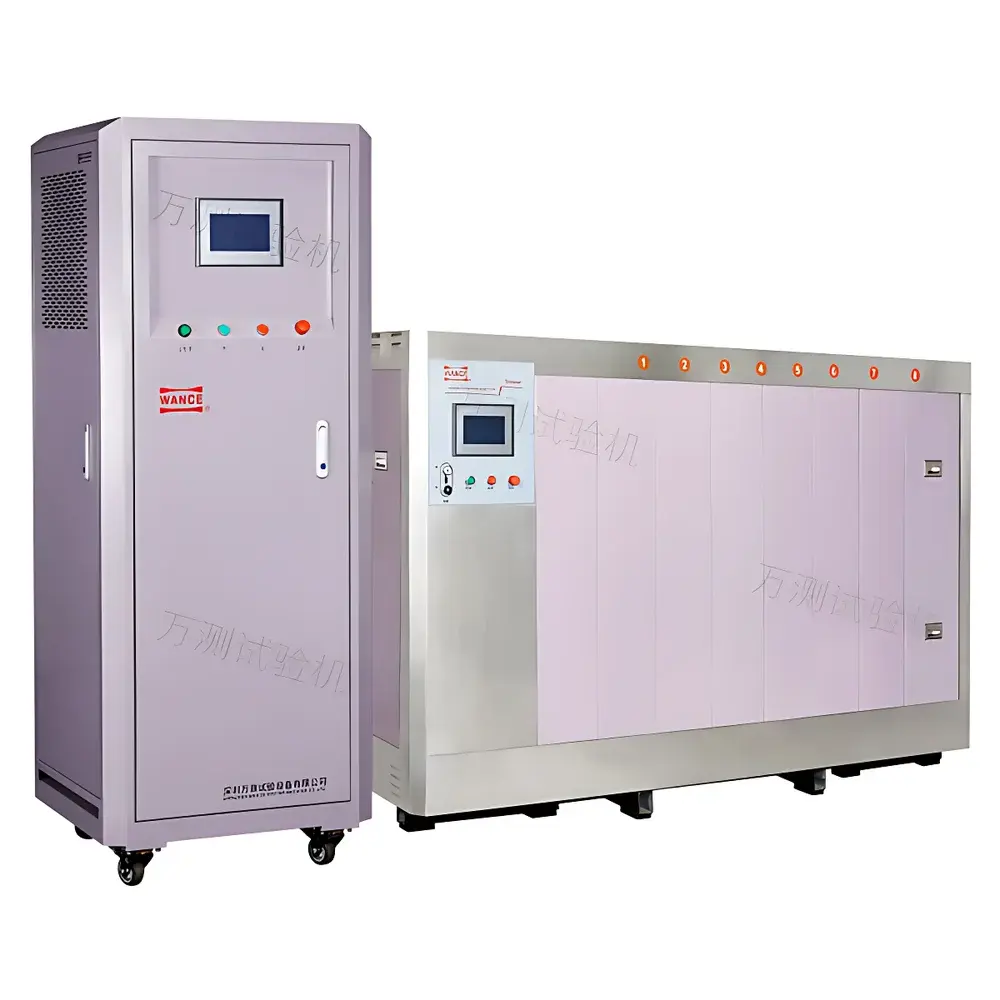
WANCE HTM Series B-Type Hydrostatic Burst Testing Machine
| Brand | WANCE |
|---|---|
| Origin | Guangdong, China |
| Model | HTM Series B-Type |
| Max Pressure | 50 MPa, 120 MPa, 150 MPa, 200 MPa, 250 MPa, 300 MPa, 400 MPa, 500 MPa |
| Control Options | PLC-based microcomputer control (7″ industrial color touchscreen) or PC-integrated dual-level control (PLC + upper computer) |
| Simultaneous Test Channels | 1–3 independent channels |
| Pressure Accuracy | ≤ ±1% of full scale |
| Holding Pressure Accuracy | –2% to +2% |
| Holding Range | 20–100% of max pressure |
| Timing Range | 0–10,000 h |
| Timing Accuracy | ≤ ±0.1% |
| Power Supply | 220 V AC, 50 Hz |
| Compliance Standards | GB 16897-2010, GB/T 7127.1–2000, GB/T 7127.2–2000, GB/T 241–2007, GB/T 9251–1997, GB 15385–1994 |
Overview
The WANCE HTM Series B-Type Hydrostatic Burst Testing Machine is a high-pressure, precision-engineered system designed for static hydraulic pressure testing, burst resistance evaluation, and cyclic pulse pressure analysis of critical fluid-conveying components. Based on the fundamental principle of hydrostatic pressure application—where a controlled, incompressible medium (typically water or glycol-water mixture) is pressurized within a sealed test specimen—the machine quantifies structural integrity, pressure retention capability, and failure thresholds under sustained or transient loading conditions. Its modular architecture supports maximum test pressures ranging from 50 MPa up to 500 MPa, enabling qualification of high-strength automotive brake assemblies, reinforced hydraulic hoses, seamless metal tubing, welded pressure vessels, and industrial piping systems. The system operates in strict accordance with internationally referenced national standards—including GB 16897 (brake hose performance), GB/T 241 (metal tube hydraulic testing), and GB 15385 (cylinder burst testing)—making it suitable for both routine quality assurance and R&D validation in regulated manufacturing environments.
Key Features
- Two configurable control architectures: standalone PLC-based microcomputer control with 7-inch industrial color touchscreen interface, or integrated dual-level control (PLC + Windows-based upper computer) for advanced data handling and remote supervision.
- True closed-loop pressure regulation using high-fidelity pressure transducers and servo-driven intensifiers, delivering ≤ ±1% pressure accuracy and stable holding performance across 20–100% of full-scale range (±2% deviation).
- Independent channel control architecture—supporting 1 to 3 parallel test circuits—with electrical isolation between channels to ensure cross-talk-free operation and scalable throughput.
- Robust hardware design featuring imported industrial-grade solenoid valves, high-cycle-life seals, and corrosion-resistant wetted components compliant with long-term exposure to aqueous test media.
- Integrated safety subsystems including automatic overpressure cutoff, emergency depressurization, real-time leak detection, and hardware-enforced interlock logic meeting IEC 61508 SIL2 functional safety requirements.
- Power-loss recovery function: upon unexpected shutdown, the system preserves all active test parameters and elapsed time; resumption requires only a single command to resume from the exact prior state—eliminating data loss and retest redundancy.
Sample Compatibility & Compliance
The HTM Series B accommodates a broad spectrum of cylindrical and tubular specimens—from 4 mm OD flexible brake hoses to 300 mm OD welded steel pressure vessels—via interchangeable fixture kits (custom clamping solutions available upon request). Specimen mounting interfaces conform to ISO 1402 (hydraulic hose coupling dimensions) and ASTM D3078 (leak-tightness verification protocol). All control firmware and calibration routines are traceable to NIST-traceable reference standards, and the system supports audit-ready documentation per GLP/GMP and ISO/IEC 17025 laboratory accreditation requirements. Test reports generated include full metadata: operator ID, environmental conditions (ambient temperature/humidity), calibration certificate numbers, raw pressure/time arrays, and pass/fail determinations against selected standard clauses (e.g., GB/T 7127.1 §5.3 for minimum burst pressure ratio).
Software & Data Management
The optional PC-based software suite provides comprehensive test lifecycle management. It supports real-time multi-channel pressure curve visualization, synchronized timestamped logging at user-defined sampling intervals (10 ms to 1 s), and automated report generation in PDF, XLSX, and CSV formats compatible with Microsoft Office. Data export modules allow direct integration into LIMS platforms via ODBC drivers. All electronic records comply with FDA 21 CFR Part 11 requirements—including electronic signatures, audit trails, role-based access control, and immutable archive storage. Post-test analysis tools include curve overlay comparison, derivative-based slope analysis for creep rate estimation, and statistical summary (mean, SD, Cp/Cpk) across batch test sets. Raw binary data files are stored in HDF5 format for long-term archival integrity and third-party algorithmic reprocessing.
Applications
- Automotive OEMs and Tier-1 suppliers performing type approval testing of ABS-compatible brake lines per GB 16897-2010 and UNECE R13-H.
- Pressure vessel fabricators validating hydrostatic proof and burst tests per ASME BPVC Section VIII Div. 1 and GB/T 150.
- Hydraulic component manufacturers conducting ISO 6803 pulse endurance tests on high-pressure hose assemblies (up to 400 MPa peak).
- National metrology institutes and third-party certification labs executing accredited conformity assessments for CE, CCC, and CNAS scopes.
- Materials science laboratories investigating time-dependent deformation mechanisms (creep, stress rupture) in thermoplastic composites and duplex stainless steels.
FAQ
What pressure media are supported?
Deionized water, inhibited water-glycol mixtures (up to 50% vol), and low-viscosity synthetic test fluids meeting ISO 11171 cleanliness class 12/9/6. Compressed gas media (e.g., nitrogen) are not supported due to compressibility-induced control instability.
Can the system perform ISO 6803-compliant pulse testing?
Yes—when equipped with optional high-frequency servo-valve actuation and waveform synthesis module, the HTM-B platform executes programmable triangular, sinusoidal, or square-wave pulse profiles (0.1–5 Hz) with amplitude modulation and dwell control.
Is remote monitoring possible?
Standard Ethernet (TCP/IP) and optional RS-485 Modbus RTU interfaces enable integration into factory SCADA networks. Web-based HMI access is available via secure HTTPS tunnel with TLS 1.2 encryption.
How often does calibration require verification?
Per ISO/IEC 17025, pressure transducers must be verified at least annually against certified deadweight testers; system-level validation (including controller timing and ramp fidelity) is recommended every six months or after major maintenance.
Are custom fixture designs available?
Yes—WANCE offers engineering consultation and turnkey fixture development for non-standard geometries, including flanged vessel caps, swaged tube ends, and multi-port manifolds, with full dimensional inspection reports and FEA-based load-path validation.



