
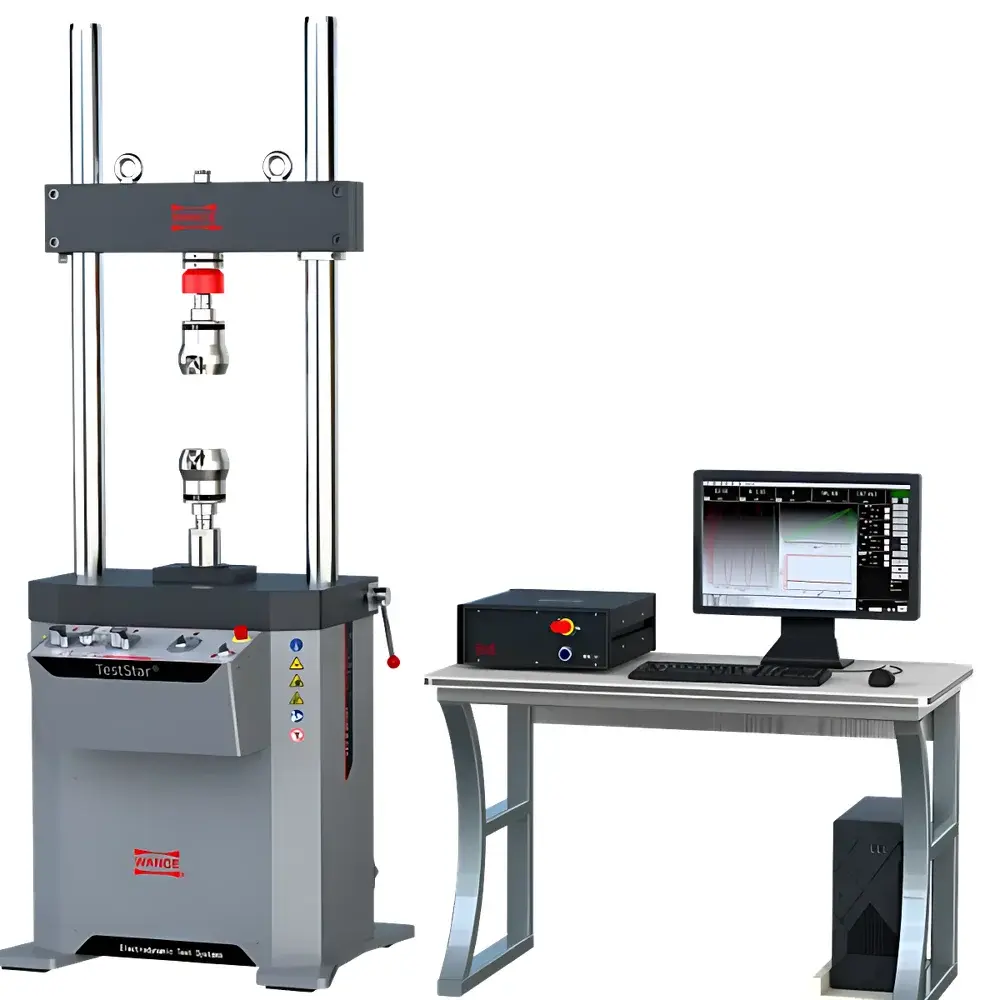
WANCE EDT-B Electronic Servo Fatigue Testing Machine
| Brand | WANCE |
|---|---|
| Origin | Guangdong, China |
| Model | EDT-B |
| Maximum Test Force | 20 kN (Static & Dynamic) |
| Force Accuracy | ±0.5% of reading (static), ±1% (dynamic) |
| Displacement Accuracy | <0.5% F.S. |
| Strain Measurement Accuracy | ±0.5% of reading |
| Test Frequency Range | 0.01–10 Hz |
| Waveform Options | Sine, Triangle, Square, Trapezoidal, Ramp, Random |
| Control Modes | Force, Displacement, and Strain Closed-Loop Control |
| Actuator Type | Integrated Linear Servo Electric Cylinder |
| Frame Configuration | Top-mounted Crosshead, Bottom-mounted Actuator (Closed-Frame Rigidity Design) |
| Environmental Compatibility | Optional High-Temperature Furnace, Thermal Chamber (–70°C to +300°C), Corrosion Chamber |
Overview
The WANCE EDT-B Electronic Servo Fatigue Testing Machine is an electromechanical dynamic testing system engineered for high-fidelity static and cyclic mechanical characterization of small-scale specimens and precision components. Operating on the principle of closed-loop servo-controlled linear actuation, the EDT-B delivers precise force, displacement, and strain regulation across a broad frequency spectrum (0.01–10 Hz), enabling rigorous evaluation of material fatigue behavior under controlled loading conditions. Unlike hydraulic systems, its all-electric architecture eliminates fluid maintenance, reduces thermal drift, and ensures repeatable low-force resolution—critical for evaluating elastomers, thin films, MEMS structures, biomedical implants, and miniature structural joints. The machine’s rigid closed-frame design—featuring a top-mounted crosshead and bottom-mounted servo actuator—minimizes parasitic compliance and eliminates backlash, directly supporting high reproducibility in both high-cycle fatigue (HCF, >10⁴ cycles) and low-cycle fatigue (LCF, <10⁴ cycles) regimes.
Key Features
- Rigid closed-frame architecture with optimized load path geometry, delivering axial stiffness >3×10⁶ N/mm and near-zero reverse-direction play for metrologically traceable force transmission.
- Integrated linear servo electric cylinder with brushless rotary motor and precision ball-screw transmission—enabling smooth, silent, and energy-efficient actuation without hydraulic oil or noise-generating valves.
- Three independent closed-loop control modes: force, displacement, and strain—each supported by real-time PID tuning and adaptive gain scheduling to maintain accuracy across varying specimen stiffness and cycle amplitude.
- Front-panel button interface for crosshead elevation, mechanical locking, and hydraulic/pneumatic-free specimen clamping—reducing setup time and operator dependency while enhancing repeatability.
- Modular environmental integration: standardized flange interfaces support seamless coupling with ASTM E2368-compliant high-temperature furnaces (up to 1200°C), ISO 11357-3 thermal chambers (–70°C to +300°C), and ASTM G34 corrosion cells with programmable electrolyte flow and pH monitoring.
Sample Compatibility & Compliance
The EDT-B accommodates specimens ranging from 1 mm diameter wire segments to 100 mm long machined coupons, with standard grips for flat, round, and threaded geometries. Its force range (±20 kN) and displacement resolution (0.1 µm) meet ISO 12106 (metallic materials—fatigue testing), ASTM E466 (constant-amplitude axial fatigue testing), and ASTM E606 (strain-controlled fatigue testing). For regulatory environments, the system supports audit-ready data logging compliant with FDA 21 CFR Part 11 requirements—including electronic signatures, immutable timestamped records, and user-access-level permissions—when paired with optional WANCE TestSuite™ software.
Software & Data Management
Control and analysis are executed via WANCE TestSuite™ v5.2—a Windows-based platform featuring real-time waveform synthesis, multi-channel synchronized acquisition (force, displacement, extensometer, thermocouple), and automated test sequence scripting. All raw data are stored in HDF5 format with embedded metadata (test standard, operator ID, calibration certificate IDs, environmental setpoints). Export options include CSV, MATLAB .mat, and universal MDF4 for third-party post-processing. The software includes built-in fatigue life prediction tools (e.g., Basquin, Coffin-Manson, Walker model fitting) and fracture mechanics modules for da/dN vs. ΔK plotting per ASTM E647.
Applications
- High-cycle fatigue evaluation of aerospace fasteners, turbine blade coatings, and additive-manufactured Ti-6Al-4V lattice structures.
- Low-cycle fatigue and ratcheting behavior of polymer-based dampers and silicone elastomeric isolators used in medical devices.
- Cyclic crack propagation studies using compact tension (CT) and single-edge notched bend (SENB) specimens under load- or displacement-control.
- Time-dependent viscoelastic response mapping of hydrogels and soft tissue analogs via stress-relaxation and creep-recovery protocols.
- Environmental fatigue screening—e.g., hydrogen embrittlement susceptibility of high-strength steels in cathodic charging cells or chloride-induced degradation of stainless steel welds.
FAQ
What standards does the EDT-B comply with for fatigue testing?
The system meets core requirements of ASTM E466, ISO 12106, ASTM E606, and ISO 1099 for axial fatigue, and supports custom protocol development aligned with OEM-specific specifications (e.g., GMW14872, Ford CETP 00.00-L-467).
Can the EDT-B perform crack growth rate (da/dN) measurements?
Yes—when equipped with a clip-on or laser extensometer and DC potential drop (DCPD) crack length monitoring kit, it fully supports ASTM E647-compliant da/dN testing.
Is remote operation and data export supported?
All test control, monitoring, and reporting functions are accessible via secure RDP or VNC; data exports support CSV, HDF5, MDF4, and XML formats with full metadata embedding.
What maintenance is required for the servo actuator?
The integrated linear servo cylinder requires no routine lubrication or fluid replacement; annual verification of encoder linearity and force transducer calibration is recommended per ISO/IEC 17025 guidelines.
How is thermal expansion compensated during elevated-temperature fatigue tests?
The system supports dual-sensor compensation: furnace thermocouples feed real-time temperature into the controller, which applies pre-characterized thermal drift offsets to displacement and strain channels—verified per ASTM E220 methodology.



