
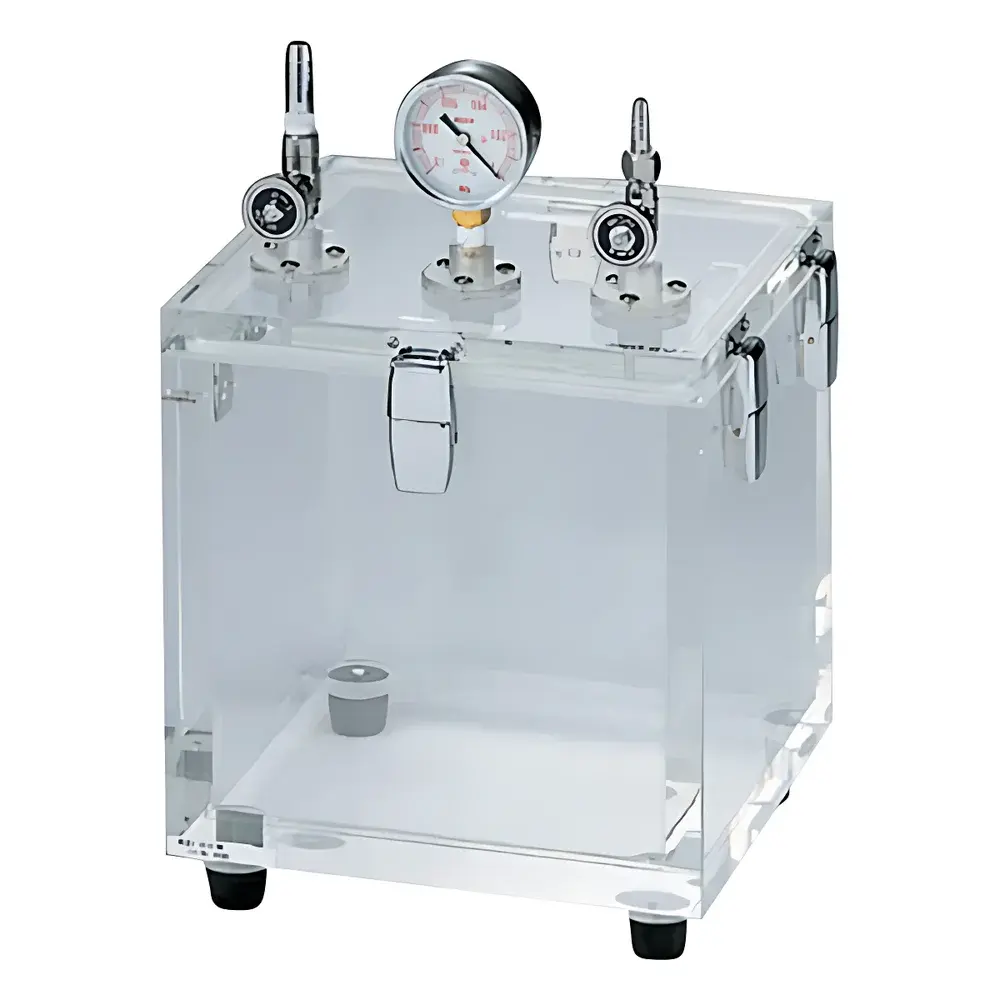
AS ONE VM Series Vacuum Desiccator Cabinet
| Brand | AS ONE |
|---|---|
| Origin | Japan |
| Manufacturer | AS ONE Corporation |
| Model | 1-5800-01 |
| Instrument Type | Vacuum Desiccator Cabinet |
| Chamber Material | Transparent Reinforced PMMA (20 mm thick) + PC Valve & Vacuum Gauge Mounting Port |
| Sealing System | High-Integrity Silicone Gasket (Lubricant-Free) |
| Maximum Vacuum Level | ~133 Pa |
| External Dimensions (W×D×H) | 250 × 250 × 380 mm |
| Internal Dimensions (W×D×H) | 210 × 210 × 210 mm |
| Power Interface | None (Non-Electric, Passive Vacuum Operation) |
Overview
The AS ONE VM Series Vacuum Desiccator Cabinet is a precision-engineered, non-electric environmental control solution designed for long-term moisture-sensitive sample storage and low-humidity conditioning under reduced pressure. Unlike conventional drying ovens or heated desiccators, the VM cabinet operates passively—requiring no power supply—relying instead on vacuum evacuation via external pump (e.g., diaphragm or rotary vane pump) to achieve and maintain sub-atmospheric conditions. Its core function is to suppress water vapor partial pressure, thereby inhibiting hydrolysis, oxidation, and humidity-induced degradation of hygroscopic materials such as lithium battery cathode precursors, pharmaceutical reference standards, calibration weights, optical coatings, and high-purity metal-organic frameworks (MOFs). The chamber employs Couette-type vacuum integrity principles: a rigid, optically transparent reinforced PMMA body (20 mm thickness) ensures structural stability under repeated vacuum cycling, while the integrated silicone gasket system—designed with compression-set resistance and low outgassing characteristics—eliminates the need for lubricants that could contaminate sensitive samples or compromise vacuum fidelity.
Key Features
- Non-powered, passive vacuum architecture compliant with ISO 14644-1 Class 5 cleanroom-compatible handling protocols.
- 20 mm-thick transparent reinforced PMMA chamber walls provide >92% visible light transmission and mechanical rigidity up to 133 Pa absolute pressure.
- Lubricant-free silicone sealing gasket engineered for >10,000 vacuum cycles without degradation; validated per ASTM D1418 elastomer compatibility standards.
- Integrated vacuum gauge port and valve assembly machined from chemical-resistant polycarbonate (PC), enabling real-time pressure monitoring and controlled venting.
- Compact footprint (250 × 250 × 380 mm external) optimized for benchtop integration in analytical labs, QC suites, and glovebox-adjacent workflows.
- No internal electrical components—fully compatible with explosion-proof environments and ESD-safe facilities per IEC 61340-5-1.
Sample Compatibility & Compliance
The VM cabinet accommodates standard laboratory containers—including glass desiccator dishes (ID ≤ 200 mm), aluminum weighing boats, and sealed sample vials—within its 210 × 210 × 210 mm usable volume. It supports storage of moisture-sensitive reference standards compliant with USP and EP 2.1.12 for hygroscopicity testing. The absence of heating elements eliminates thermal drift risks during gravimetric analysis, making it suitable for pre-weighing operations under GLP conditions. All wetted materials meet FDA 21 CFR §177.2415 (silicone elastomers) and EU Regulation (EC) No. 1935/2004 for food-contact safety. Vacuum integrity is verified per ISO 2859-1 sampling plans for leakage rate acceptance (≤5 × 10⁻³ mbar·L/s at 133 Pa).
Software & Data Management
As a purely mechanical vacuum containment system, the VM cabinet does not incorporate embedded electronics or firmware. Pressure monitoring requires external instrumentation—such as digital vacuum gauges with RS-485 or analog 0–10 V outputs—that may interface with LIMS or ELN platforms (e.g., LabWare LIMS, Benchling) via third-party DAQ modules. Audit trails for vacuum exposure duration and pressure history must be manually logged or captured using calibrated external recorders compliant with FDA 21 CFR Part 11 when used in regulated pharmaceutical or medical device manufacturing environments.
Applications
- Precise conditioning of hygroscopic reference standards prior to HPLC or ICP-MS analysis.
- Storage of anhydrous reagents (e.g., TiCl₄, AlCl₃, LiAlH₄) without solvent-based desiccants.
- Stabilization of humidity-sensitive sensors (e.g., capacitive RH sensors, MEMS accelerometers) during calibration.
- Pre-treatment of electrode materials in battery R&D to quantify moisture content per ISO 16232-C.
- Long-term archival of forensic evidence requiring inert, low-humidity preservation (per SWGDRUG guidelines).
- Backup containment for glovebox transfers where nitrogen purge is unavailable or insufficient.
FAQ
Does the VM cabinet include a built-in vacuum pump?
No. It is a passive desiccator cabinet requiring connection to an external vacuum source.
What vacuum level can be sustained over time?
When properly sealed and evacuated, the cabinet maintains ≤133 Pa (1 Torr) for ≥72 hours, verified by helium leak testing per ASTM E499.
Is the PMMA chamber resistant to common organic solvents?
PMMA exhibits good resistance to alcohols and aqueous solutions but is incompatible with chlorinated solvents (e.g., chloroform, methylene chloride) and strong ketones (e.g., acetone); consult AS ONE’s chemical compatibility chart before use.
Can the cabinet be used for outgassing volatile organic compounds (VOCs)?
Yes—its non-porous PMMA construction and low-outgassing gasket make it suitable for VOC containment during thermal desorption prep, provided external venting is routed through appropriate scrubbers.
Is calibration documentation provided with shipment?
A factory-installed vacuum integrity certificate (traceable to JCSS-accredited pressure standards) is included; user-level verification tools are not supplied but recommended annually per ISO/IEC 17025.



