
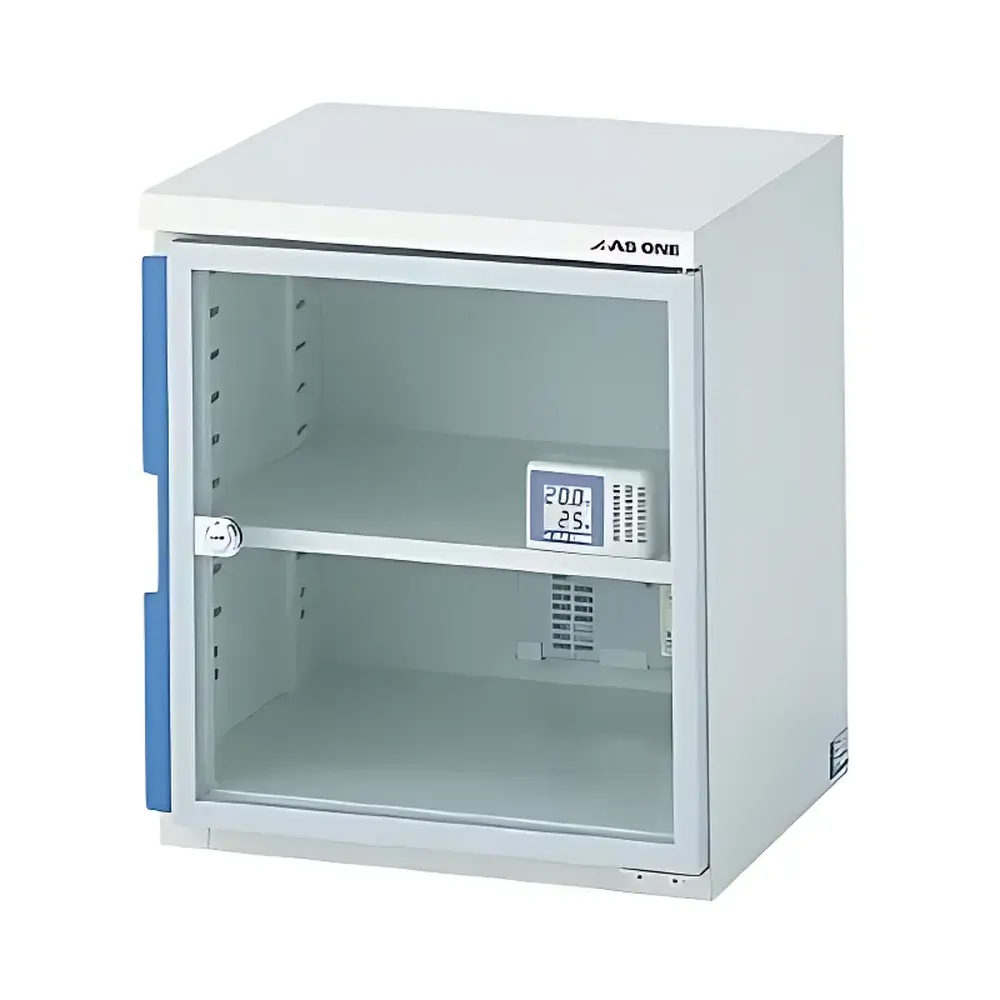
AS ONE ND-1S Automatic Desiccator Cabinet (AC100V)
| Brand | AS ONE |
|---|---|
| Origin | Japan |
| Manufacturer | AS ONE Co., Ltd. |
| Product Type | Electrolytic Desiccator Cabinet |
| Model No. | 1-5466-21 |
| External Dimensions | 400 × 350 × 453 mm |
| Internal Dimensions | 398 × 324 × 409 mm |
| Power Supply | AC 100 V, 50/60 Hz, 3 W |
| Dehumidification Principle | Solid Polymer Electrolyte (SPE) Membrane Electrolysis |
| Minimum Achievable Humidity | 25 %RH (empty chamber, ambient-dependent) |
| SPE Membrane Area | 30 × 30 mm |
| Cabinet Construction | Steel body with melamine baked finish, front panel: tempered glass |
| Display | Digital THA-01M Temperature & Relative Humidity Monitor |
| Weight | 10 kg |
| Included Accessories | 1 adjustable shelf, 2 keys, THA-01M display unit, AC adapter plug (Japan standard) |
Overview
The AS ONE ND-1S Automatic Desiccator Cabinet (AC100V) is a compact, self-contained electrolytic desiccation system engineered for precise, maintenance-free humidity control in laboratory and electronics storage environments. Unlike conventional desiccant-based or refrigerated dry cabinets, the ND-1S employs solid polymer electrolyte (SPE) membrane technology to actively decompose water vapor molecules (H₂O) into hydrogen and oxygen gases via low-power electrochemical dissociation. This process eliminates condensation entirely—moisture is removed as gaseous byproducts vented externally, avoiding liquid accumulation, drip corrosion, or periodic desiccant regeneration. Designed for stable operation at ambient temperatures, the cabinet maintains a controlled internal environment down to 25 %RH under no-load conditions, making it suitable for moisture-sensitive components including semiconductor wafers, precision optical elements, calibration standards, hygroscopic reagents, and archival reference materials. Its AC100V power architecture aligns with Japanese domestic electrical infrastructure and enables consistent performance without voltage conversion hardware.
Key Features
- Electrolytic dehumidification using a 30 × 30 mm solid polymer electrolyte (SPE) membrane—no consumables, no saturation cycles, no manual regeneration required.
- Digital THA-01M temperature and relative humidity monitor with real-time readout and data stability tracking.
- Robust steel enclosure with melamine-baked finish and front-facing tempered glass door for visual monitoring without compromising seal integrity.
- Compact footprint (400 × 350 × 453 mm external) optimized for benchtop integration in QC labs, cleanrooms, and R&D workstations.
- Low-energy operation: rated at only 3 W continuous draw—compatible with uninterruptible power supply (UPS) systems for critical long-term storage.
- Integrated mechanical lock with two supplied keys ensures secure access control in shared laboratory settings.
- Single adjustable stainless-steel shelf included; load capacity engineered for uniform airflow distribution and minimal thermal stratification.
Sample Compatibility & Compliance
The ND-1S supports storage of non-volatile, non-corrosive, and non-outgassing samples within its specified operational envelope (ambient temperature range: 15–35 °C; ambient RH ≤ 70 %). It is routinely deployed for preserving moisture-sensitive instrumentation components (e.g., quartz crystal microbalances, IR detector windows), photomask substrates, lithium battery test cells, and certified reference materials (CRMs) requiring ISO/IEC 17025-compliant environmental conditioning. While not classified as a medical device or GMP-grade environmental chamber, its design adheres to JIS Z 8806 (humidity measurement methods) and conforms to basic electrical safety standards per JIS C 61010-1 for laboratory equipment. The absence of moving parts, refrigerants, or silica gel simplifies validation protocols and reduces risk of cross-contamination—supporting GLP-aligned documentation workflows.
Software & Data Management
The ND-1S operates as a standalone hardware platform with no embedded firmware, network interface, or proprietary software dependency. Environmental parameters are displayed locally on the THA-01M digital module, which provides analog output capability (0–1 V DC proportional to RH) for optional external logging via third-party DAQ systems (e.g., National Instruments CompactDAQ, Keysight 34972A). For audit-trail compliance in regulated environments, users may integrate the THA-01M’s analog signal into validated data acquisition platforms configured for 21 CFR Part 11-compliant electronic records—including user authentication, time-stamped readings, and immutable data archiving. No cloud connectivity, remote configuration, or over-the-air updates are supported—ensuring deterministic behavior and cybersecurity resilience.
Applications
- Long-term storage of high-purity metal oxide powders and catalyst precursors susceptible to hydrolysis.
- Pre-conditioning of test specimens prior to ASTM E104 or ISO 62 humidity exposure testing.
- Stabilization of weighing vessels and analytical balances in gravimetric analysis suites.
- Protection of surface-mount device (SMD) reels and bare PCBs during pre-reflow staging in electronics manufacturing labs.
- Holding calibration artifacts—including gauge blocks and interferometer reference flats—under traceable humidity conditions.
- Supporting ISO/IEC 17025 clause 6.4.6 (environmental monitoring) requirements for accredited testing laboratories.
FAQ
Does the ND-1S require desiccant replacement or maintenance?
No. The solid polymer electrolyte membrane operates continuously without consumables, degradation, or scheduled servicing under normal ambient conditions.
Can the cabinet be used in environments exceeding 35 °C?
Operation above 35 °C ambient is not recommended; elevated temperatures reduce SPE membrane efficiency and may compromise long-term RH stability.
Is the THA-01M display calibrated and traceable to NIST?
The THA-01M is factory-calibrated; full NIST-traceable calibration certificates are available as an optional add-on service through AS ONE’s authorized calibration centers.
What is the expected service life of the SPE membrane?
Under continuous use at ≤70 % ambient RH and 25 °C, the membrane maintains functional integrity for ≥5 years, per AS ONE accelerated lifetime testing data.
Can multiple ND-1S units be daisy-chained or networked?
No. Each unit functions independently; there is no built-in communication interface or synchronization capability.



