
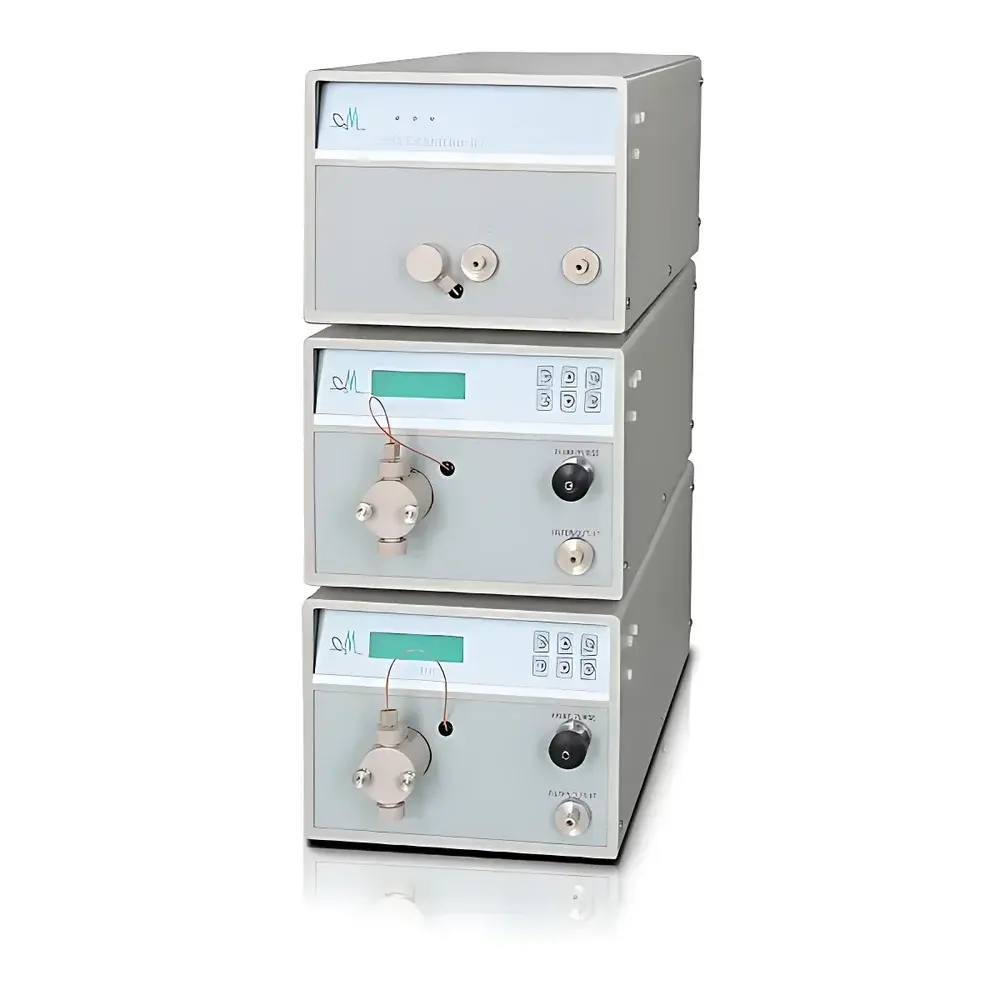
CoMetro COM6000 Post-Column Derivatization System for Carbamate Pesticide Residues in Food
| Brand | CoMetro |
|---|---|
| Origin | Imported |
| Model | COM6000 |
| Temperature Range | Ambient +10 °C to 150 °C |
| Derivatization Reagent Flow Rate | 0.001–10 mL/min |
Overview
The CoMetro COM6000 Post-Column Derivatization System is an engineered solution for the sensitive, selective, and regulatory-compliant quantification of nine carbamate pesticides and their metabolites in food matrices. It operates on the principle of post-column chemical derivatization—where analytes eluting from a reversed-phase HPLC column react with thermally activated reagents (e.g., o-phthalaldehyde or naphthalene-2,3-dicarboxaldehyde) in a precisely controlled reaction coil, generating highly fluorescent isoindole derivatives. This fluorescence-enhanced detection enables sub-ppb sensitivity without requiring mass spectrometry, making the system ideal for routine food safety laboratories operating under ISO/IEC 17025, GLP, or FDA-regulated environments. The system is explicitly validated per GB 23200.112–2018, which mandates post-column derivatization coupled with fluorescence detection for official residue analysis in plant-derived foods.
Key Features
- Thermally stable reaction manifold with programmable heating zone (ambient +10 °C to 150 °C), ensuring reproducible derivatization kinetics across diverse carbamates including carbaryl, carbofuran, methomyl, and aldicarb.
- High-precision dual-channel reagent delivery: independent control of primary derivatization reagent and secondary catalyst stream, supporting both single- and dual-reagent protocols per method requirements (e.g., HJ 960–2018 and HJ 1025–2019).
- Chemically inert fluid path constructed from PEEK, stainless steel, and fused silica—resistant to aggressive reagents such as sodium hydroxide, potassium cyanide, and organic solvents used in carbamate derivatization chemistries.
- Integrated pressure monitoring and leak detection at critical junctions (mixer, reaction coil, detector interface) to ensure uninterrupted analytical continuity during unattended overnight runs.
- Modular design compatible with all major HPLC platforms—including Agilent 1260/1290, Waters e2695, Shimadzu Nexera X2—and fully synchronized via TTL or RS-232 trigger signals for precise timing of derivatization onset relative to analyte elution.
Sample Compatibility & Compliance
The COM6000 supports complex food extracts—including fruit, vegetable, grain, and processed commodity homogenates—following QuEChERS or SPE cleanup. Its robust architecture accommodates high-salt and pigment-rich extracts common in plant-based samples without clogging or signal drift. Method validation aligns with multiple international and national standards: GB 23200.112–2018 (food), HJ 960–2018 (soil/sediment), HJ 1025–2019 (solid waste), NY/T 761–2008 (multi-residue screening), and GB/T 5750.9–2023 (drinking water). All operational parameters—including temperature ramp profiles, reagent flow gradients, and dwell times—are fully documented and auditable to support GLP/GMP compliance and 21 CFR Part 11 data integrity requirements when paired with compliant chromatography data systems (CDS).
Software & Data Management
The system operates via CoMetro’s PC-based ControlSuite v3.2 software, offering method-driven automation with full parameter logging (temperature setpoint, actual coil temp, reagent flow rate, pressure trace, and system status flags). Raw data export is provided in ASCII and .csv formats; audit trails record user actions, method changes, and calibration events with timestamp and operator ID. When integrated with LECO ChromaTOF, Thermo Chromeleon, or Waters Empower CDS, the COM6000 supports electronic signature workflows, version-controlled method storage, and automatic report generation compliant with ISO/IEC 17025 clause 7.8.2.
Applications
- Quantitative determination of carbaryl, carbofuran, methomyl, oxamyl, aldicarb, propoxur, thiodicarb, bendiocarb, and pirimicarb in apples, lettuce, rice, and soybean flour per GB 23200.112–2018.
- Multi-matrix environmental analysis: soil, sediment, and landfill leachate per HJ 960–2018 and HJ 1025–2019.
- Drinking water surveillance for carbaryl and carbofuran in accordance with GB/T 5750.9–2023.
- Validation studies for laboratory accreditation (CNAS, UKAS) where fluorescence-based HPLC methods are specified over LC-MS/MS due to cost-of-ownership and throughput constraints.
- Method transfer between QC labs using standardized derivatization protocols and certified reference materials (CRMs) traceable to NIST SRM 3149 and ERM-BB127.
FAQ
What reagent kits are certified for use with the COM6000 in GB 23200.112–2018 testing?
CoMetro YS-CB-001 Derivatization Reagent Kit is pre-qualified for this standard and includes OPA, 2-mercaptoethanol, and borate buffer in stabilized, ready-to-use formulations.
Can the COM6000 be operated without a fluorescence detector?
No—it is designed exclusively for fluorescence-enhanced detection; UV or MS detection requires alternative derivatization strategies not supported by this hardware configuration.
Is temperature calibration traceable to national standards?
Yes—each unit ships with a NIST-traceable temperature verification certificate covering the full 20–150 °C operating range, verified using calibrated PT100 sensors.
How often does the reaction coil require replacement?
Under normal use (≤8 h/day, aqueous/organic mobile phases), the PEEK-coated fused silica coil maintains performance for ≥12 months; replacement part number is COM-COIL-PCD-01.
Does the system support gradient reagent flow programming?
Yes—ControlSuite v3.2 allows time-based flow rate modulation across up to 32 segments, enabling optimized derivatization for co-eluting carbamates with differing reaction kinetics.



