
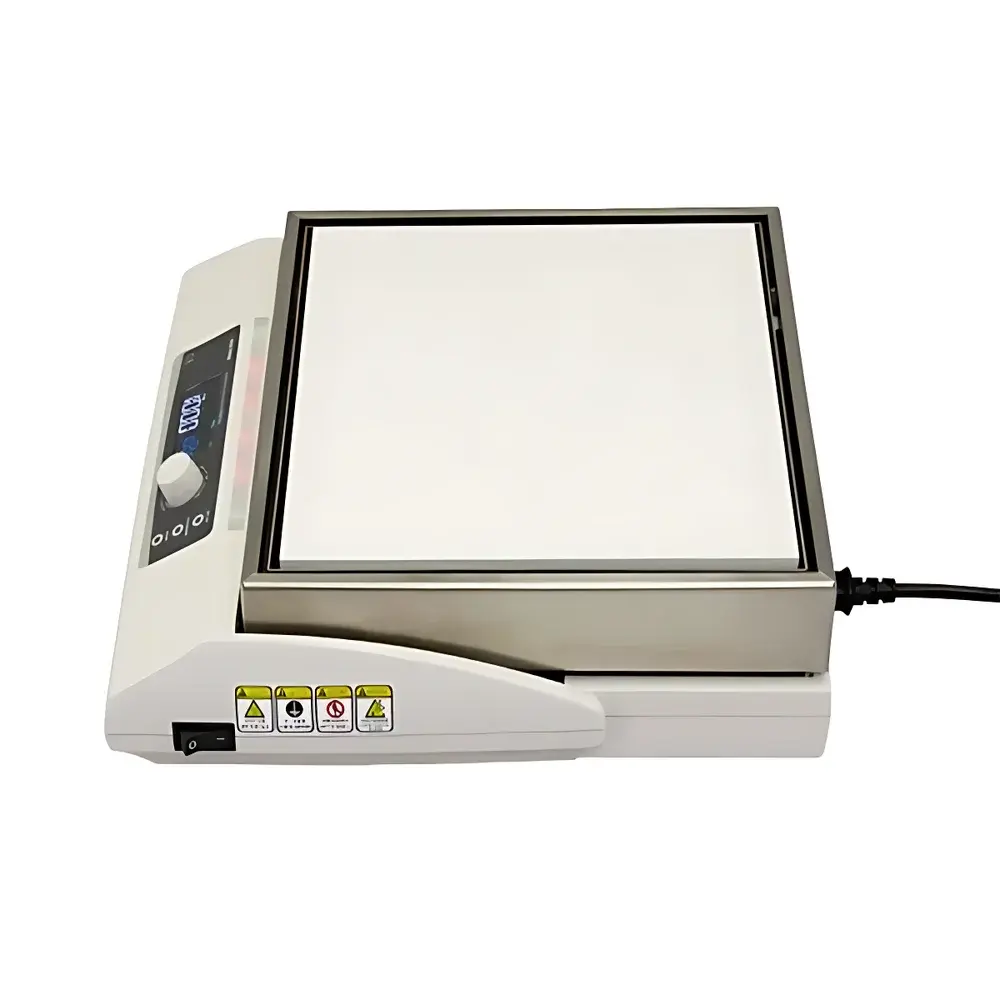
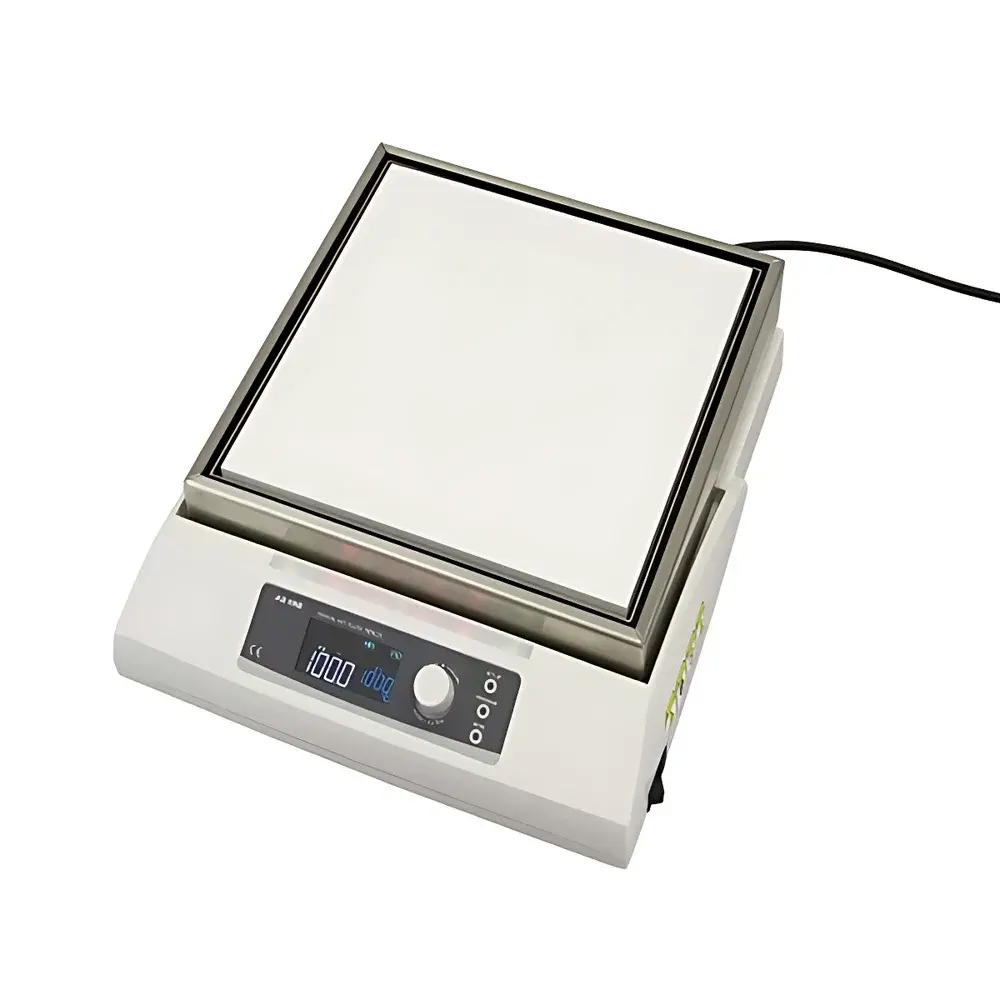
AS ONE NINOS NDK-2A-I Digital Heating Plate with PID Temperature Control
| Brand | AS ONE |
|---|---|
| Origin | Japan |
| Manufacturer | AS ONE Co., Ltd. |
| Model No. | 1-4601-32-91 |
| Temperature Range | RT +10°C to 350°C |
| Plate Dimensions | 250 × 250 mm |
| Power Supply | AC 220 V, 50/60 Hz |
Overview
The AS ONE NINOS NDK-2A-I is a precision-engineered digital heating plate designed for laboratory and industrial thermal processing applications requiring stable, repeatable, and programmable surface heating. Utilizing microprocessor-based PID (Proportional-Integral-Derivative) temperature control architecture, the unit delivers high-resolution thermal regulation across its 250 × 250 mm ceramic-coated aluminum heating surface. Unlike basic hotplates, the NDK-2A-I implements dual-loop thermal feedback—integrating both heater-block and optional external probe inputs—to minimize overshoot and ensure ±0.5°C stability under steady-state conditions. Its operational envelope spans from ambient +10°C to 350°C, making it suitable for solvent evaporation, sample preheating, catalyst activation, and controlled drying protocols where precise thermal input is critical to process reproducibility. The device complies fully with EU RoHS 2 Directive 2015/863, confirming absence of restricted substances including lead, cadmium, mercury, hexavalent chromium, PBBs, and PBDEs.
Key Features
- Microprocessor-controlled PID algorithm with auto-tuning capability for optimal thermal response across load variations
- Backlit LCD display with intuitive menu navigation and real-time visualization of setpoint, actual temperature, elapsed time, and status indicators
- Four built-in timer modes: ON-only, OFF-only, ON/OFF cycling, and SET-based countdown—enabling unattended operation with fail-safe termination
- Multi-step program mode supporting up to eight user-defined temperature/time segments for complex thermal profiles
- Dual independent alarm outputs (relay contacts) configurable for overtemperature, sensor fault, or timeout events—compatible with external PLCs or emergency shutdown circuits
- Integrated safety illumination system: front-panel LED activates only when top-plate surface temperature remains below 55°C, providing immediate visual confirmation of safe handling conditions
- Robust mechanical construction featuring corrosion-resistant anodized aluminum housing and reinforced ceramic-coated heating plate for long-term thermal cycling integrity
Sample Compatibility & Compliance
The NDK-2A-I accommodates a wide range of laboratory vessels—including glass beakers, stainless steel crucibles, aluminum digestion blocks, and polymer reaction tubes—without risk of warping or localized overheating due to uniform heat distribution across the 250 × 250 mm surface. Optional PT100 or K-type external temperature sensors (sold separately) enable direct sample-contact temperature regulation, essential for applications governed by ISO 17025 or GLP-compliant workflows. The unit meets IEC 61010-1:2010 safety standards for electrical equipment used in laboratory environments and carries CE marking for conformity with EU Low Voltage and EMC directives. It supports audit-ready documentation through optional data logging software (supplied on CD-ROM) and RS-232 communication interface (cable sold separately), facilitating traceability in regulated environments subject to FDA 21 CFR Part 11 or ISO 9001 requirements.
Software & Data Management
The included NINOS Data Logger software (Windows-compatible, CD-ROM delivery) enables real-time monitoring, remote parameter adjustment, and time-stamped temperature logging at user-selectable intervals (1–60 sec). All recorded datasets export natively to CSV format for downstream analysis in Excel, MATLAB, or LIMS platforms. The software supports multi-device configuration management and includes password-protected user roles to enforce procedural controls. When paired with the optional communication cable, the system provides full bidirectional command support via ASCII protocol—including START/STOP, SETPOINT write, READBACK queries, and alarm status polling—making it integrable into automated lab networks or centralized facility monitoring systems.
Applications
- Controlled evaporation of solvents in analytical sample preparation (e.g., prior to GC or HPLC injection)
- Pre-heating of reagents and calibration standards in QC laboratories adhering to ASTM E29 or ISO/IEC 17025
- Thermal conditioning of polymer films and composite substrates during R&D prototyping
- Stabilization of enzymatic reactions requiring precise incubation temperatures
- Supporting gravimetric moisture analysis per USP or AOAC 950.46 methodologies
- Calibration verification of infrared thermometers and contact probes using NIST-traceable reference points
FAQ
Is the NDK-2A-I compatible with external temperature probes for direct sample monitoring?
Yes—when equipped with an optional PT100 or Type-K thermocouple sensor (model-specific adapter required), the unit can switch from plate-surface control to sample-contact temperature regulation.
Does the device support integration into a networked laboratory information management system (LIMS)?
Through its RS-232 interface and ASCII command protocol, the NDK-2A-I can be integrated into custom or commercial LIMS environments for automated data capture and electronic record retention.
What safety certifications does the NDK-2A-I hold for use in regulated pharmaceutical labs?
It complies with IEC 61010-1:2010 and carries CE marking; while not intrinsically 21 CFR Part 11 compliant, its data logging capabilities—when used with validated software and access controls—support alignment with Part 11 expectations for electronic records.
Can multiple NDK units be operated simultaneously from one PC?
Yes—the NINOS Data Logger software supports daisy-chained RS-232 connections or USB-to-serial adapters for concurrent monitoring and control of up to four units.
Is the heating surface resistant to chemical splashes commonly encountered in wet chemistry labs?
The ceramic-coated aluminum plate exhibits high resistance to diluted acids, bases, and organic solvents; however, prolonged exposure to concentrated HF, molten alkalis, or halogenated solvents is not recommended.



