
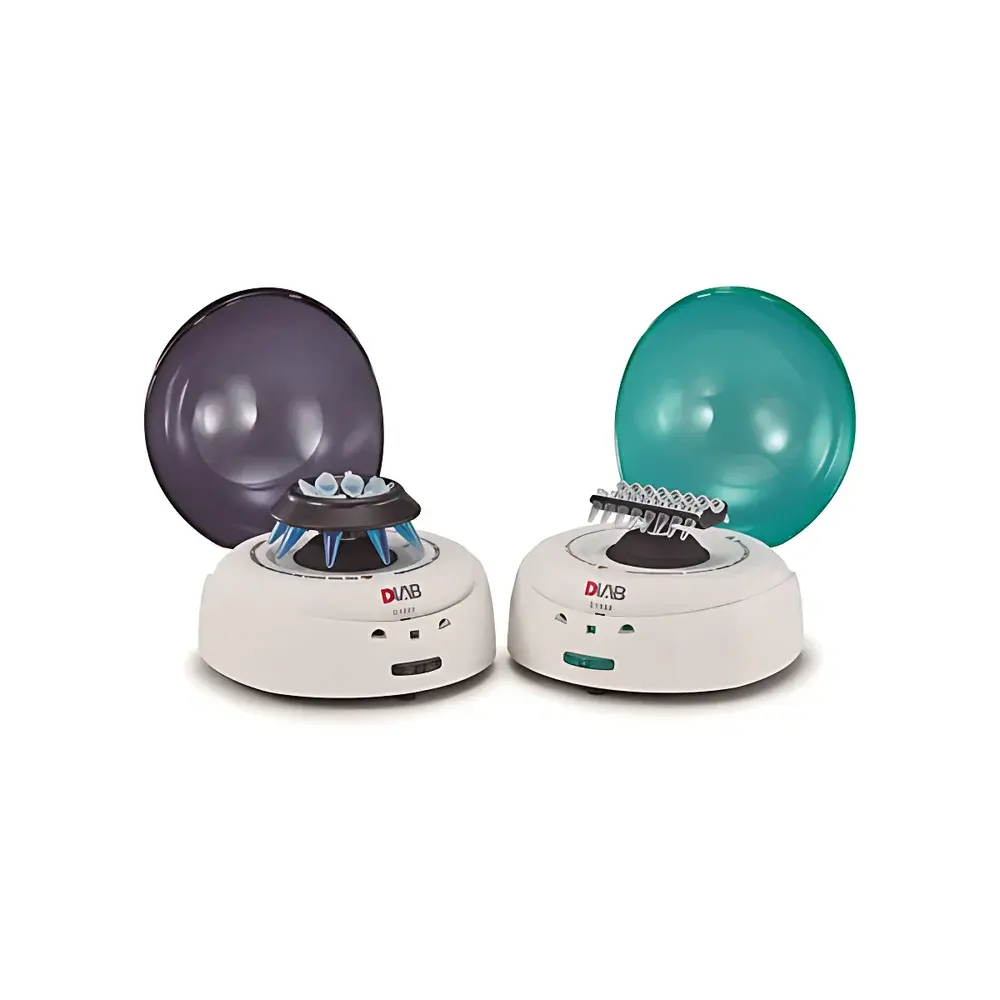
DLAB D1008E Palm-Sized Centrifuge
| Brand | DLAB (AS ONE) |
|---|---|
| Origin | Japan |
| Manufacturer Type | Original Equipment Manufacturer (OEM) |
| Origin Category | Imported |
| Model | CC-8046-02 |
| Instrument Type | Benchtop Centrifuge |
| Max Speed | 5000 rpm |
| Max RCF | 1360 × g |
| Power Supply | AC 100–240 V, 50/60 Hz |
| Noise Level | ≤45 dB(A) |
| Weight | 0.5 kg |
| Dimensions (L×W×H) | 150 × 150 × 117 mm |
| Rotor Capacity | 2 mL × 8 tubes |
| PCR Compatibility | 0.2 mL × 16 tubes or 0.2 mL × 2 × 8-strip PCR plates |
| Drive System | Brushless DC Motor |
| Operation Mode | Continuous |
| Safety Certification | TÜV Rheinland Low-Voltage Directive & EMC Compliant |
Overview
The DLAB D1008E Palm-Sized Centrifuge is a compact, high-efficiency benchtop centrifuge engineered for rapid microsample separation in resource-constrained or high-throughput laboratory environments. Utilizing brushless DC motor technology and optimized rotor dynamics, it delivers precise, repeatable centrifugal force generation via fixed-angle rotor geometry—operating on the principle of sedimentation under controlled angular acceleration. Designed specifically for nucleic acid purification, protein precipitation, column-based cleanup, and micro-volume sample concentration, the D1008E achieves a maximum relative centrifugal force (RCF) of 1360 × g at 5000 rpm—sufficient for pelleting cellular debris, binding matrices, and small-molecule aggregates in volumes ranging from 0.2 mL to 2.0 mL. Its ultra-compact footprint (150 × 150 × 117 mm) and sub-0.5 kg mass enable seamless integration onto biosafety cabinets, laminar flow hoods, or portable workstations without compromising mechanical stability or thermal management.
Key Features
- Brushless DC motor architecture ensures consistent rotational speed across variable line voltages (AC 100–240 V, 50/60 Hz), eliminating speed drift due to input fluctuations and supporting stable performance in multi-voltage international labs.
- Dual interlock lid mechanism complies with IEC 61010-1 safety requirements—mechanically preventing rotor operation unless fully closed and latched, with automatic deceleration upon lid opening.
- Patented quick-release rotor system enables tool-free installation and removal of the aluminum alloy rotor within seconds, minimizing cross-contamination risk during high-turnover workflows.
- Acoustically damped housing and precision-balanced rotor assembly limit operational noise to ≤45 dB(A), meeting ISO 7779 acoustic emission standards for quiet laboratory environments.
- Instant start-stop functionality triggered by lid actuation (close-to-run, open-to-halt) reduces procedural latency and supports GLP-compliant documentation of centrifugation event timing.
- Four color-coded housing options (green, pink, yellow, DLAB blue) facilitate visual workflow segregation in shared core facilities or teaching laboratories.
Sample Compatibility & Compliance
The D1008E accommodates standard microcentrifuge tube formats including 0.2 mL, 0.5 mL, 1.5 mL, and 2.0 mL conical tubes (8-position rotor), as well as dual 0.2 mL PCR strip carriers (2 × 8-well configuration) and individual 0.2 mL PCR tubes (16-position layout). All rotors are autoclavable at 121 °C for 20 minutes, supporting ISO 13485-aligned sterilization protocols in diagnostic or clinical research settings. The device carries TÜV Rheinland certification for low-voltage safety (EN 61010-1) and electromagnetic compatibility (EN 61326-1), confirming conformance with EU CE marking directives. It is suitable for use in ISO/IEC 17025-accredited testing laboratories where instrument traceability, mechanical integrity, and electrical safety are audited per clause 6.4.
Software & Data Management
As a standalone electromechanical instrument, the D1008E operates without embedded firmware or digital interface—eliminating software validation requirements under FDA 21 CFR Part 11. Its analog control logic ensures deterministic behavior, making it inherently compatible with paper-based or electronic lab notebook (ELN) documentation systems requiring minimal validation effort. For audit readiness, users may record operational parameters (e.g., run duration, observed speed confirmation via tachometer verification) directly into batch records or SOP-mandated log sheets. No data export, cloud connectivity, or remote monitoring capabilities are present—aligning with security-sensitive environments such as regulated biobanking or forensic DNA analysis labs.
Applications
- Routine spin-down of spin-column purification kits (e.g., silica-membrane RNA/DNA isolation)
- Microcentrifugation of PCR master mixes prior to thermal cycling to eliminate air bubbles and ensure homogeneous reagent distribution
- Clarification of bacterial lysates in plasmid miniprep workflows
- Concentration of dilute protein samples in microvolume vials prior to SDS-PAGE or mass spectrometry analysis
- Centrifugal filtration using 0.2 µm PVDF or nylon membrane filters in 2 mL tubes
- Field-deployable sample preparation in mobile diagnostic units or point-of-collection sites where space and power stability are limited
FAQ
Is the D1008E suitable for use with hazardous biological agents?
Yes—its sealed rotor chamber and Class II biosafety-compatible design allow safe operation with BSL-2 agents when used inside certified containment hoods; however, aerosol-generating procedures require additional secondary containment.
Can the rotor be sterilized using ethylene oxide (EtO)?
No—only autoclaving (121 °C, 20 min) is validated for rotor decontamination; EtO exposure may degrade aluminum surface passivation and compromise structural integrity.
Does the unit support timer-based operation?
No—the D1008E operates in continuous mode only; manual intervention is required to terminate runs, supporting real-time observation of pellet formation in transparent tubes.
What is the expected service life under continuous daily use?
Rated for ≥20,000 hours of cumulative runtime based on brushless motor MTBF data and bearing endurance modeling under nominal load conditions.
Is calibration required before first use?
No factory calibration is needed; however, users should verify rotational speed accuracy annually using an NIST-traceable handheld tachometer per ISO/IEC 17025 clause 6.5.2.



