
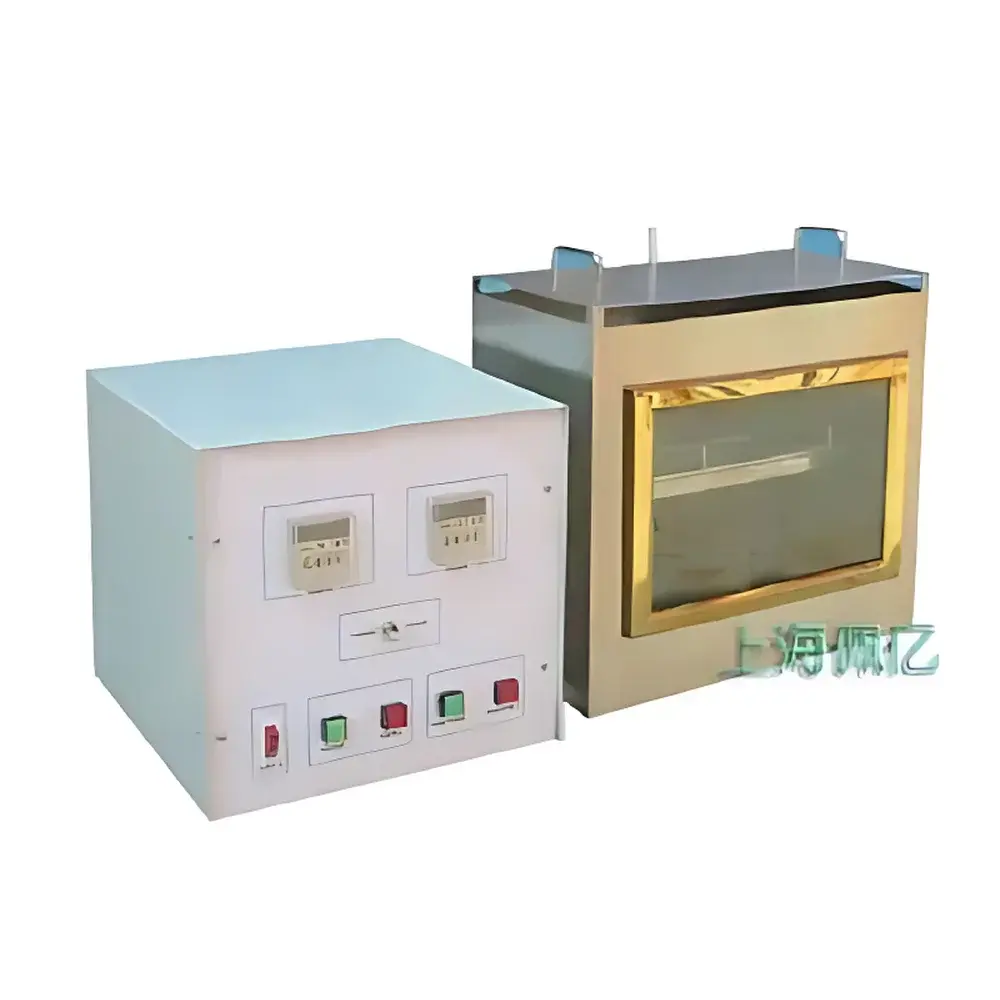
INSMENT PY-NS07 Automotive Interior Materials Horizontal Burning Tester
| Brand | INSMENT |
|---|---|
| Origin | Shanghai, China |
| Model | PY-NS07 |
| Power Supply | 220 V / 50 Hz |
| Gas Source | Propane or Liquefied Petroleum Gas (LPG) |
| Burner Nozzle Inner Diameter | 9.5 mm |
| Specimen Support Height | 19 mm below nozzle centerline |
| Combustion Chamber Dimensions | 385 mm (L) × 204 mm (D) × 360 mm (H), stainless steel construction |
| Ventilation | 10 × Ø19 mm floor holes + 13 mm wide top perimeter vent groove |
| Temperature Probe Port | centered 20 mm from rear inner wall |
| Timer Range | 0–99.99 s/min/h |
| Comb Metal Comb | ≥110 mm length, 7–8 smooth rounded teeth per 25 mm |
| Steel Ruler Accuracy | ±1 mm |
| Compliance Standards | GB 8410, TL 1010, GM 6090M, DIN 75200, GM 9070P, FMVSS 302 |
Overview
The INSMENT PY-NS07 Automotive Interior Materials Horizontal Burning Tester is a precision-engineered instrument designed to evaluate the horizontal flame propagation behavior of automotive interior trim materials under standardized ignition conditions. It operates on the principle of controlled surface ignition and linear flame spread measurement—specifically aligned with the horizontal burning test methodology defined in key international automotive safety standards. The device subjects conditioned specimens to a calibrated Bunsen-type flame for a fixed duration (typically 15 seconds), then measures post-ignition flame travel distance and afterflame time to determine compliance with flammability thresholds. Its rigid stainless-steel combustion chamber, thermally stable gas delivery system, and repeatable specimen positioning mechanism ensure high inter-laboratory reproducibility—critical for OEM supplier qualification and Tier-1 component validation workflows.
Key Features
- Stainless-steel combustion chamber (385 × 204 × 360 mm) with precision-machined ventilation architecture: ten 19 mm-diameter floor ports and a continuous 13 mm-wide top vent groove to maintain laminar airflow and prevent pressure buildup during testing.
- Adjustable-height burner assembly featuring a 9.5 mm inner-diameter nozzle; nozzle centerline positioned exactly 19 mm above the free end of the horizontally mounted specimen—ensuring strict geometric conformity to GB 8410 and FMVSS 302.
- Digital timer with 0.01-second resolution across seconds, minutes, and hours—capable of logging both ignition exposure time and post-removal afterflame duration independently.
- Integrated high-voltage piezoelectric igniter eliminates external spark sources and ensures consistent flame initiation without manual pilot lighting.
- Modular control box housing electromagnetic gas valve, safety interlock circuitry, and real-time status indicators—designed for fail-safe operation in regulated laboratory environments.
- Standardized specimen holder fixture compatible with 100 mm × 356 mm test strips; includes calibrated steel ruler (±1 mm accuracy) and comb tool (≥110 mm, 7–8 teeth/25 mm) for pre-test surface conditioning per GM 6090M requirements.
Sample Compatibility & Compliance
The PY-NS07 accommodates flat, rigid, or semi-rigid polymeric substrates commonly used in automotive interiors—including PVC, PU foam, nonwovens, laminated fabrics, ABS composites, and thermoplastic olefin (TPO) skins. Specimens must be conditioned at 23 ± 2 °C and 50 ± 5 % RH for minimum 48 hours prior to testing, as mandated by ISO 291 and referenced in all target standards. The instrument fully supports regulatory verification against GB 8410 (China), FMVSS 302 (US DOT), TL 1010 (BMW), GM 6090M (General Motors), DIN 75200 (German automotive standard), and GM 9070P (GM Global Engineering Standards). While the unit does not include an integrated fume hood, it is engineered to operate within externally supplied ventilation enclosures meeting ASTM E1231 criteria—i.e., internal volume between 20× and 110× the combustion chamber volume, with no single dimension exceeding 2.5× either of the other two.
Software & Data Management
The PY-NS07 operates as a standalone hardware platform with analog/digital hybrid control logic—no embedded software or PC interface is required for basic compliance testing. However, its modular signal outputs (TTL-level timer triggers, valve status feedback, and ignition pulse signals) are compatible with third-party data acquisition systems (e.g., National Instruments DAQmx or LabVIEW-based GLP-compliant logging platforms). When integrated into validated quality management systems, users may configure electronic audit trails, user access controls, and PDF report generation in accordance with FDA 21 CFR Part 11 and ISO/IEC 17025 documentation requirements. All test parameters—including gas pressure, ambient temperature (via optional probe input), exposure time, and observed flame spread—are manually recorded on standardized test forms traceable to internal SOPs.
Applications
This tester serves as a primary screening tool in Tier-1 automotive suppliers’ material laboratories, OEM component engineering centers, and independent testing service providers accredited to ISO/IEC 17025. Typical use cases include incoming inspection of seat covers, door panel laminates, headliner substrates, carpet backings, and dashboard surface films. It also supports R&D efforts in flame-retardant additive development, comparative evaluation of halogen-free vs. brominated FR formulations, and root-cause analysis of nonconforming batches flagged during production audits. Because horizontal burning performance correlates strongly with real-world cabin fire dynamics—particularly in low-ventilation scenarios such as parked vehicles—the PY-NS07 remains a foundational element of automotive passive safety validation protocols worldwide.
FAQ
Does the PY-NS07 include a fume hood?
No. Per ASTM E1231 and ISO 5659-2 Annex A, the combustion chamber must be installed inside a separately procured ventilation enclosure with specified volumetric and dimensional constraints. Users are responsible for verifying hood performance prior to test execution.
Can the instrument operate with natural gas?
No. The burner is calibrated for propane or LPG only. Natural gas requires different stoichiometric air-fuel ratios and would invalidate calibration and standard compliance.
Is operator training included with purchase?
INSMENT provides comprehensive installation verification and on-site operational familiarization (2–4 hours), covering safety interlocks, gas leak checks, timer calibration, and sample mounting procedures per GB 8410 Clause 5. Advanced GLP documentation support is available as a billable consultancy service.
What maintenance intervals are recommended?
Monthly visual inspection of nozzle orifice integrity, quarterly cleaning of ventilation ports with non-abrasive tools, and annual verification of timer accuracy against NIST-traceable stopwatch standards. Gas regulator and hose assemblies should be replaced every 24 months per manufacturer guidelines.
How is traceability ensured for calibration records?
Each unit ships with a factory calibration certificate listing measured dimensions, timer deviation (< ±0.1 s at 15 s setpoint), and burner alignment verification data. Customers are advised to retain these documents alongside in-house verification logs per ISO/IEC 17025 Clause 6.5.



