
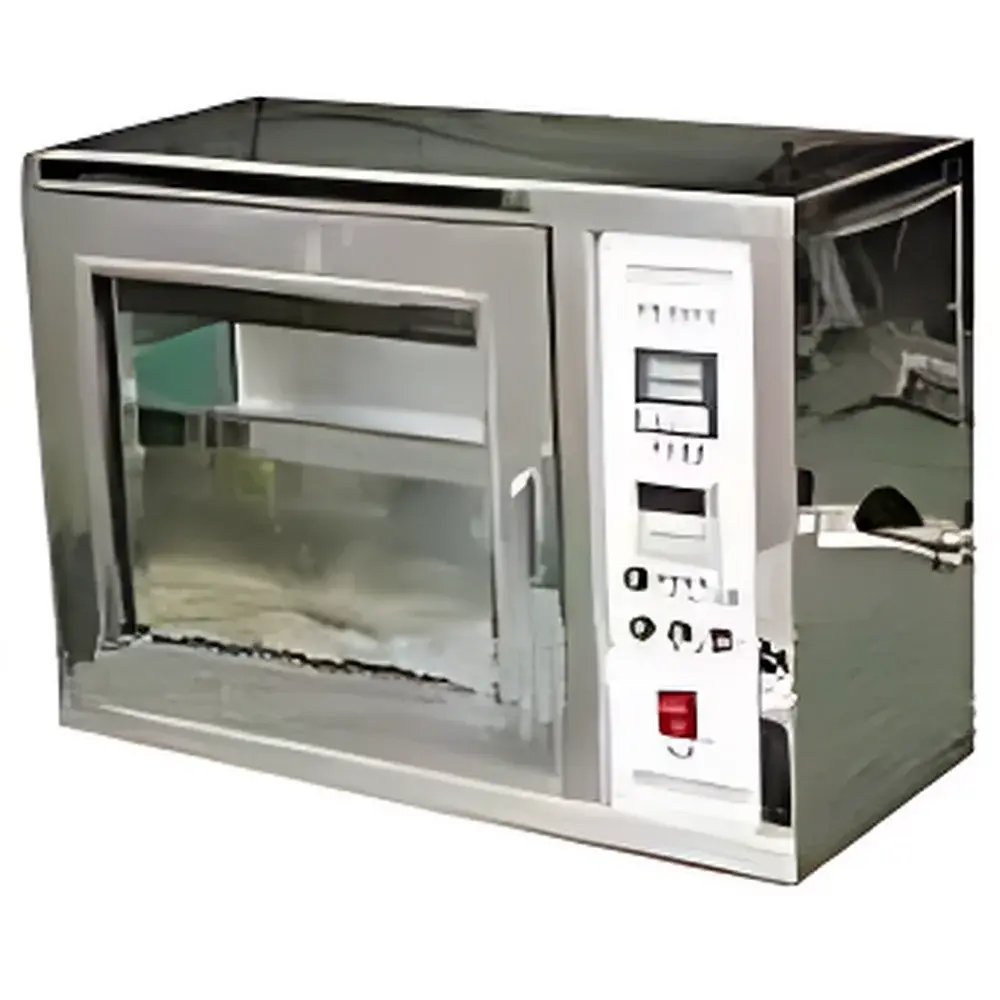
Peiyi PY-NS01 Automotive Interior Material Horizontal Burning Tester
| Brand | Peiyi |
|---|---|
| Origin | Shanghai, China |
| Model | PY-NS01 |
| Ignition Source | Liquefied Petroleum Gas (LPG) or Town Gas |
| Burner Inner Diameter | 9.5 ± 0.5 mm, Length: ~100 mm |
| Adjustable Flame Height | 20–100 mm |
| Flame Application Time Range | 0–99 min 99 sec |
| Chamber Volume | 0.05 m³ |
| Chamber Material | Stainless Steel or Powder-Coated Steel |
| Power Supply | AC 220 V, 50 Hz, 5 A |
| Compliance | GB 8410–2006, FMVSS 302, ISO 3795, ASTM D5132 |
Overview
The Peiyi PY-NS01 Automotive Interior Material Horizontal Burning Tester is a precision-engineered instrument designed to evaluate the horizontal flame propagation behavior of automotive interior components under controlled laboratory conditions. It operates on the principle of standardized radiant and convective ignition, where a calibrated Bunsen-type burner applies a defined flame to the edge of a horizontally oriented test specimen for a specified duration. The resulting flame spread distance, afterflame time, and afterglow time are measured to assess compliance with regulatory thresholds for flammability performance. This apparatus is purpose-built for evaluating trim materials—including seat fabrics, headliners, door panels, carpeting, and insulation foams—used in passenger cars, light-duty trucks, buses, and multipurpose vehicles. Its design adheres strictly to internationally harmonized test methodologies that form the technical basis for type approval, homologation, and quality assurance in OEM supply chains.
Key Features
- Calibrated horizontal burner assembly with precise 9.5 ± 0.5 mm inner diameter and integrated air adjustment ports to ensure consistent stoichiometric flame geometry per GB 8410–2006 and FMVSS 302 requirements.
- Digitally adjustable flame height control (20–100 mm), enabling reproducible ignition intensity across test cycles without manual reconfiguration.
- Programmable flame application timer with resolution down to 1 second and range up to 99 minutes 99 seconds, supporting both standard and extended exposure protocols.
- Sealed stainless steel or powder-coated steel combustion chamber (0.05 m³ internal volume) with observation window and ventilation interlock, minimizing ambient interference and ensuring operator safety.
- Automated test sequence execution—from specimen positioning to flame initiation, timing, and termination—reducing procedural variability and human error.
- Gas supply interface compatible with liquefied petroleum gas (LPG) or town gas; includes pressure regulator and leak-tested delivery lines to maintain stable combustion characteristics.
Sample Compatibility & Compliance
The PY-NS01 accommodates flat, rigid, or semi-rigid specimens measuring 356 mm × 100 mm × thickness ≤ 13 mm, as specified in GB 8410–2006 and FMVSS 302. Specimens are clamped horizontally with 25 mm overhang beyond the burner tip, simulating real-world mounting orientation. The system supports evaluation of laminated composites, coated textiles, polymer blends, and fiber-reinforced thermoplastics common in Tier-1 and Tier-2 automotive interiors. All mechanical and thermal parameters—including burner alignment tolerance, chamber airflow velocity (< 0.2 m/s), and ambient temperature (23 ± 2 °C) —are maintained within tolerances defined by ISO/IEC 17025-accredited testing laboratories. The instrument satisfies essential requirements for use in GLP-compliant environments and supports traceable calibration documentation per ISO/IEC 17025 Clause 6.5.
Software & Data Management
While the PY-NS01 operates via embedded microcontroller logic without proprietary PC software, its control interface provides non-volatile storage of test parameters (flame duration, start/stop timestamps) and enables manual annotation of pass/fail outcomes per specimen. Test logs are exportable via USB or RS-232 (optional module) for integration into enterprise LIMS or QMS platforms. The system architecture supports audit trail generation for critical events—including gas valve actuation, timer activation, and chamber door status—meeting foundational data integrity expectations aligned with FDA 21 CFR Part 11 Annex 11 principles when deployed in regulated manufacturing settings.
Applications
- OEM and Tier-1 supplier R&D labs conducting pre-validation screening of new interior material formulations prior to full-scale certification testing.
- Third-party testing laboratories accredited to ISO/IEC 17025 performing routine conformance verification against GB 8410, FMVSS 302, ISO 3795, and ASTM D5132.
- Quality control departments monitoring batch-to-batch consistency of flame-retardant additives in polypropylene, PVC, PET, and PU-based substrates.
- Regulatory submission support for UN ECE R118, China CCC, and other regional type-approval programs requiring documented horizontal burn performance data.
- Root cause analysis of field-reported fire incidents involving interior trim, correlating lab-measured flame spread rates with real-world ignition scenarios.
FAQ
What ignition gases are compatible with the PY-NS01?
Liquefied petroleum gas (LPG) or town gas may be used; LPG is recommended for higher flame stability and repeatability.
Is the instrument supplied with calibration certificates?
Factory calibration verification is provided; users must perform periodic verification of burner dimensions, flame height, and timer accuracy per ISO/IEC 17025 internal procedure requirements.
Can the PY-NS01 be integrated into an automated test line?
It features discrete I/O signals for external PLC synchronization but lacks native industrial Ethernet or Modbus RTU; custom interface development is required.
Does the chamber meet explosion-proof classification standards?
No; it is designed for controlled laboratory use under ventilation hoods compliant with local occupational health and safety regulations (e.g., OSHA 1910.1200).
How frequently should the burner nozzle be cleaned or replaced?
Inspection and cleaning with compressed air or fine-gauge wire are recommended before each test series; replacement every 6–12 months depending on usage frequency and gas impurity levels.



