
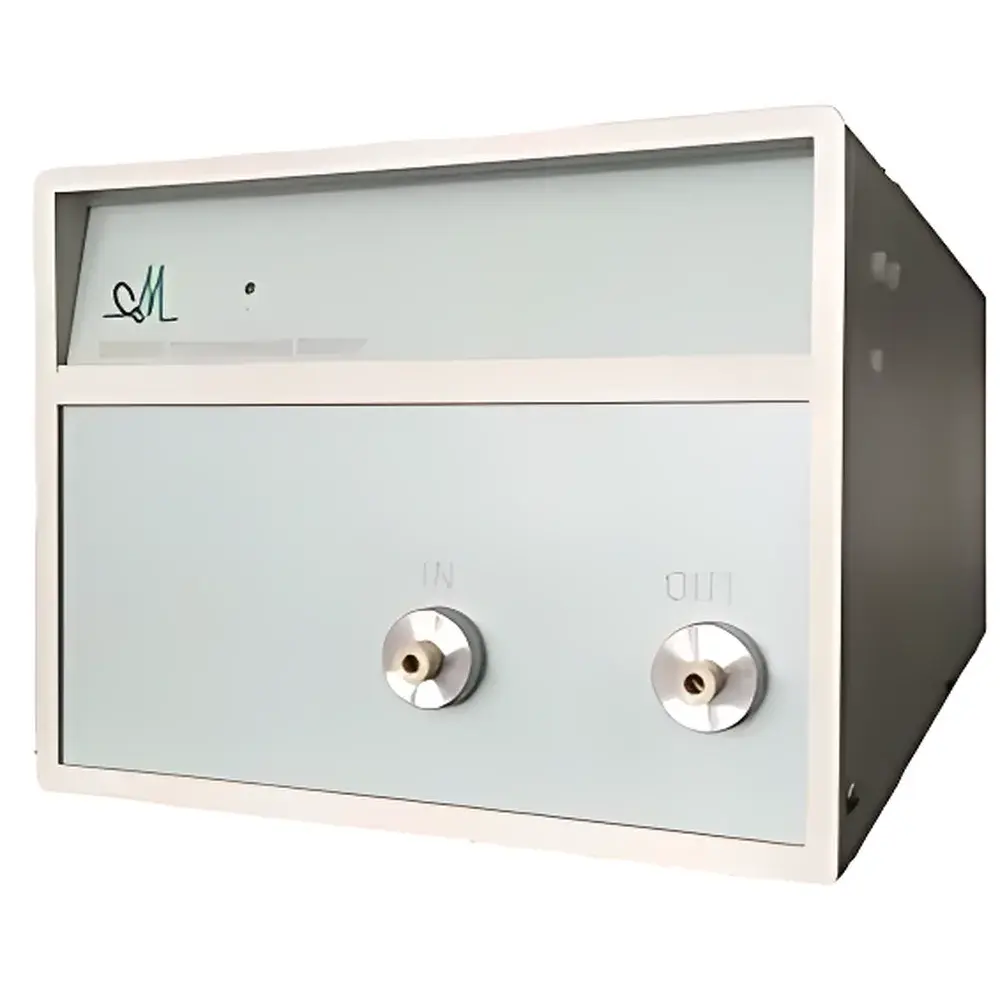
CoMetro 6000PER Photochemical Derivatization System
| Brand | CoMetro |
|---|---|
| Origin | Imported |
| Model | 6000PER Photochemical Derivatization System |
| Derivatization Flow Rate | 3 mL/min |
| Light Source | Cold UV LED |
| Output Power | 8 mW |
| Wavelength | 254 nm |
| Reactor Type | Köhler Illumination Chamber |
| Cooling Method | Forced Air Cooling |
| Compliance | Designed for HPLC post-column derivatization per ASTM D7577 (aflatoxins) and USP <1092> (derivatization validation) |
Overview
The CoMetro 6000PER Photochemical Derivatization System is an engineered HPLC post-column reactor designed to enhance the detection sensitivity of native-fluorescent or photo-activatable analytes—primarily aflatoxin B₁ and G₁, as well as sulfonamide antibiotics—without chemical reagent addition. It operates on the principle of controlled ultraviolet photolysis: a precisely collimated 254 nm cold UV LED irradiates the eluent stream immediately after column exit but prior to fluorescence detection, inducing photochemical cleavage or structural rearrangement that increases quantum yield and native fluorescence intensity. Unlike thermal or chemical derivatization methods, this system introduces no reagent mixing, no reaction by-products, and no additional dwell volume—preserving chromatographic resolution, peak shape integrity, and column backpressure stability. Its Köhler illumination chamber ensures uniform photon flux across the capillary flow path, enabling high reproducibility and robust inter-laboratory transferability.
Key Features
- Cold UV LED light source (254 nm, 8 mW output) with >10,000-hour operational lifetime and negligible heat emission—eliminating thermal degradation of thermally labile analytes and mobile phase components
- Köhler illumination optical design delivering homogeneous irradiance across the 0.17 mm ID PEEK-silica reaction capillary, minimizing axial dispersion and ensuring consistent derivatization efficiency at flow rates up to 3 mL/min
- Forced-air cooling architecture maintaining reactor housing temperature within ±2 °C of ambient—critical for long-term retention time stability during multi-hour sequence runs
- Zero dead-volume integration: direct 1/16″ tubing connections compatible with standard HPLC fittings; no internal valves, mixers, or reservoirs that contribute to extra-column band broadening
- Modular, tool-free access to lamp module and reaction capillary—routine maintenance completed in under 90 seconds without system recalibration
- CE-marked enclosure with integrated UV shielding (OD ≥ 4 at 254 nm) meeting IEC 61000-6-3 EMC and IEC 62471 Photobiological Safety requirements
Sample Compatibility & Compliance
The 6000PER is validated for use with reversed-phase C18 and phenyl-hexyl columns operating under aqueous/organic gradient conditions typical for mycotoxin and sulfonamide analysis (e.g., acetonitrile/water or methanol/water with 0.1% formic acid). It supports regulatory-compliant workflows aligned with AOAC Official Method 2005.08 (aflatoxins in feed), EU Commission Regulation (EC) No. 401/2006, and FDA’s Guidance for Industry: Analytical Procedures and Methods Validation for Drugs and Biologics. The system’s passive derivatization mechanism avoids reagent-induced matrix effects, facilitating method transfer across laboratories conducting GLP-compliant residue testing. All firmware and hardware configurations adhere to ISO/IEC 17025:2017 clause 5.9.1 (method validation) and support audit-ready documentation when paired with compliant CDS platforms.
Software & Data Management
The 6000PER operates as a fully passive inline device—no embedded microcontroller, firmware, or software driver required. It integrates transparently into any HPLC data system (e.g., Waters Empower, Thermo Chromeleon, Agilent OpenLab CDS) without protocol modification. Lamp status (on/off) is monitored via optional TTL-compatible external indicator circuit (sold separately), enabling synchronized event logging in audit trails. For 21 CFR Part 11 compliance, instrument use logs—including date/time-stamped installation records, lamp usage hours (tracked manually or via external counter), and maintenance entries—are maintained in laboratory notebooks or LIMS according to institutional SOPs. No electronic records are generated or stored internally by the device.
Applications
- Quantification of aflatoxin B₁ and G₁ in cereal grains, nuts, spices, and dairy matrices at sub-ppb levels per EU maximum limits (e.g., 2 µg/kg for B₁ in almonds)
- Detection of sulfadiazine, sulfamethoxazole, and sulfamerazine in animal tissues and honey using fluorescence detection following photolytic activation
- Method development for emerging mycotoxins (e.g., ochratoxin A derivatives) where photochemical enhancement improves signal-to-noise ratio without derivatization chemistry interference
- Supporting multi-residue screening workflows where minimal system modification preserves existing HPLC method parameters and column lifetime
- Academic and contract research applications requiring trace-level analysis under ISO 17025-accredited quality systems
FAQ
Does the 6000PER require calibration or periodic performance verification?
Yes—per ISO/IEC 17025 and USP , users must verify derivatization efficiency at least daily using a certified aflatoxin B₁ reference standard. A 20% increase in peak area vs. non-irradiated control confirms optimal lamp output and flow-path alignment.
Can it be used with UHPLC systems operating above 600 bar?
Yes—the reactor body and capillary are rated to 1000 bar; however, ensure downstream detector cell pressure tolerance is not exceeded when placing the unit between column and detector.
Is ozone generation a concern with 254 nm UV exposure?
No—unlike mercury-vapor lamps, the cold LED emits negligible VUV radiation (<200 nm); ozone formation is undetectable under normal operation and does not require ventilation.
What maintenance intervals are recommended for the lamp module?
Lamp output should be verified every 500 operational hours; replacement is recommended at 8,000–10,000 hours or upon observed >15% reduction in derivatization gain.
Does the system introduce carryover or memory effects?
No—absence of chemical reagents, mixing chambers, or solvent-wetted surfaces eliminates carryover risk; system equilibrates fully within one column volume after flow initiation.
Related Products





