
SDL MODEL 1080 Multicomponent Infrared Gas Analyzer
| Brand | SDL |
|---|---|
| Origin | Beijing, China |
| Manufacturer Type | Direct Manufacturer |
| Product Type | Online Continuous Emission Monitoring System (CEMS) |
| Model | MODEL 1080 |
| Measurement Principle | Non-Dispersive Infrared (NDIR) Absorption Spectroscopy |
| Response Time | ≤30 s (T90) |
| Repeatability | ≤±1% FS (for CO, CO₂, CH₄, SO₂, NO) |
| Output Interfaces | 4–20 mA analog outputs (up to 8 channels), relay contact outputs (6 configurable), RS-485/Modbus RTU, optional Ethernet |
| Calibration | Automatic zero/span calibration with built-in reference cell or external gas cylinder |
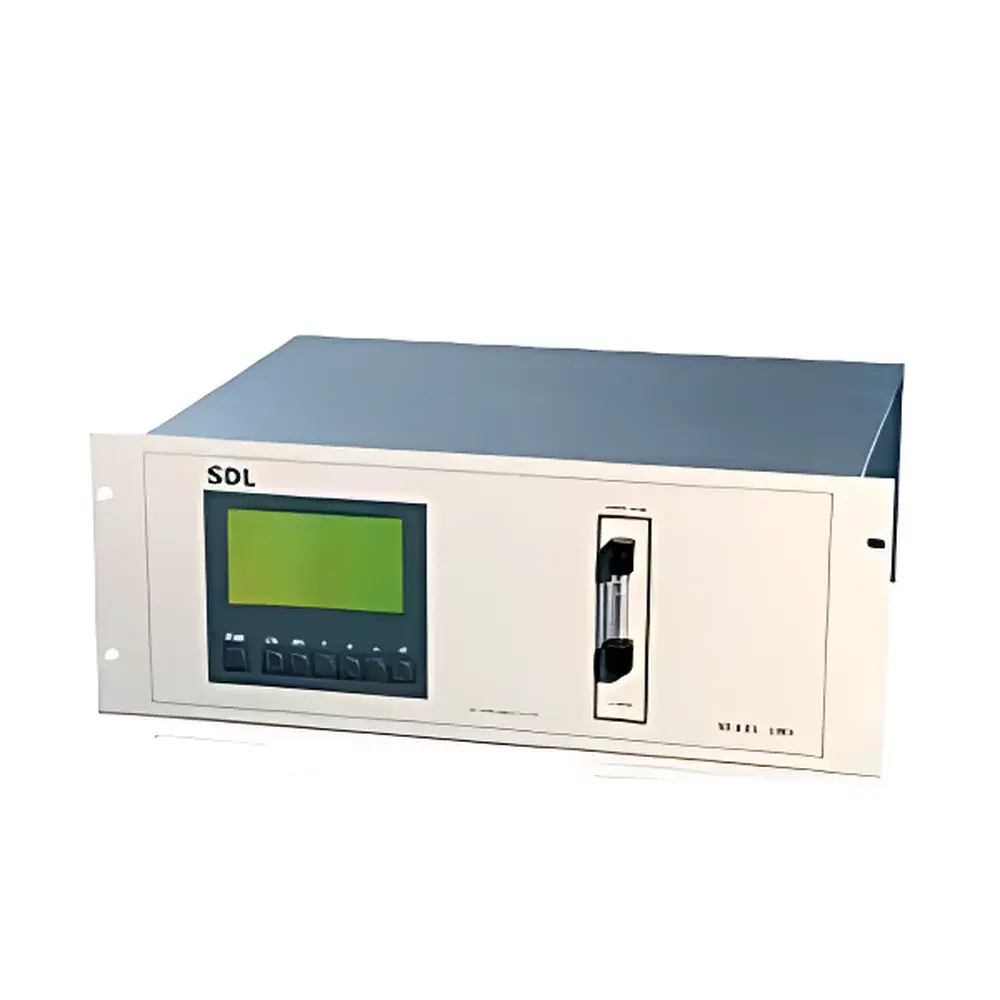
| Display | 5.7″ TFT LCD with bilingual (Chinese/English) menu interface |
| Warm-up Time | ≤5 min |
| Enclosure Rating | IP65 (standard) |
| Compliance | Meets HJ 76-2017, HJ 1013-2018 (China EPA CEMS Technical Specifications), CE marked for industrial environments |
Overview
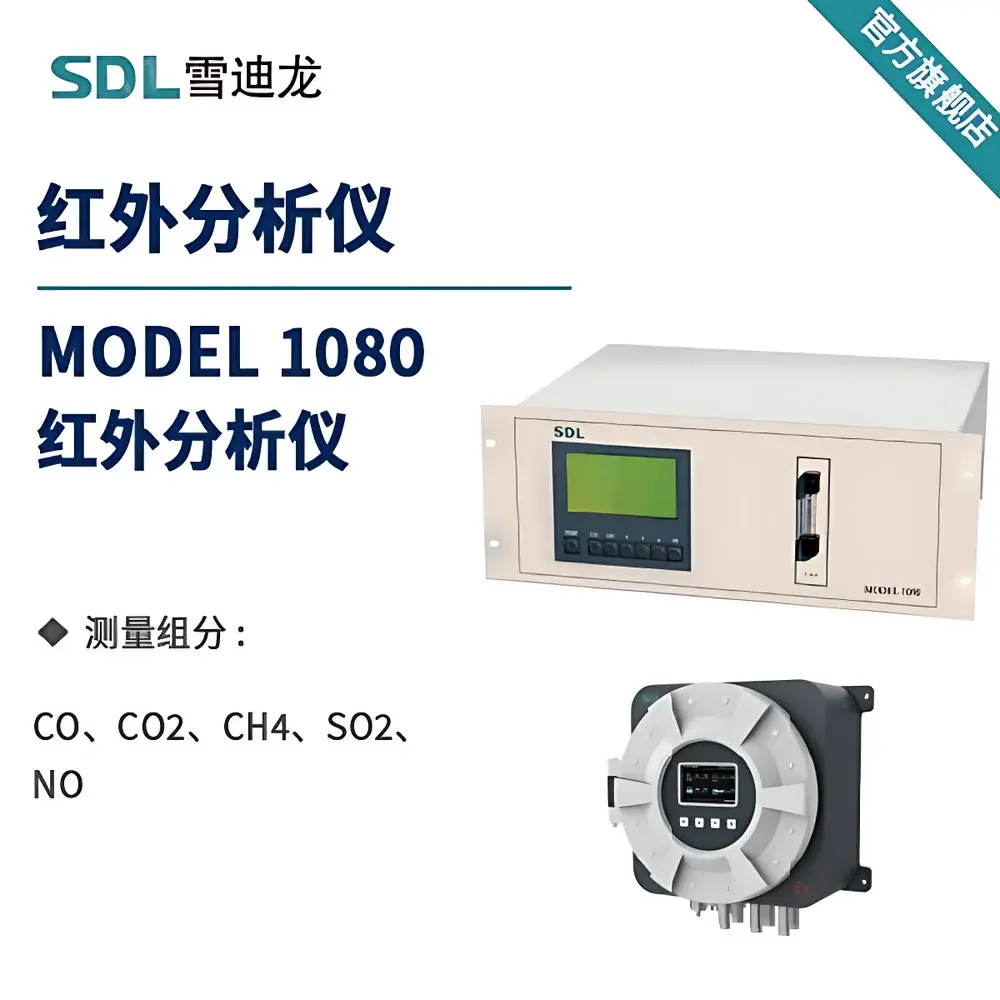
The SDL MODEL 1080 Multicomponent Infrared Gas Analyzer is an online continuous emission monitoring system engineered for high-reliability, real-time quantification of up to five key gaseous pollutants—carbon monoxide (CO), carbon dioxide (CO₂), methane (CH₄), sulfur dioxide (SO₂), and nitric oxide (NO)—in flue gas, process streams, and ambient air applications. It operates on the physical principle of non-dispersive infrared (NDIR) absorption spectroscopy: each target gas exhibits unique fundamental vibrational absorption bands in the mid-infrared region (typically 2–14 µm). The analyzer employs dual-beam optical architecture with thermopile detectors and micro-flow modulation to generate stable, low-noise differential signals proportional to gas concentration. Unlike filter-wheel or FTIR-based systems, the MODEL 1080 utilizes dedicated narrowband optical filters and matched detector pairs per gas channel, minimizing cross-sensitivity and enabling simultaneous multi-component measurement without spectral deconvolution. Its design targets continuous operation under industrial conditions—including variable temperature, particulate load, and moisture content—with integrated sample conditioning (heated sampling line, particulate filter, and optional chiller/dryer) recommended for stack applications.
Key Features
- Simultaneous real-time analysis of up to five gases (CO, CO₂, CH₄, SO₂, NO) using independent NDIR optical channels
- High-stability micro-flow sensor technology for pulse-modulated signal generation, enhancing signal-to-noise ratio and long-term baseline stability
- Auto-calibration capability with programmable zero/span cycles; supports both internal reference cell and external certified gas standards
- Robust industrial enclosure rated IP65; explosion-proof variant compliant with Ex d IIB T4 Gb for hazardous area installation (Zone 1/2)
- Full-featured digital communication suite: RS-485 Modbus RTU as standard; optional TCP/IP Ethernet for integration into DCS/SCADA or cloud-based EMS platforms
- Bilingual (English/Chinese) graphical user interface with intuitive menu navigation, data logging (≥30 days internal storage), and event-driven alarm history
- Fast commissioning: operational readiness achieved within ≤5 minutes after power-on due to optimized thermal management and optical stabilization algorithms
Sample Compatibility & Compliance
The MODEL 1080 is validated for use with hot, humid, and particulate-laden flue gases typical of coal-fired boilers, cement kilns, waste incinerators, and chemical reactors. Sample gas must be conditioned to ≤50 °C and <90% RH prior to inlet; optional heated sampling probe (up to 200 °C) and permeation dryer modules are available. The analyzer meets China’s mandatory CEMS performance standards HJ 76-2017 (Technical Specification for Continuous Emission Monitoring Systems) and HJ 1013-2018 (Technical Specification for Monitoring of Gaseous Pollutants from Fixed Pollution Sources), including requirements for accuracy (±2% FS), drift (<1% FS/24 h), and interference rejection. While not certified to EN 15267 or US EPA PS-15, its NDIR methodology and documented uncertainty budget support alignment with ISO 14064-3 QA/QC protocols for greenhouse gas reporting and EU Industrial Emissions Directive (IED) auxiliary monitoring.
Software & Data Management
Firmware includes embedded data acquisition logic compliant with GLP principles: all calibration events, fault logs, and configuration changes are time-stamped and stored with operator ID (if enabled via password protection). Raw analog outputs (4–20 mA) are linearized and temperature-compensated per channel; digital outputs include Modbus registers for concentration values, status flags (e.g., “Calibration Active”, “Optical Fault”), and diagnostic counters. Optional PC-based configuration software (SDL ConfigTool v3.x) enables remote parameter setup, trend visualization, and CSV export for third-party LIMS or ERP integration. Audit trail functionality satisfies basic 21 CFR Part 11 requirements for electronic records when deployed with network authentication and role-based access control.
Applications
- Continuous emissions monitoring (CEMS) in power plants, steel mills, and municipal solid waste incinerators
- Process gas analysis in syngas production, biogas upgrading, and catalytic reforming units
- Environmental compliance verification at regulatory fence-line monitoring stations
- Research-grade combustion diagnostics requiring synchronized multi-species temporal resolution
- Indoor air quality (IAQ) assessment in large-scale HVAC systems where CO/CO₂/CH₄ co-monitoring is required
FAQ
What gases can the MODEL 1080 measure simultaneously?
It measures CO, CO₂, CH₄, SO₂, and NO concurrently—each via a dedicated NDIR channel. Custom configurations for other IR-active gases (e.g., N₂O, NH₃) require optical filter and detector re-engineering.
Is the analyzer suitable for wet-stack applications?
Yes, provided sample gas is pre-conditioned to remove condensate and particulates. A heated sampling line (180 °C) and PTFE membrane filter are strongly recommended for high-moisture stacks.
Does it support remote diagnostics and firmware updates?
Remote diagnostics are supported via Modbus register interrogation; firmware updates require local USB connection and signed binary files to ensure integrity and traceability.
How often must calibration be performed?
Per HJ 76-2017, automatic zero/span calibration is recommended every 24 hours; manual verification with certified gases is required at least once per quarter.
Can the MODEL 1080 integrate with existing DCS systems?
Yes—via 4–20 mA analog signals (with HART option) or native Modbus RTU over RS-485; engineering support is available for DCS-specific protocol mapping (e.g., Siemens S7, Yokogawa CENTUM VP).
Related Products







