
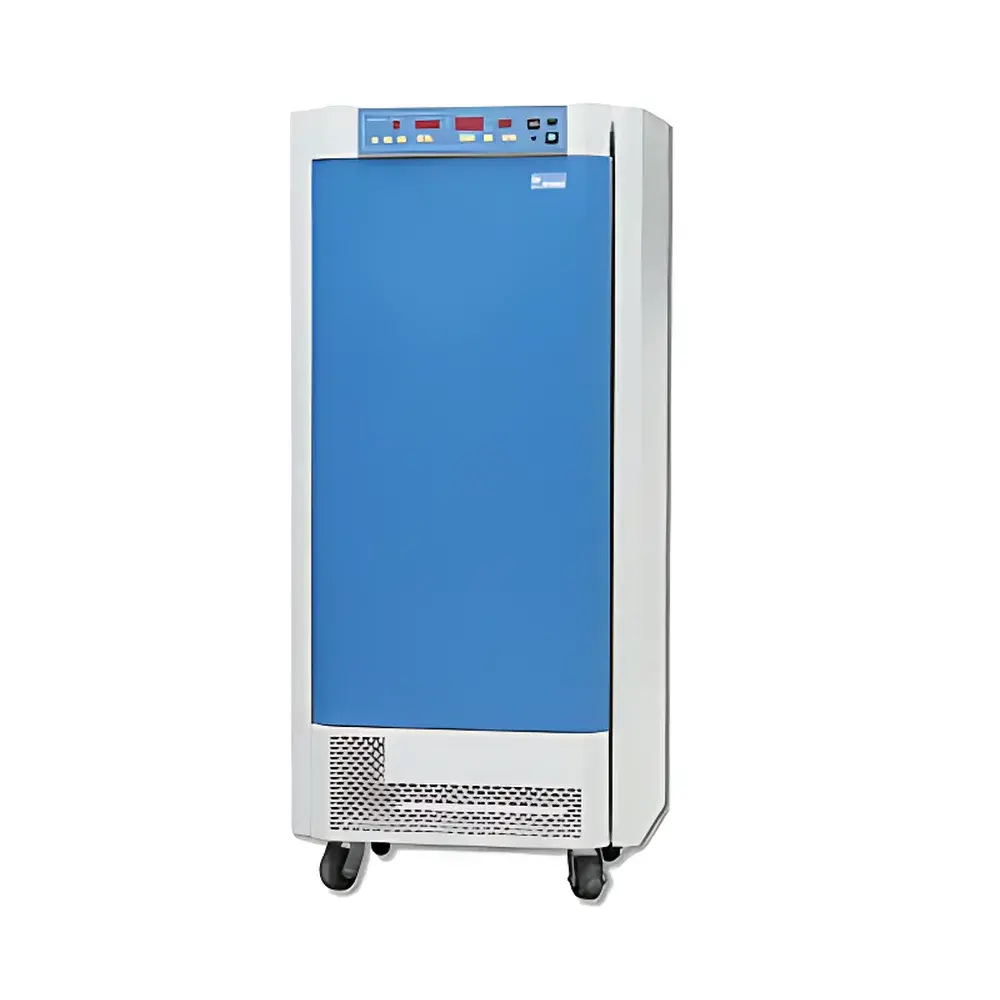
Jihepu KRQ-400 Plant Growth Chamber
| Brand | Jihepu |
|---|---|
| Model | KRQ-400 |
| Chamber Volume | 400 L |
| Temperature Range (Dark) | 0–50 °C |
| Temperature Range (Illuminated) | 10–50 °C |
| Temperature Uniformity | ±2.0 °C |
| Temperature Fluctuation | ±1.0 °C |
| Temperature Resolution | 0.1 °C |
| Humidity Range | 50–90 %RH |
| Humidity Fluctuation | ±5 %RH |
| Humidity Resolution | 1 %RH |
| Illuminance Range | 0–20,000 lx (6-level adjustable) |
| Programmable Cycles | 99 hours × 30 segments × 99 cycles |
| Power Supply | AC 220 V, 50 Hz |
| Interior Dimensions (W×D×H) | 520 × 670 × 1150 mm |
| Exterior Dimensions (W×D×H) | 840 × 900 × 1850 mm |
| Standard Shelves | 4 pcs |
| Lighting Configuration | Triple-sided illumination |
| Operating Mode | Continuous |
| Water Management | Drain-free closed-loop humidification system |
Overview
The Jihepu KRQ-400 Plant Growth Chamber is a precision-engineered environmental control system designed for reproducible, long-term plant physiology studies, photobiological assays, seed germination trials, and controlled-environment agriculture research. It operates on a dual-mode thermal management principle—combining PID-controlled heating with pressure-balanced refrigeration—to maintain stable temperature setpoints across both dark and illuminated conditions. Unlike standard incubators, the KRQ-400 integrates independent regulation of temperature, relative humidity, and spectrally balanced photosynthetic photon flux (PPF), enabling researchers to simulate diurnal cycles, seasonal transitions, or stress-response environments with high fidelity. Its triple-sided lighting architecture ensures uniform irradiance distribution across the full 400 L chamber volume, minimizing positional bias in growth experiments—a critical requirement for ISO 17025-accredited botanical laboratories and GLP-compliant phytochemical stability testing.
Key Features
- PID-based microprocessor controller with real-time monitoring of temperature and humidity; supports multi-segment programmable cycles (up to 99 hours × 30 segments × 99 cycles) for simulating complex environmental profiles.
- Pressure-balanced refrigeration system optimized for energy efficiency and thermal stability under continuous operation—validated for ≥720-hour uninterrupted runtime at 25 °C/70 %RH.
- Closed-loop humidification design eliminates condensate drainage requirements; uses distilled-water reservoir with automatic level detection and anti-scale treatment to ensure consistent RH delivery without manual intervention.
- Triple-sided LED-based illumination system delivering 0–20,000 lx output with six discrete intensity levels; spectral output calibrated to match PAR (400–700 nm) requirements per ASTM E2913-22 for plant photomorphogenesis studies.
- Robust stainless-steel interior (304 grade) with seamless welds and rounded corners for easy decontamination; compliant with ISO 14644-1 Class 8 cleanroom protocols when operated under laminar airflow add-on configuration.
- Integrated safety architecture includes over-temperature cut-off (±5 °C above setpoint), independent limit thermostat, power-fail memory retention, and audible/visual alarm outputs compatible with building management systems (BMS).
Sample Compatibility & Compliance
The KRQ-400 accommodates a wide range of biological specimens—from Arabidopsis thaliana seedlings and tissue culture plates to mature potted crops up to 60 cm in height. Its 4 removable stainless-steel shelves (520 × 670 mm each) support standard growth trays (e.g., 12-well, 24-well, and 100-mm Petri dishes) as well as custom hydroponic racks. The chamber meets mechanical safety requirements per IEC 61010-1:2010 and electromagnetic compatibility standards per EN 61326-1:2013. While not certified for medical device use, its environmental control repeatability (±1.0 °C temp fluctuation, ±5 %RH humidity deviation) aligns with method validation criteria outlined in USP for botanical stability testing and OECD Test Guideline 208 (Terrestrial Plant Test). Data logging integrity supports audit readiness for FDA 21 CFR Part 11 when paired with validated third-party software.
Software & Data Management
The embedded controller provides local data logging (internal memory: 30 days @ 1-min intervals) with USB export capability for CSV-formatted time-series records. Optional Ethernet or RS-485 interfaces enable integration into centralized lab information management systems (LIMS) via Modbus RTU or TCP/IP protocols. All logged parameters—including chamber temperature, setpoint deviation, humidity, light intensity, and alarm status—are timestamped with millisecond precision and include checksum verification. Audit trail functionality (enabled via firmware update) records operator login events, parameter modifications, and cycle start/stop actions—meeting GLP documentation requirements for regulated plant science workflows.
Applications
- Phenotypic screening of genetically modified crops under controlled photoperiod and thermoperiod regimes.
- Standardized seed viability and germination rate assessment per ISTA Rules (International Seed Testing Association).
- In vitro propagation of medicinal plants under defined light quality and intensity gradients.
- Stress physiology modeling—including drought simulation via dynamic RH ramping and heat shock response profiling.
- Pre-clinical evaluation of phytopharmaceutical stability per ICH Q1A(R2) guidelines using accelerated aging protocols.
- Microbial co-culture studies requiring simultaneous control of temperature, humidity, and aerobic conditions (with optional CO₂ module).
FAQ
What is the maximum load capacity for uniform temperature distribution?
Uniformity specifications (±2.0 °C) are guaranteed under ISO-standard empty-chamber validation. With full shelf loading (4 shelves × 20 kg max), deviation remains within ±2.5 °C when airflow baffles are correctly positioned.
Can the KRQ-400 be integrated into a facility-wide environmental monitoring network?
Yes—via optional RS-485 or Ethernet modules supporting Modbus TCP/RTU, enabling remote supervision through SCADA platforms or custom Python-based dashboards.
Is calibration traceability available for temperature and humidity sensors?
Factory calibration certificates (NIST-traceable reference standards) are provided with each unit; annual recalibration services are supported through authorized Jihepu service centers in APAC and EU regions.
Does the chamber support custom light spectra beyond white-light output?
The base model delivers broad-spectrum white light; narrowband LED modules (e.g., 450 nm blue, 660 nm red, 730 nm far-red) are available as field-installable upgrades under part number KRQ-LIGHT-ADDON-BR.
How is condensation managed during high-humidity operation?
The closed-loop humidification system employs a Peltier-cooled condensate recovery circuit that re-evaporates condensed moisture back into the air stream—eliminating external drain lines and preventing microbial stagnation points.




